Outsourcing HR: The Benefits, Risks and Costs for UK Businesses
What outsourcing HR really offers a UK business: the benefits and downsides, what to outsource or keep, rough costs, the legal duties that stay with you and how to choose a provider.
 9 min read
Comments: 0Views: 2
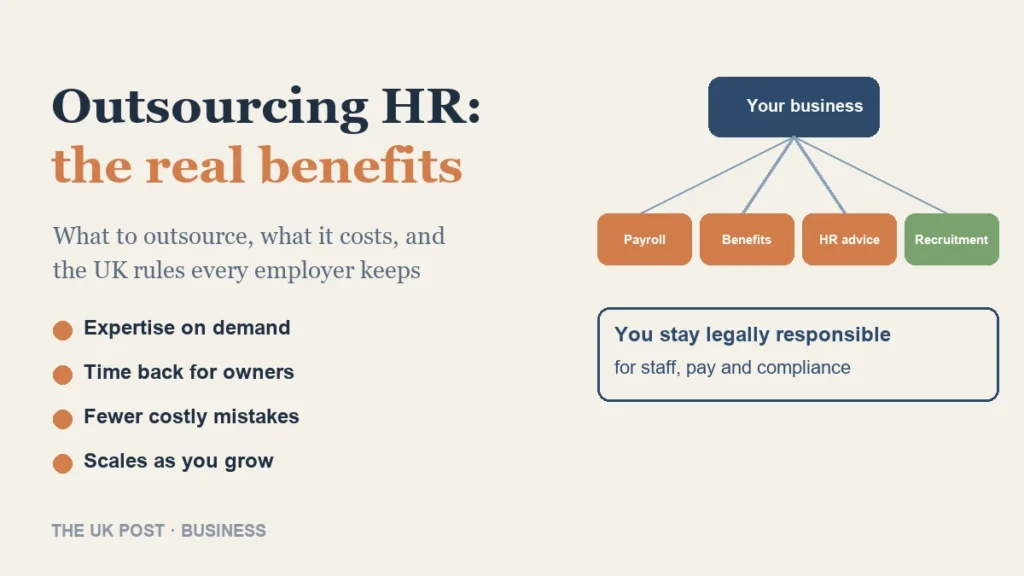
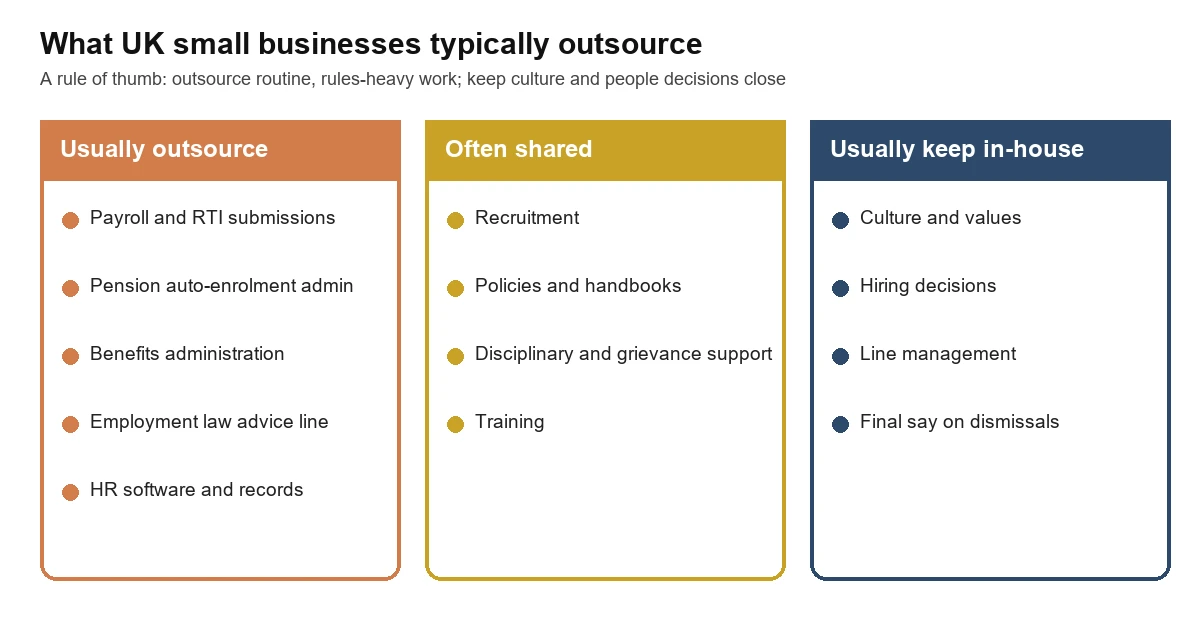
Short answer: the main benefits of outsourcing HR are access to expert advice you could not afford to employ full time, time back for owners and managers, fewer costly legal mistakes, predictable costs, and support that scales as you grow. Most UK small businesses outsource the routine, rules-heavy work, such as payroll, pension auto-enrolment, benefits administration, HR software and an employment law advice line, while keeping hiring decisions, culture and line management in-house. The key thing to understand is that outsourcing moves the work, not the responsibility: you remain the employer in law. Choose a provider carefully, put a proper contract and data processing agreement in place, and check how they will handle changes such as HMRC’s move to payrolling benefits in kind from April 2027.
What Does Outsourcing HR Mean?
HR outsourcing means paying an external provider to handle some or all of your human resources work. It ranges from a single service, such as a payroll bureau, to a full outsourced HR department. Common models include:
| Model | What you get | Best for |
|---|---|---|
| Payroll bureau | Payroll, payslips, RTI submissions to HMRC, pension deductions | Any employer who wants payroll off their desk |
| HR advice line (“retained” HR) | Phone and email access to HR and employment law advisers, template documents | Small firms without an HR person |
| Benefits administration | Managing pensions, health cover, salary sacrifice and benefit platforms | Firms with a growing benefits package |
| HR software with services | Cloud HR system for records, holidays and absence, plus optional support | Growing teams moving off spreadsheets |
| Recruitment process outsourcing | Some or all of your hiring run by a specialist | Firms hiring at volume |
| Fully outsourced HR | A named HR partner handling most people matters | Businesses of roughly 20 to 250 staff without in-house HR |
The Benefits of Outsourcing HR
- Expertise on demand. UK employment law is complex and changing, with major employment rights reforms being phased in. A good provider keeps up so you do not have to.
- Fewer costly mistakes. Errors in contracts, dismissals, holiday pay or the minimum wage can lead to tribunal claims, back pay and penalties. Specialists reduce that risk.
- Time back. Owners of small firms often spend hours a week on people admin. Outsourcing frees that time for running the business.
- Predictable costs. A fixed monthly fee is often cheaper than a full-time HR salary plus employer costs, especially for smaller teams.
- Scalability. Support grows or shrinks with your headcount, useful for seasonal or fast-growing businesses. Remote and hybrid teams often pair this with a cloud phone and meetings platform; see the best UC solutions for remote teams.
- Better technology. Providers usually bring modern HR and payroll software you would otherwise have to buy and maintain.
- Objectivity. An outside adviser can help handle grievances and disciplinaries fairly, without office politics.
- Better benefits for staff. Benefits specialists can give small employers access to schemes, discounts and platforms usually offered by big companies.
The Downsides to Weigh Up
- You are still the employer. If the provider gets something wrong, you face the claim. Contracts and insurance matter.
- Less day-to-day presence. An adviser on the phone does not know your team the way an in-house HR person does.
- Generic advice. Some services push template answers that do not fit your situation.
- Contract lock-in. Watch for long minimum terms, high exit fees, and “insurance-backed” services whose cover depends on following their advice exactly.
- Data risk. You are sharing sensitive personal data, so security and UK GDPR compliance are essential.
UK Rules That Stay With You
Whatever you outsource, these remain the employer’s legal duties:
- Payroll and HMRC: accurate PAYE, National Insurance and Real Time Information (RTI) submissions. From 6 April 2027, HMRC is phasing in mandatory payrolling of benefits in kind, starting with company cars, vans and fuel, with most other benefits following from April 2028. Ask any payroll or benefits provider how they will handle it.
- Workplace pensions: auto-enrolment duties, overseen by The Pensions Regulator, including enrolling eligible staff and paying contributions on time.
- Right to work checks: fines for employing someone without the right to work can be severe, whoever carried out the check.
- Data protection: under UK GDPR, the provider is usually your “processor”, so you need a written contract covering security, confidentiality and what happens to data at the end.
- TUPE: if you move in-house HR or payroll staff to the provider, the Transfer of Undertakings (Protection of Employment) Regulations may apply, protecting their jobs and terms.
- Employment law: fair processes for discipline, dismissal, redundancy and flexible working requests remain your responsibility.
Software and suppliers help you show you are compliant; they do not make you compliant. Our guide to digital facilities management makes the same point about building records, and our explainer on AML AI software shows how regulators treat outsourced technology in financial services.
What Does Outsourced HR Cost in the UK?
Prices vary widely and are often quoted per employee per month, with minimum fees. As a rough guide:
- Payroll bureau: usually a few pounds per payslip, plus set-up and year-end fees.
- HR software: commonly a few pounds to around £10 per employee per month.
- HR advice line or retained HR: typically a monthly fee based on headcount, often with a minimum term.
- Fully outsourced HR: higher monthly fees or day rates, depending on how much hands-on support you need.
Compare the total with the cost of employing HR staff yourself, including salary, employer National Insurance, pension contributions, training and software. For many businesses under about 50 staff, outsourcing is cheaper; larger firms often combine an in-house HR lead with outsourced payroll and specialist advice.
How to Choose an HR Outsourcing Provider
Outsourcing HR in six steps
- Check credentials: advisers with CIPD membership, and payroll specialists with recognised qualifications.
- Ask for references from businesses of your size and sector.
- Read the contract: minimum term, notice period, exit support, fee increases and what is included versus billed extra.
- Check data security and where data is stored, and get a UK GDPR-compliant processing agreement.
- Test the service: how quickly do they answer, and do you get a named adviser?
- Plan for change: ask how they keep clients updated on law changes such as payrolling benefits in kind.
My advice: start by outsourcing the task that causes you the most stress or risk, usually payroll or employment law advice, and keep the relationship side of HR close to home. Your team should still feel managed by you, not by a call centre.
For free, impartial guidance before you commit, Acas offers advice on employment rights and good practice, and its helpline is free to call.
Many small firms use the same thinking for customer systems; see our explainer on CRM software demand.
Frequently Asked Questions
What are the benefits of outsourcing HR?
Expert advice on demand, time saved, fewer legal mistakes, predictable costs, scalable support and access to better HR and payroll technology.
What HR functions can be outsourced?
Payroll, pension auto-enrolment, benefits administration, HR software and records, employment law advice, recruitment, training, and support with disciplinaries and grievances.
Is outsourcing HR worth it for a small business?
Often, yes. For businesses without an HR specialist, it is usually cheaper than hiring one and reduces legal risk.
Am I still responsible if my HR provider makes a mistake?
Yes. You remain the employer in law. Check the provider’s contract, liability terms and insurance.
How much does HR outsourcing cost in the UK?
It varies by service and headcount, from a few pounds per payslip for payroll to monthly per-employee fees for HR advice and software.
Does TUPE apply when outsourcing HR?
It can, if existing HR or payroll staff move to the provider. Take advice before you start.
What is mandatory payrolling of benefits in kind?
From 6 April 2027, employers must report and tax company cars, vans and fuel through payroll in real time, with most other benefits following from April 2028, instead of using P11D forms.
Do I need a data processing agreement with my HR provider?
Yes. Under UK GDPR, a provider handling your employees’ data on your behalf needs a written contract setting out how it protects that data.
What should I keep in-house?
Culture, hiring decisions, day-to-day management and final decisions on serious matters such as dismissals.
Where can I get free HR advice in the UK?
Acas provides free, impartial guidance and a helpline; GOV.UK covers employer duties such as payroll, pensions and right to work checks.
Final Thoughts
Outsourcing HR can give a growing business big-company expertise without big-company costs, but it works best when you treat the provider as a partner and stay in charge of the decisions that shape your team. Outsource the rules-heavy routine, keep the people side close, read the contract carefully, and make sure your provider is ready for the changes coming in 2027.
Sources: GOV.UK guidance on mandatory payrolling of benefits in kind (updated 2026); HMRC; The Pensions Regulator; Information Commissioner’s Office guidance on controllers and processors; GOV.UK guidance on TUPE and right to work checks; Acas; CIPD.