AML AI Software: How It Works, UK Rules and How to Choose
What AML AI software does, how machine learning beats rules on false alerts, the UK duties it cannot replace, the main vendors and a practical checklist for choosing one.
 9 min read
Comments: 0Views: 3
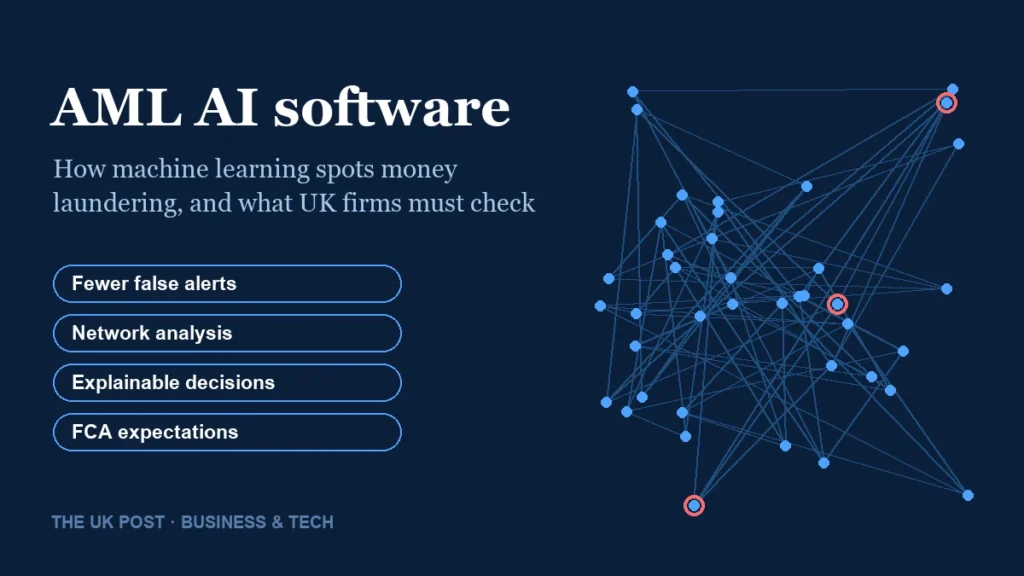
Short answer: AML AI software uses machine learning to help banks, payment firms, crypto exchanges and other regulated businesses detect money laundering, mainly by spotting unusual transactions, linking related customers and accounts, and cutting the huge number of false alerts produced by traditional rules-based systems. In the UK it supports, but does not replace, the legal duties in the Money Laundering Regulations 2017 and the Proceeds of Crime Act 2002: firms must still understand how the system reaches its decisions, keep people accountable, and report suspicions to the National Crime Agency. The FCA encourages technology-led monitoring, but expects firms to test, govern and explain it. The best buying test is simple: can the vendor show, on your own data, that it finds more real risk with fewer wasted alerts, and explain why each alert fired?
What AML AI Software Does
Anti-money laundering (AML) covers everything a regulated business does to stop criminals using it to move or hide money: checking who customers are, screening them against sanctions lists, monitoring their activity, investigating anything suspicious and reporting it. AI tools now help at every stage.
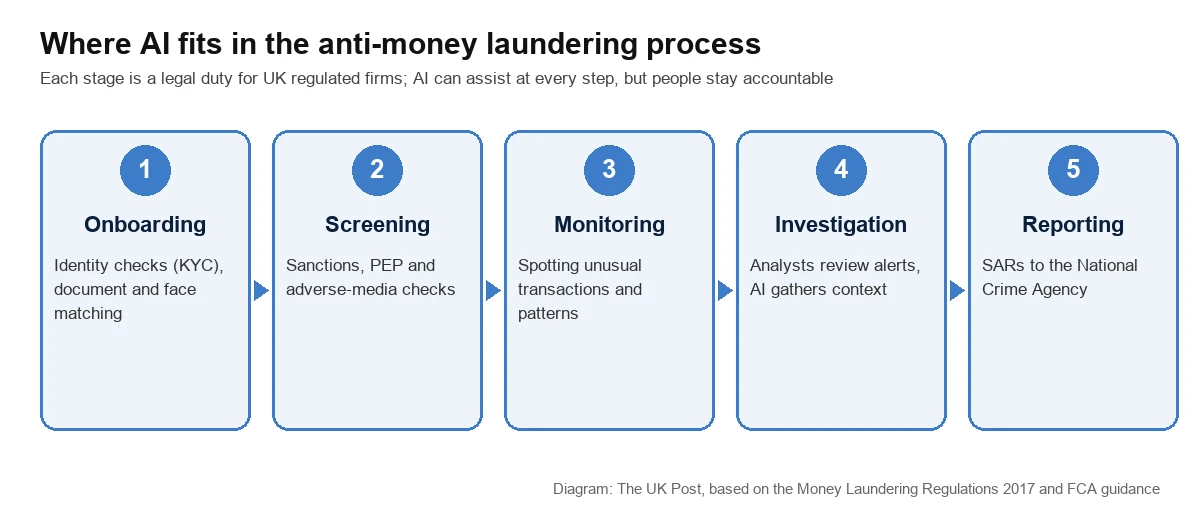
| Task | What AI adds |
|---|---|
| Customer onboarding (KYC) | Document checks, face matching and liveness tests; spotting synthetic or stolen identities |
| Sanctions and PEP screening | Smarter name matching across spellings and alphabets, reducing false matches |
| Adverse media | Reading news and records in many languages to flag relevant negative coverage |
| Transaction monitoring | Learning each customer’s normal behaviour and flagging unusual patterns, not just fixed thresholds |
| Network analysis | Linking accounts, devices, addresses and companies to expose mule networks and hidden ownership |
| Alert triage | Scoring and prioritising alerts so analysts see the riskiest first |
| Investigation support | Summarising a customer’s history and drafting case notes, with generative AI increasingly used here |
Rules-Based vs AI Monitoring
Traditional systems use fixed rules, such as “flag any cash deposit over a set amount” or “flag five transfers to new payees in a day”. Rules are easy to explain, but criminals learn them, and they generate large numbers of false positives, alerts on perfectly innocent customers that analysts must clear by hand.
| Rules-based | AI and machine learning | |
|---|---|---|
| How it works | Fixed thresholds and scenarios | Learns patterns from data; can adapt |
| False alerts | Typically very high | Can be much lower, if well tuned |
| New typologies | Missed until someone writes a rule | Anomaly detection can surface unfamiliar behaviour |
| Explainability | Easy | Needs deliberate design and documentation |
| Data needs | Modest | Good-quality, well-labelled data |
| Governance | Rule reviews | Model validation, bias testing, drift monitoring |
In practice, most firms run a hybrid: core rules for clear regulatory requirements, with machine-learning models layered on top to prioritise alerts and find what rules miss.
The UK Rules You Cannot Outsource to Software
- Money Laundering Regulations 2017: require a risk-based approach, customer due diligence, ongoing monitoring, record keeping and senior management responsibility.
- Proceeds of Crime Act 2002 and Terrorism Act 2000: require suspicious activity reports (SARs) to the UK Financial Intelligence Unit at the National Crime Agency. Tipping off a customer is an offence.
- FCA expectations: the FCA’s Financial Crime Guide was updated (PS24/17) to make room for more efficient, technology-led transaction monitoring, but firms must understand and test their systems. In October 2026 the FCA published findings on good and poor practice in firms’ use of AI, highlighting continuous, outcomes-focused monitoring of AI outputs.
- Data protection: UK GDPR applies to customer data used to train and run models, including rules on automated decision-making.
- Sanctions: the Office of Financial Sanctions Implementation (OFSI) expects firms to screen properly; sanctions breaches can be strict liability for civil penalties.
The FCA has also been running a synthetic data project, with industry partners including Napier AI, to let firms test monitoring tools without using real customer data. And from 2028 the FCA is due to take over AML supervision of professional services such as accountants and lawyers, bringing tens of thousands more firms under its oversight.
Software helps a firm evidence compliance; it does not create it. The same lesson applies in other fields, as our guide to digital facilities management argues for building safety records.
Who Makes AML AI Software?
The market includes specialist “RegTech” firms and big established vendors. Britain is home to several well-known names:
- ComplyAdvantage (London): screening and transaction monitoring, popular with fintechs.
- Quantexa (London): network and entity-resolution analytics used by large banks.
- Napier AI (London): transaction monitoring and screening.
- Featurespace (Cambridge): behavioural analytics for fraud and financial crime; acquired by Visa in 2024.
- International vendors include NICE Actimize, SAS, Oracle, SymphonyAI, Feedzai, Hawk and Unit21.
Listing a vendor here is not a recommendation. Prices are rarely published and depend on transaction volumes, modules and deployment, so expect anything from a monthly subscription for a small fintech to multi-year enterprise contracts for a bank.
How to Choose AML AI Software
Choosing and running AML AI software: six steps
- Insist on a proof of concept with your own data. Compare true positives and false positives against your current system, not the vendor’s demo figures.
- Demand explainability. Every alert should come with clear reasons an analyst, auditor or the FCA can follow.
- Check model governance. Who validates the models, how often are they retrained, and how is drift and bias monitored?
- Plan for resilience. If a cloud model goes down, what is the fallback? Regulators expect firms to keep monitoring running.
- Look at the analyst experience. Most cost sits in investigation time; good case management matters as much as clever models.
- Check data residency and security, and that the contract gives you access to your data and models’ documentation.
My advice: start with the problem you can measure, usually false-positive volumes in transaction monitoring, and judge every tool by whether it moves that number while keeping your SAR quality high.
Risks and Limits
- Garbage in, garbage out: poor or incomplete data produces poor models.
- Bias: models trained on past decisions can repeat unfair patterns, for example against customers from certain countries.
- Over-automation: closing alerts automatically without oversight can hide real crime. Many experts suggest keeping humans on higher-risk decisions.
- Adversarial criminals: launderers adapt, so models need ongoing testing against new typologies.
- Vendor lock-in: make sure you can export data and change provider.
Consumers see the other side of this. Banks’ stronger monitoring is one reason accounts are sometimes frozen while checks are made (and why a cash machine withdrawal can occasionally be declined), and it is also why crypto exchanges ask for identity documents; our guide to crypto exchange sign-up and verification explains what to expect. For your own protection against scams, see our tips on staying safe online.
Frequently Asked Questions
What is AML AI software?
Software that uses artificial intelligence and machine learning to help regulated firms detect and investigate money laundering, from identity checks to transaction monitoring.
How does AI reduce false positives in AML?
By learning each customer’s normal behaviour and scoring alerts by risk, it can filter out innocent activity that fixed rules would flag, so analysts focus on genuinely suspicious cases.
Does the FCA allow AI for anti-money laundering?
Yes. The FCA supports technology-led monitoring, but firms must understand, test and govern their systems, and remain accountable for decisions.
Can AI file suspicious activity reports automatically?
AI can help draft and prioritise, but the decision to report a suspicion to the National Crime Agency should be made by people with the right responsibility, usually under the firm’s nominated officer.
What is the difference between KYC and AML?
KYC (know your customer) is the identity and due diligence part, done at onboarding and kept up to date. AML is the wider set of controls, including monitoring, investigation and reporting.
Is AML AI software only for banks?
No. Payment firms, crypto businesses, gambling operators, estate agents, accountants and other regulated businesses use it, scaled to their size and risk.
What are the main UK AML laws?
The Money Laundering Regulations 2017, the Proceeds of Crime Act 2002 and the Terrorism Act 2000, with sanctions rules enforced by OFSI.
How much does AML AI software cost?
Vendors rarely publish prices. Costs depend on transaction volumes, modules and deployment, from subscriptions for small firms to large enterprise contracts.
What is explainable AI in AML?
AI designed so each alert or decision comes with understandable reasons, which analysts, auditors and regulators can review.
Will AI replace AML analysts?
It is changing the job rather than removing it: AI handles routine sifting and summarising, while people make judgement calls and decide what to report.
Final Thoughts
AML AI software can make financial crime controls far more effective and less wasteful, but only if firms treat it as a tool inside a well-run compliance programme, not a box to tick. Test it on your own data, insist on explanations, keep people accountable, and remember that the law in the UK places the duty on the firm, not the software.
Sources: Money Laundering Regulations 2017; Proceeds of Crime Act 2002; National Crime Agency, UKFIU SARs annual reports; FCA Financial Crime Guide and PS24/17; FCA findings on AI good practice (October 2026) and synthetic data AML project report (April 2026); OFSI guidance; vendor information from company websites; Visa’s 2024 announcement of its Featurespace acquisition.