PLA+ Filament: What It Is, PLA vs PLA+, and Best Print Settings
PLA+ explained: what the plus means, PLA vs PLA+ vs PETG, the print settings that work, when it is worth buying, and why it is not as green as the label suggests in the UK.
 8 min read
Comments: 0Views: 3
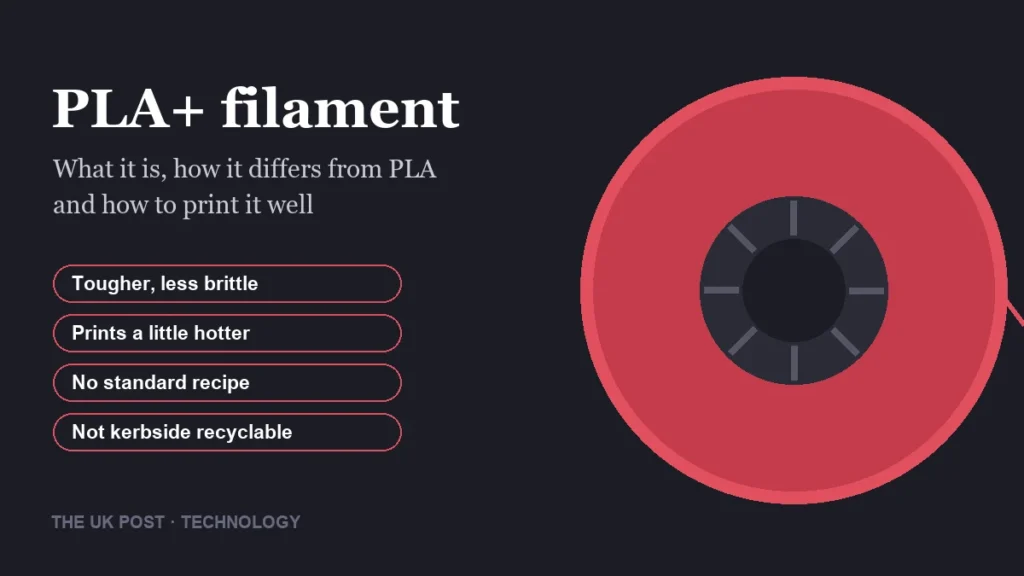
Short answer: PLA+ (or “PLA Plus”) is standard PLA 3D printing filament with additives that make it tougher and less brittle, while staying almost as easy to print. There is no official standard, so every brand’s PLA+ is a different recipe, and some cheap “PLA+” performs no better than ordinary PLA. Typically it prints 5 to 15°C hotter than PLA, often around 205 to 230°C, with a bed at 55 to 65°C. Choose PLA+ for functional parts that might be dropped, clipped or flexed; choose PETG or ABS/ASA for heat, outdoor use or real strength. In the UK, a 1kg spool usually costs about the same as good PLA, and like PLA it is only industrially compostable: it does not go in your recycling bin or home compost.
What Is PLA+?
PLA (polylactic acid) is the most popular filament for home 3D printers. It is made from plant sugars such as corn starch, prints at low temperatures, barely smells and rarely warps. Its weakness is brittleness: PLA parts tend to snap rather than bend.
PLA+ is the industry’s answer. Manufacturers blend in impact modifiers, other polymers or mineral fillers to improve toughness, layer bonding or surface finish. Because “PLA+” is a marketing name, not a defined material, the only way to know what you are getting is to read the brand’s technical data sheet and reviews. One widely sold example, eSun PLA+, lists a nozzle range of 205 to 225°C and a small calcium carbonate content; other brands use entirely different formulas, and some sell similar materials as “Tough PLA” or “PLA Pro”.
PLA vs PLA+ vs PETG vs ABS
| PLA | PLA+ | PETG | ABS / ASA | |
|---|---|---|---|---|
| Ease of printing | Easiest | Very easy | Moderate (stringing) | Harder (warping, fumes) |
| Toughness | Brittle | Better impact resistance | Tough, slightly flexible | Tough |
| Heat resistance | Low (softens around 55–60°C) | Low, similar to PLA | Medium | Good |
| Outdoor / UV | Poor | Poor | Fair | ASA is good |
| Enclosure needed | No | No | No | Yes, recommended |
| Best for | Models, prototypes, décor | Functional household parts, clips, brackets | Mechanical parts, containers | Car parts, outdoor and hot environments |
The key point many guides miss: PLA+ is tougher, but it still softens at roughly the same temperature as PLA. A PLA+ phone mount left on a car dashboard in summer will still sag. If heat is involved, use PETG, ABS or ASA.
Recommended Print Settings
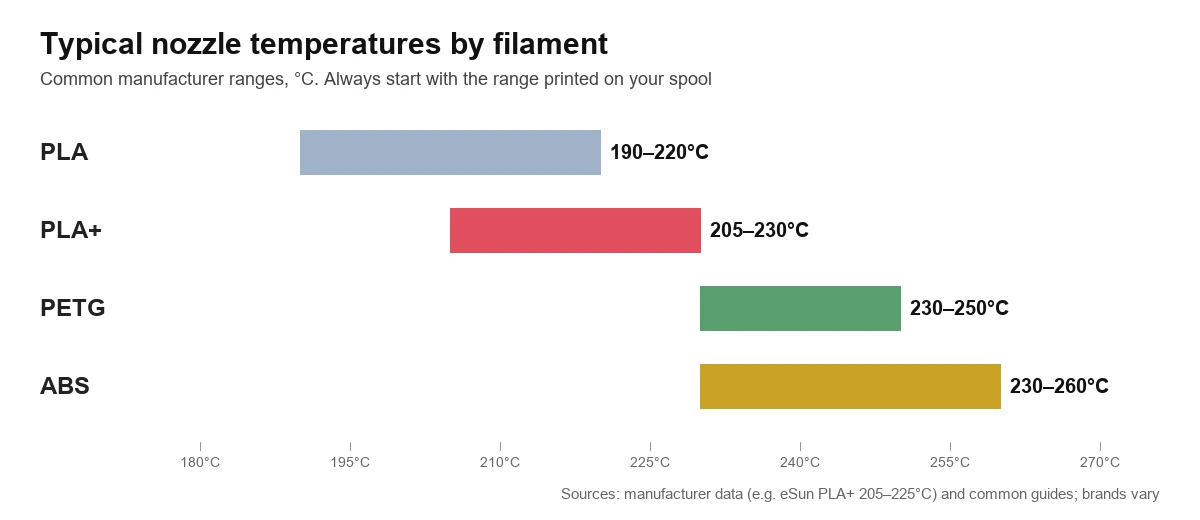
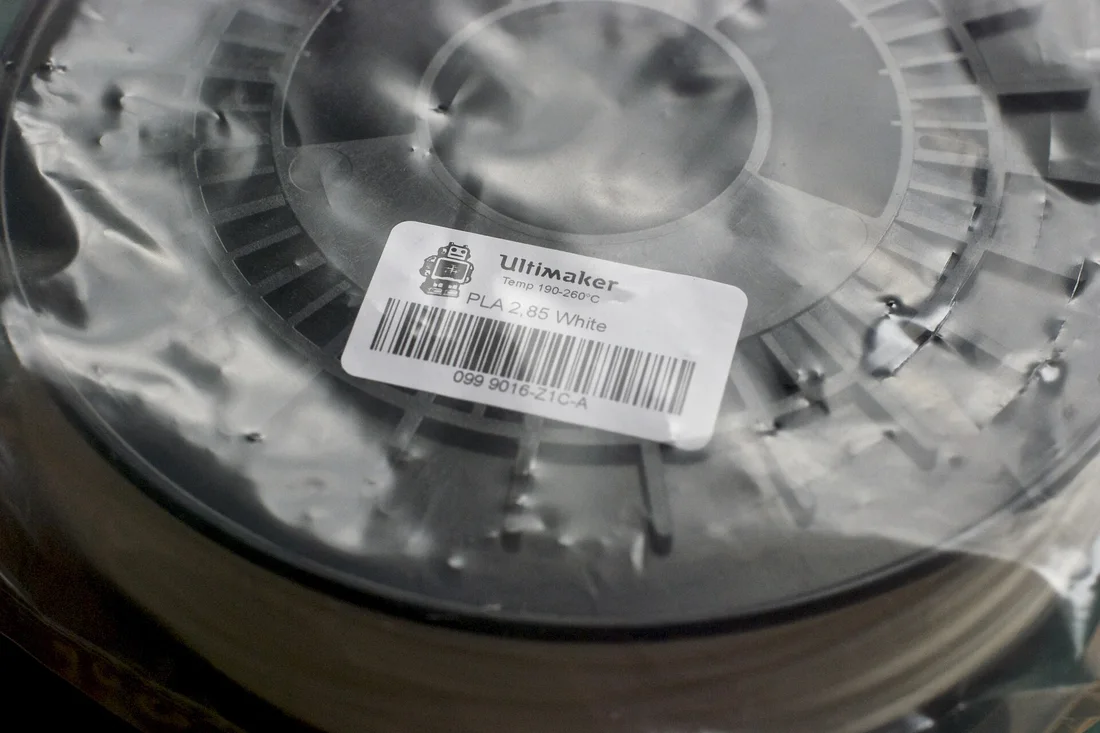
- Nozzle: start in the middle of the range on the spool, often 210 to 220°C, then fine-tune with a temperature tower.
- Bed: 55 to 65°C on PEI or textured sheets; clean the bed with isopropyl alcohol for good adhesion.
- Cooling: part-cooling fan at or near 100% after the first few layers, as with PLA.
- Speed: similar to PLA; very high-speed printers may need “high-speed” PLA+ grades or a hotter nozzle.
- Retraction: similar to PLA; increase slightly if you see stringing.
- Warping: some PLA+ blends warp a little more than PLA on large parts; a brim and a draught-free room help.
Dialling in a new spool of PLA+
Is PLA+ Worth It?
For many people, yes. If you print things that get used, such as hooks, cable clips, tool holders, replacement knobs, toy parts or brackets, PLA+ makes them less likely to snap, for little or no extra cost or effort. For display models and figurines, standard PLA (or silk and matte PLA for looks) is fine.
It is not worth it if you need heat or weather resistance, or genuinely strong mechanical parts. Then PETG, ASA, nylon or carbon-fibre blends are better choices, and some UK makers now default to PETG for practical prints.
My advice: buy one spool of a well-reviewed PLA+ and one of plain PLA from the same brand, print the same test hook in both, and try to break them. You will know in five minutes whether the “plus” is worth it for what you make.
Buying PLA+ in the UK
- Price: 1kg spools of reputable PLA and PLA+ are widely available from UK retailers and Amazon, typically in a similar price bracket; very cheap spools are more likely to vary in diameter and quality.
- Diameter: almost all modern printers use 1.75mm; check before you buy.
- Tolerance: look for a stated diameter tolerance such as ±0.02mm or ±0.03mm.
- Storage: PLA and PLA+ absorb moisture, which causes stringing and brittle filament. Store spools sealed with silica gel, especially in a damp British winter, and dry them if prints go bad.
- UK-made options: several British manufacturers produce filament, which can mean faster delivery and lower carbon transport.
Is PLA+ Biodegradable? The UK Reality
PLA is often sold as “biodegradable”, which is misleading. It is industrially compostable: it breaks down in commercial composting facilities that run at around 50 to 60°C. In a home compost heap, in soil or in the sea it can last for years. In the UK there is no kerbside collection for compostable plastics, many industrial composters do not accept them, and PLA must not go in plastic recycling, where it contaminates PET bottle recycling. Additives in PLA+ make its end of life even less clear.
The greener options are to print less waste (fewer failed prints, minimal supports), reuse scrap where you can, and look for filament take-back or recycling schemes run by some UK manufacturers. Otherwise, failed prints go in general waste.
Safety Tips
- Print in a ventilated room, as all filament printing gives off fine particles; keep the printer out of bedrooms where possible.
- Never leave a printer running unattended for long periods without smoke detection, and keep it away from flammable materials.
- Be careful with hot ends (over 200°C) and keep children and pets away from moving parts.
- Do not use ordinary PLA+ for food contact or parts for babies to chew unless the manufacturer certifies the specific product as safe for that use; layer lines can harbour bacteria anyway.
If you are curious how printed prototypes fit into product design, our guide to how children’s toys are made shows where 3D printing comes in. Many modern printers also use load cells, a type of strain gauge, to level the bed automatically, and a stripped screw on a printer frame can be rescued with our stripped screw guide.
Frequently Asked Questions
What is PLA+ filament?
A modified PLA with additives that make it tougher and less brittle than standard PLA, while keeping it easy to print.
Is PLA+ stronger than PLA?
It is usually tougher, meaning more impact-resistant and less likely to snap. Raw strength and heat resistance are similar, and results vary by brand.
What temperature should I print PLA+ at?
Usually 205 to 230°C, depending on the brand. Start mid-range and use a temperature tower to find the best setting.
Can I use PLA settings for PLA+?
Mostly, but raise the nozzle temperature by around 5 to 15°C and check the manufacturer’s recommendations.
Is PLA+ heat resistant?
Not much. It softens at roughly the same temperature as PLA, so avoid hot cars and dishwashers.
Is PLA+ better than PETG?
PLA+ is easier to print and gives cleaner detail. PETG is better for heat, outdoor use and parts that need to flex.
Is PLA+ biodegradable?
Not in normal conditions. PLA is industrially compostable only, and the UK has no kerbside collection for it.
Can PLA+ be recycled in the UK?
Not in household recycling. Some filament makers run take-back schemes; otherwise it goes in general waste.
Does PLA+ need an enclosure?
No. It prints well in open-frame printers in a draught-free room.
Is PLA+ food safe?
Only if the manufacturer certifies that specific product for food contact, and even then printed layer lines are hard to clean.
Final Thoughts
PLA+ is a sensible upgrade for anyone printing practical objects at home: almost as easy as PLA, but far less likely to snap. Just remember that the label means different things from different brands, that it is no better than PLA in the heat, and that its green credentials depend on industrial composting the UK barely offers. Test a spool, store it dry, and use the right material for the job.
Sources: eSun PLA+ technical data; All3DP, Xometry and CNC Kitchen testing of PLA and PLA+; Royal Society of Chemistry explainer on compostable plastics (EN 13432); UCL policy brief on compostable plastics; UK council guidance on compostable packaging; Ingenia on compostable plastics.