Yeah, Yea or Yay? Meaning, Spelling and Difference
Yeah, yea or yay? Yeah is an informal yes, yay is a cheer, and yea is a formal or old yes used in votes. With examples and a quiz.
 7 min read
Comments: 0Views: 4
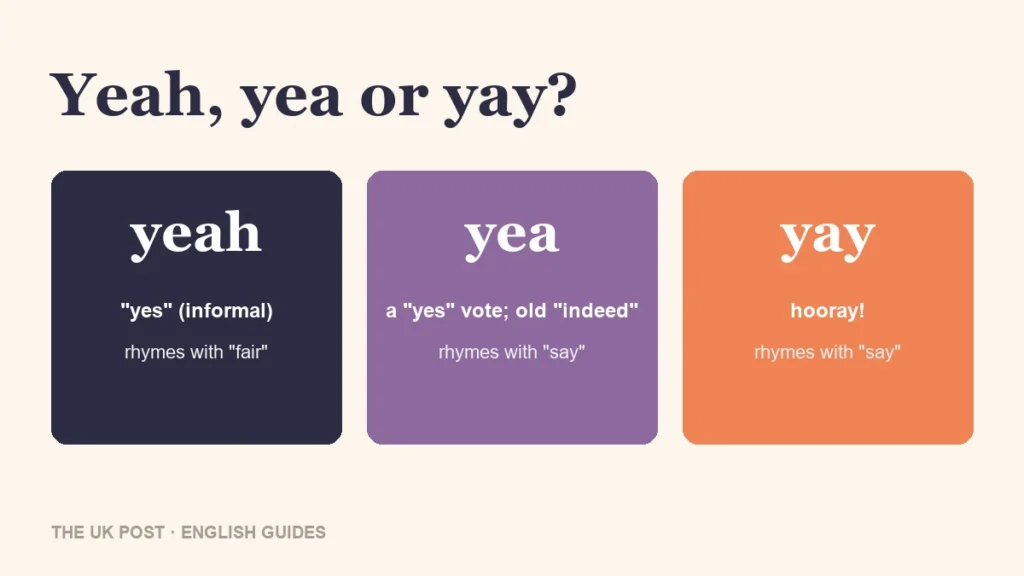
Short answer: “yeah” is the informal way of saying yes (“Yeah, I’ll be there”). “Yay” is a cheer of happiness (“Yay, it’s Friday!”). “Yea”, pronounced like “yay”, is an old-fashioned word for yes that survives mainly in formal voting and in older texts such as the King James Bible. So if you mean a casual yes in a text or email, write yeah. Writing “yea” for “yeah” is a common slip, and dictionaries treat it as nonstandard. In Britain, MPs vote “aye” and “no”, so “yea” is rarer still here than in the US, where Congress records “yeas and nays”.
Yeah vs Yea vs Yay at a Glance
| Word | Meaning | Sounds like | Example |
|---|---|---|---|
| yeah | Yes (informal) | “yeh”, rhymes with “fair” in British English | “Yeah, sounds good.” |
| yay | Hooray! (joy or approval) | Rhymes with “say” | “Yay, we won!” |
| yea | Yes (formal or old); a yes vote | Rhymes with “say” | “The yeas have it.” / “Yea, though I walk…” |
Yeah: the Everyday Yes
“Yeah” began as a relaxed, spoken form of “yes” (or of “yea”), and dictionaries label it colloquial. It is perfect for texts, chats, informal emails and dialogue in stories, but in formal writing, such as a job application or an essay, “yes” is safer.
It also turns up in some familiar phrases:
- “Yeah, no”: a softened no, as in “Yeah, no, I don’t think that’ll work.”
- “Yeah, right”: sarcastic disbelief, so it actually means “I don’t believe you”.
- “Oh yeah?”: a challenge or a sign of interest, depending on tone.
There is no single “correct” spelling of the sound in casual writing: you will also see yeh, yah and ya. But “yeah” is by far the most common, and it is the one dictionaries list as standard.
Yay: the Happy Cheer
“Yay” is an exclamation of happiness or approval: “Yay, the train’s on time!” Dictionaries say it developed as an alteration of “yea”. It is informal, so keep it for messages, social media and cards.
In American English, “yay” (or “yea”) can also mean “this much” or “so”, usually with a hand gesture: “The fish was yay big.” British speakers rarely use it this way, and would more often say “this big”.
Yea: Votes, Bibles and Old English
“Yea” is the oldest of the three. It comes from Old English gēa, meaning “yes”, and it rhymes with “say”, probably by association with its opposite, “nay”. Today it survives in three places:
- Voting: the US Constitution requires “the Yeas and Nays” of members of Congress to be recorded on certain votes. In the UK, the House of Commons divides into “Ayes” and “Noes” instead, and the Speaker announces “The ayes have it”.
- The King James Bible: “Yea, though I walk through the valley of the shadow of death” (Psalm 23) and “let your communication be, Yea, yea; Nay, nay” (Matthew 5:37).
- Formal or old-fashioned writing: as a way of adding emphasis, meaning “indeed” or “or even”: “It was a fine, yea, a glorious day.”

Yeah vs Yea: What Our Data Shows
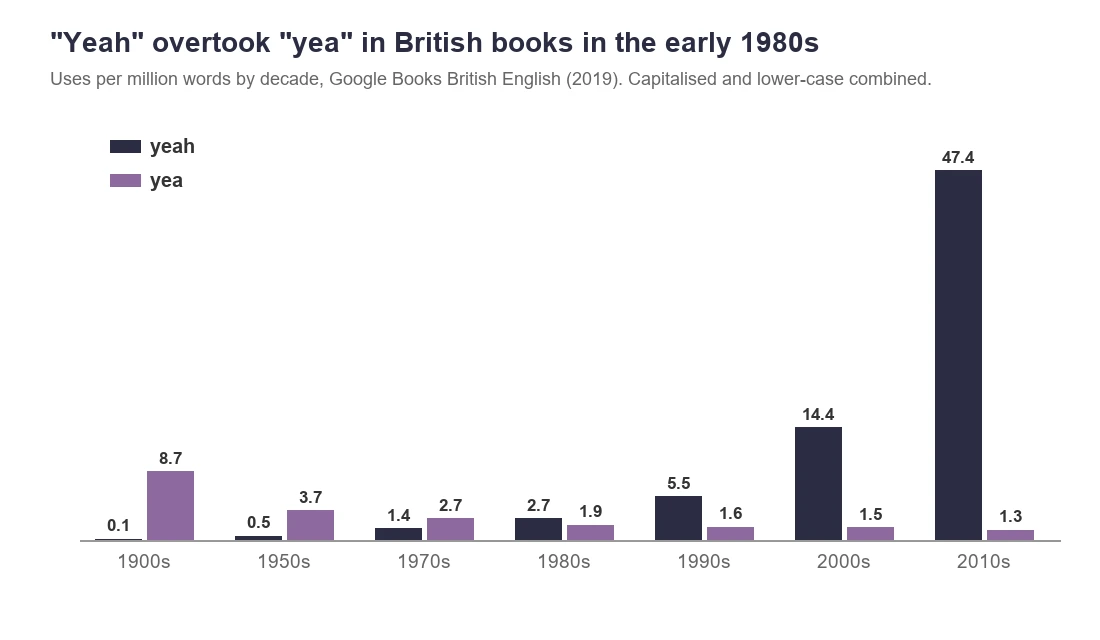
We analysed Google Books’ British and American English collections, which run to 2019:
- In the 1900s, “yea” was used more than 100 times as often as “yeah” in British books, largely thanks to biblical and literary quotations.
- “Yeah” overtook “yea” in British books in about 1982, around ten years after it did so in American books (about 1972).
- By the 2010s, “yeah” was about 38 times as common as “yea” in British books.
- “Yay” is still rare in print, but its use in British books rose about sixteenfold between the 1990s and the 2010s, as informal dialogue and social-media styles spread.
- Old Englishgēa, meaning “yes”, the ancestor of yea.
- 1611The King James Bible fixes “yea” and “nay” in English for centuries.
- 1787The US Constitution requires “the Yeas and Nays” to be recorded on certain votes.
- 1900s“Yea” is used over 100 times as often as “yeah” in British books.
- c. 1972“Yeah” overtakes “yea” in American books.
- c. 1982“Yeah” overtakes “yea” in British books.
- 2010s“Yeah” is 38 times as common as “yea” in British books; “yay” is rising fast.
How to Remember the Difference
- Yeah has an “h” at the end, like a relaxed breath: “yeah…”.
- Yay has a “y” at both ends, like arms thrown up in celebration.
- Yea goes with nay: both are old, formal and used in votes.
Test Yourself
Choose the right word for each sentence. Your score appears at the bottom.
1. Your friend asks if you're coming to the pub. Which is the standard informal reply?
2. Your team just won the quiz. Which word fits?
3. In a US Senate vote, members vote…
4. How do MPs vote in the House of Commons?
5. How is yea pronounced?
My Advice
In everyday British writing you will almost never need “yea”. If you are saying yes, write “yeah” (or “yes” when it is formal). If you are celebrating, write “yay”. Save “yea” for quoting the Bible, writing historical fiction or describing an American vote. For more pairs that trip people up, see our guide to commonly confused words, or try woken or woeken, verbiage or verbage and pricey or pricy.
Frequently Asked Questions
Is it yeah or yea?
For an informal yes, it is “yeah”. “Yea” is an old-fashioned word for yes, used mainly in formal voting.
How do you spell yay?
Y-A-Y. It is an exclamation of happiness: “Yay, it’s the weekend!”
What does yea mean?
Yes, especially as a vote (“the yeas and nays”). In older writing it can also mean “indeed” or “or even”.
How do you pronounce yea?
Like “yay”, rhyming with “say”.
Is “yea” wrong for “yeah”?
In standard English, yes. Dictionaries treat “yea” as a nonstandard spelling of “yeah”.
What does “yeah, no” mean?
It is a softened “no”: the “yeah” acknowledges what was said before the speaker disagrees.
Do MPs say yea or aye?
Aye. The House of Commons divides into “Ayes” and “Noes”. “Yeas and nays” is the American congressional term.
Is yeah rude?
Not usually, but it is informal. In formal situations, such as an interview or an official letter, “yes” is better.
What does “yay high” mean?
About this tall, usually said with a hand gesture. It is mainly American.
Where does yeah come from?
It is a colloquial form of “yes” or “yea”. It became much more common in print in the 20th century.
Final Thoughts
Yeah means yes, yay means hooray, and yea is an old yes that you mainly find in votes and Bibles. Use “yeah” for a casual yes and “yay” for a cheer, and leave “yea” to Congress and the King James Version.
Sources: Our own analysis of Google Books Ngram data (British and American English 2019 collections; notes on file); Wiktionary entries for yeah, yea and yay; US Constitution, Article I, Section 5; UK Parliament guidance on divisions; King James Bible (Psalm 23:4, Matthew 5:37).