Verbiage or Verbage? Meaning, Spelling and How British English Uses It
Verbiage or verbage? The correct spelling, both meanings, pronunciation, origin and British vs American usage, with a quiz.
 16 min read
Comments: 0Views: 6
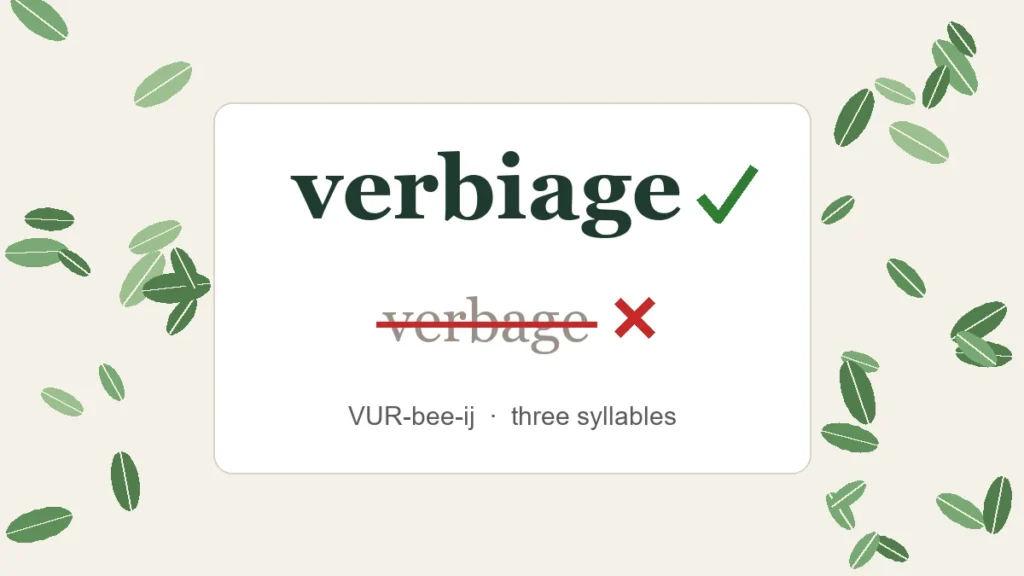
Short answer: the correct spelling is verbiage, said in three syllables: VUR-bee-ij. “Verbage” is a misspelling. No major dictionary accepts it as a standard word, and in British books verbiage appears about 180 times as often. Verbiage has two meanings. The main one is too many words with too little meaning, as in “cut the verbiage from your CV”. The second is simply wording, as in “the verbiage of the contract”. In British English that second use can sound American or a bit corporate, so my advice is to write “wording” when you mean wording.
Verbiage vs Verbage at a Glance
| Verbiage | Verbage | |
|---|---|---|
| Is it a real word? | Yes, in every major dictionary | No. A misspelling of verbiage |
| Pronunciation | VUR-bee-ij (three syllables) | Usually said VUR-bij, which is where the error comes from |
| Main meaning | Too many words, often with little content | Used by mistake for verbiage |
| Second meaning | Wording, the way something is put into words | None |
| Tone in British English | Usually disapproving, and formal | Looks like a typo |
| Countable? | Usually not: “a lot of verbiage”, not “verbiages” | n/a |
| Safe in a CV, essay or work email? | Yes, if you mean wordiness | No |
What Does Verbiage Mean?
Dictionaries agree that verbiage has two senses. Which one someone means depends on context, and in British English the first is far more common.
1. Too many words, too little meaning
This is the main meaning and the one most British readers will assume. Merriam-Webster defines it as “a profusion of words usually of little or obscure content”. The Oxford Advanced Learner’s Dictionary, which follows British usage, labels it formal and disapproving and defines it as the use of too many words, or of more difficult words than are needed. Collins gives “the excessive and often meaningless use of words; verbosity”.
So when a teacher writes “too much verbiage” on an essay, or a manager asks you to “strip out the verbiage” from a report, they mean padding: words that take up space without adding anything. Typical examples are long-winded openings (“I am writing to you today in order to inform you that…”), stacked qualifiers (“very extremely important”) and jargon used to sound impressive.
In British books, verbiage most often appears with words that make the criticism plain: mere verbiage, empty verbiage and meaningless verbiage are all more common in British books than in American ones.
2. Wording, with no criticism
The second sense is neutral. Merriam-Webster gives it as “manner of expressing oneself in words: diction”, and notes that it developed in the early 19th century. In this sense, “the verbiage on the form” just means what the form says. It is common in American business, legal and technical writing: “contract verbiage”, “marketing verbiage”, “the verbiage on the warning label”.
Is this second sense wrong? Not according to the dictionaries. Merriam-Webster calls it well established and standard, even though some people treat it as an error. The American usage expert Bryan Garner is cooler about it. He calls the neutral sense “unneeded”, because it makes it hard to tell whether a criticism is meant.
That is the real problem with it. If you tell a colleague “I’ve tweaked the verbiage in your proposal”, a British reader may hear “I’ve cut your waffle”. I don’t think the neutral sense is a mistake, but I would only use it with readers who know the American usage. For a UK audience, wording says the same thing with no risk of offence.
Is Verbage a Word?
No. Verbage is not a standard word, and you should treat it as a spelling mistake. Merriam-Webster has no entry for it, Dictionary.com sends searches for it to verbiage, and Wiktionary lists it as a misspelling. Bryan Garner’s usage guide marks it as an “invariably inferior form”.
Why do so many people write it? There are three good reasons:
- Pronunciation. Many people say the word in two syllables, VUR-bij, and spell it the way they say it. Garner names this mispronunciation as one source of the error.
- Look-alike words. English has dozens of nouns that end in plain -age: herbage, luggage, package, wordage. Garner suggests herbage may have led people astray. Words ending in -iage, such as foliage and marriage, are much rarer.
- It looks like “verb” plus “-age”. Verbiage really is about words, so “verb + age” feels logical. The word’s actual history is different, as you will see below.
Grammarly suggests verbage may also be read as a blend of verbiage and garbage. That fits how it is sometimes used, but either way it is not a dictionary word. In a CV, an essay or a work email, write verbiage, or better still a plainer word.
How to Spell and Say Verbiage
Verbiage is spelled V-E-R-B-I-A-G-E. The British pronunciation is /ˈvɜːbiɪdʒ/: three syllables, with the stress on the first, VUR-bee-ij. The American pronunciation is the same, with the r sounded.
Memory trick: verbiage ends like foliage. Too much foliage is a hedge that needs trimming, and too much verbiage is a paragraph that needs trimming. Both have an i before the -age.
These are the misspellings people type into search engines most often, all from the sheet of searches behind this guide:
| Misspelling | Correct spelling | What went wrong |
|---|---|---|
| verbage | verbiage | Missing i, from the two-syllable pronunciation |
| verbige, verbeage | verbiage | The i and a are swapped or replaced |
| veribage | verbiage | The i has moved forward a syllable |
| varbiage | verbiage | Spelled as it sounds in some accents |
| verbiate | verbiage | Not a word; probably a typo or a mix-up with verbiage and “abbreviate” |
Where the Word Verbiage Comes From
Verbiage looks as if it was built from “verb” and “-age”, and the Oxford English Dictionary has analysed it that way. Most etymologists now think it was borrowed whole from French, and its story starts with birdsong rather than grammar.
- 13th c.Northern French (Picard) verbler: to warble, to speak in a singsong voice.
- Middle AgesMiddle French verbier or verboier: to chirp or warble, used of birds.
- 1674French verbiage first recorded, now linked in people’s minds with verbe (word).
- c. 1721First known use in English, in a poem by Matthew Prior. Meaning: too many words.
- Early 1800sA second, neutral sense appears: verbiage as simply “wording”.
- TodayDisapproving sense dominates in Britain; the neutral sense is common in American business writing.
According to Alain Rey’s historical dictionary of French, the French word verbiage first appeared in 1674. It came from a Middle French verb, verbier or verboier, meaning to chirp or warble, used of birds. That in turn goes back to a 13th-century northern French (Picard) word, verbler, “to warble, to speak in a singsong voice”. Over time French speakers linked the word with verbe (“word”) and verbeux (“wordy”). That is how a word for twittering birds became a word for people who talk too much.
English borrowed it in the early 18th century. Merriam-Webster dates its first known use to about 1721, and the earliest known English example is a poem by Matthew Prior from that year. The linguist Geoff Nunberg argued that this borrowing explains the word’s odd form better than the “verb + -age” theory does. The neutral “wording” sense followed in the early 1800s.
I like this history because it explains the word’s sting. To call someone’s writing verbiage is, at root, to say it is twittering: pleasant noise without much meaning.
How Often Each Spelling Appears in British Books
I checked both spellings in Google Books’ British English collection, a large body of books published in Britain, decade by decade from the 1950s to 2019. Verbage has never been more than a rare slip. In the 2010s, British books used verbiage about 183 times for every verbage.
The data shows something else too: British writers are using verbiage less, while American writers have been using it more since the 1990s. By the 2010s the word was about 40% more common in American books than in British ones. That rise in America is largely the neutral “wording” sense in business and legal writing.
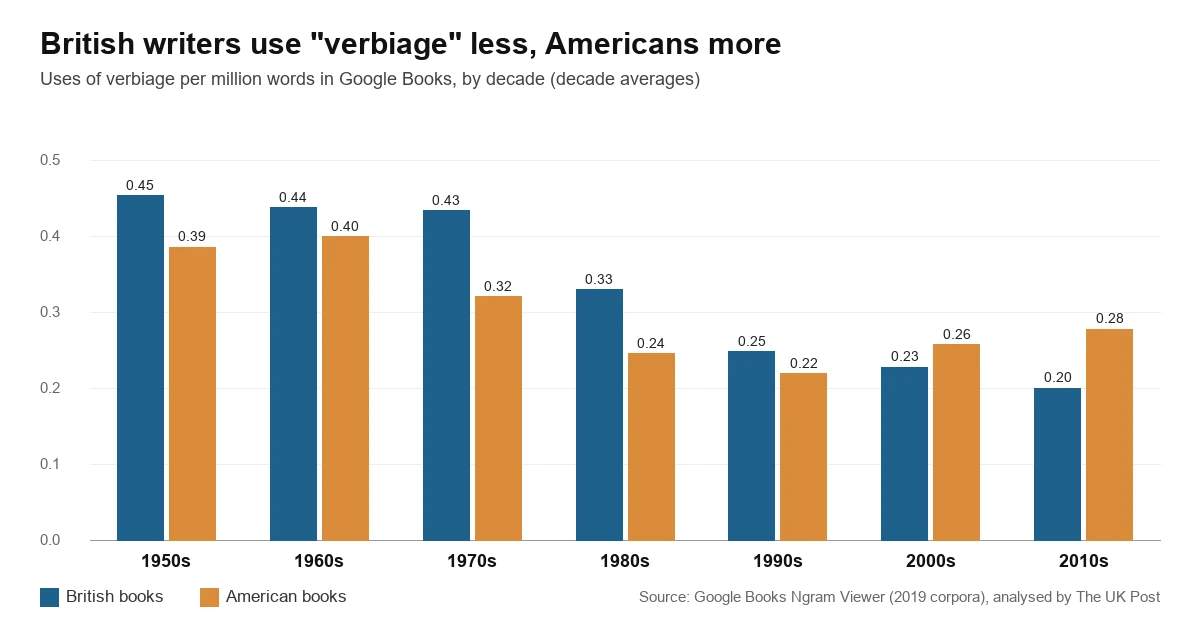
| Decade | Verbiage, British books (per million words) | Verbiage, American books (per million words) | Verbiage for every verbage (British books) |
|---|---|---|---|
| 1950s | 0.45 | 0.39 | 188 |
| 1970s | 0.43 | 0.32 | 121 |
| 1990s | 0.25 | 0.22 | 229 |
| 2000s | 0.23 | 0.26 | 128 |
| 2010s | 0.20 | 0.28 | 183 |
Book data has limits. It only covers edited, published text, where most misspellings are caught. Online, in emails and on social media, verbage is much more common, which is exactly why so many people search for the right spelling.
Verbiage in British vs American English
This is the part most guides miss, and it matters if you write for UK readers or work with American colleagues.
In British books from 2010 to 2019, phrases that criticise were more common than in American books: “mere verbiage”, “empty verbiage” and “meaningless verbiage”. Neutral phrases leaned the other way. “Legal verbiage” was more common in American books, “the verbiage on” (as in “the verbiage on the website”) was three times as common, and “contract verbiage” and “marketing verbiage” did not register in British books at all.
| Phrase (2010–2019 books) | Where it is more common | Sense |
|---|---|---|
| mere verbiage | British books (about 1.3 times) | Disapproving |
| empty verbiage | British books (about 1.2 times) | Disapproving |
| meaningless verbiage | British books (about 1.2 times) | Disapproving |
| legal verbiage | American books (about 1.4 times) | Often neutral |
| the verbiage on (a page, form, label) | American books (about 3 times) | Neutral |
| contract verbiage, marketing verbiage | American books only | Neutral |
British writers have also always had a plainer choice. In British books of the 2010s, wording appeared about 28 times as often as verbiage. In the 1950s the gap was about 13 to 1, so wording has been pulling further ahead.
My advice for UK readers: if an American client asks you to “check the verbiage”, they almost certainly just mean the wording, so don’t take offence. When you write yourself, keep verbiage for wordiness and use wording, phrasing or text for everything else.
Verbiage vs Wording, Language and Waffle
Verbiage sits among several words that overlap. Choosing the right one makes your meaning clear, and usually sounds more natural in British English.
| Word | Meaning | Tone | Example |
|---|---|---|---|
| verbiage | too many words, or (chiefly American) wording | formal, usually critical | “The report is buried in verbiage.” |
| wording | the exact words used to say something | neutral | “Can we change the wording of the second clause?” |
| phrasing | the way a particular idea is expressed | neutral | “The phrasing of the question confused people.” |
| language | the type or style of words used | neutral | “Use plain language in letters to customers.” |
| waffle | long, vague talk or writing that avoids the point | informal, critical, very British | “Less waffle, more facts.” |
| verbosity, wordiness | using more words than needed | critical | “Wordiness is the commonest fault in exam answers.” |
| padding | material added only to make something longer | critical | “Half the essay is padding.” |
| jargon | specialist terms outsiders struggle to follow | often critical | “The letter was full of legal jargon.” |
| gobbledygook | language so complicated it means nothing | informal, critical | “The form was pure gobbledygook.” |
For most British readers, waffle is the everyday word for what verbiage means in a formal register. Teachers write “waffle” in essay margins, and it is common in workplace feedback too.
Correct Verbiage or Correct Wording?
People often search for “correct verbiage” or “proper verbiage”, usually when they want the right form of words for a cover letter, a complaint, a notice or a script. Both phrases use the neutral American sense.
They are understood, but in British English they sound slightly odd. Because the main meaning of verbiage is wordiness, “the correct verbiage” can read like “the correct waffle”. Say the correct wording, the right words or the right phrasing instead. “What’s the correct wording for an out-of-office reply?” is natural British English.
How to Cut the Verbiage From Your Writing
Since verbiage usually means unnecessary words, the most useful thing to know is how to get rid of it. These are the fixes I find make the biggest difference in CVs, emails, reports and essays:
- Start with the point. Delete warm-up phrases such as “I am writing to inform you that” or “I just wanted to reach out to say”. Begin with what the reader needs.
- Swap phrases for words. “In order to” becomes “to”, “due to the fact that” becomes “because”, “at this moment in time” becomes “now”.
- Cut empty intensifiers. “Very”, “really”, “extremely” and “absolutely” rarely add anything. “Essential” does not need “absolutely”.
- Prefer verbs to noun phrases. “We carried out an investigation into” becomes “we investigated”.
- Use the active voice when you can. “Mistakes were made by the team” becomes “the team made mistakes”.
- Drop words that repeat each other. “Past history”, “future plans”, “end result” and “free gift” each need only one word.
- Read it aloud. If you run out of breath or lose the thread, the sentence is too long.
| With verbiage | Without |
|---|---|
| “Please be advised that, due to the fact that the office will be closed, deliveries will not be accepted at this moment in time.” | “The office is closed, so we can’t accept deliveries today.” |
| “I am a highly motivated, results-driven individual with a proven track record of delivering outstanding results.” | “I cut customer complaints by 30% in my first year.” |
| “I just wanted to reach out to touch base regarding the report.” | “Is the report ready?” |
| “It is absolutely essential that all staff members make sure to read the policy.” | “All staff must read the policy.” |
The UK government’s own writing guidance for GOV.UK pushes the same habits: short sentences, common words and the active voice. Writing tools can flag wordy sentences too. If you use one, our comparison of Grammarly alternatives covers the options and what each catches. For short, tidy work emails, it also helps to keep the extras out of your sign-off, as our guide to a professional email signature shows.
Example Sentences
- “The examiner’s comment was blunt: good ideas, too much verbiage.”
- “Strip out the verbiage and the policy is only two paragraphs long.”
- “The minister’s answer was a cloud of verbiage that avoided the question.”
- “Under all the verbiage, the letter simply says your bill is going up.”
- “Cut the verbiage from your CV and lead with what you achieved.”
- “The lawyers are still arguing over the verbiage of clause 4.” (neutral, more common in American English)
- “Could you look at the wording of the job advert before it goes live?” (the natural British choice)
- “Her speech was short and sharp, with no verbiage at all.”
Test Yourself
Choose the right word for each sentence. Your score appears at the bottom.
1. Which spelling is correct?
2. "The report is good, but cut the ___." Which word fits best?
3. You want to ask a British colleague to check the exact words on a poster, without criticising. Which is clearest?
4. How many syllables does verbiage have?
5. Which is the everyday British word for long, vague writing that avoids the point?
Verbiage is one of dozens of words that catch writers out. Our guide to commonly confused words covers more than 50 pairs, with British spelling tips for each. For another pair in depth, read recurring or reoccurring. And if verbiage is too many words, meet its opposite in spirit: dentiloquent, a rare word for speaking through clenched teeth.
Frequently Asked Questions
Is it verbage or verbiage?
It is verbiage, with an i before the -age. Verbage is a common misspelling and is not accepted as a standard word by the major dictionaries.
Is verbage a real word?
No. Merriam-Webster has no entry for verbage, Dictionary.com redirects it to verbiage, and usage guides such as Garner’s treat it as an error. Use verbiage.
What does verbiage mean?
Verbiage usually means too many words with little meaning, as in “the report was full of verbiage”. It can also mean simply wording, as in “the verbiage of the contract”, a sense more common in American English.
Is verbiage a negative word?
Usually, yes. Its main meaning is wordiness, and British dictionaries label it disapproving. The neutral sense, meaning wording, exists but is more common in American business and legal writing.
How do you pronounce verbiage?
In three syllables: VUR-bee-ij, with the stress on the first syllable. The British pronunciation is /ˈvɜːbiɪdʒ/. Saying it in two syllables, VUR-bij, is a common mistake that leads to the misspelling verbage.
How do you spell verbiage?
V-E-R-B-I-A-G-E. Remember that it ends like foliage, with an i before the -age.
What is the difference between verbiage and wording?
Wording is neutral and simply means the words used. Verbiage usually suggests there are too many of them. In British English, use wording when you do not mean to criticise.
Is “excess verbiage” correct?
It is common and understood, but strictly it repeats itself, because verbiage already means excessive words. “Verbiage” on its own, or “excess wording”, is tighter.
What is a British word for verbiage?
Waffle is the everyday British equivalent. It means long, vague talk or writing that avoids the point, and is the word teachers and managers in the UK most often use.
Where does the word verbiage come from?
It comes from French, where it first appeared in 1674. It goes back to an old French verb meaning to chirp or warble like a bird. English borrowed it in the early 18th century, around 1721.
Final Thoughts
If you remember one thing, make it this: the word is verbiage, three syllables, ending like foliage. Use it when you mean too many words. When you simply mean the words on a page, British readers will thank you for saying wording, which is clearer and carries no hint of criticism. And if a piece of your own writing feels heavy, the fixes above will cut the verbiage faster than any thesaurus.
Sources: Merriam-Webster (verbiage entry and Word of the Day notes); Oxford Advanced Learner’s Dictionary; Collins English Dictionary; Wiktionary (verbiage, verbage); Bryan A. Garner, Garner’s Modern English Usage, via LawProse Usage Tip, 19 February 2014; Alain Rey, Dictionnaire historique de la langue française, as cited by Languagehat (2010); Grammarly, “What Is Verbiage?”; Google Books Ngram Viewer, British English and American English 2019 corpora, analysed by The UK Post on 26 November 2026; GOV.UK content design guidance.