Woken or Woeken? The Correct Spelling Explained
Woken is the correct spelling; woeken is a common misspelling. How to use wake, woke and woken, plus what Google Books data shows.
 6 min read
Comments: 0Views: 2
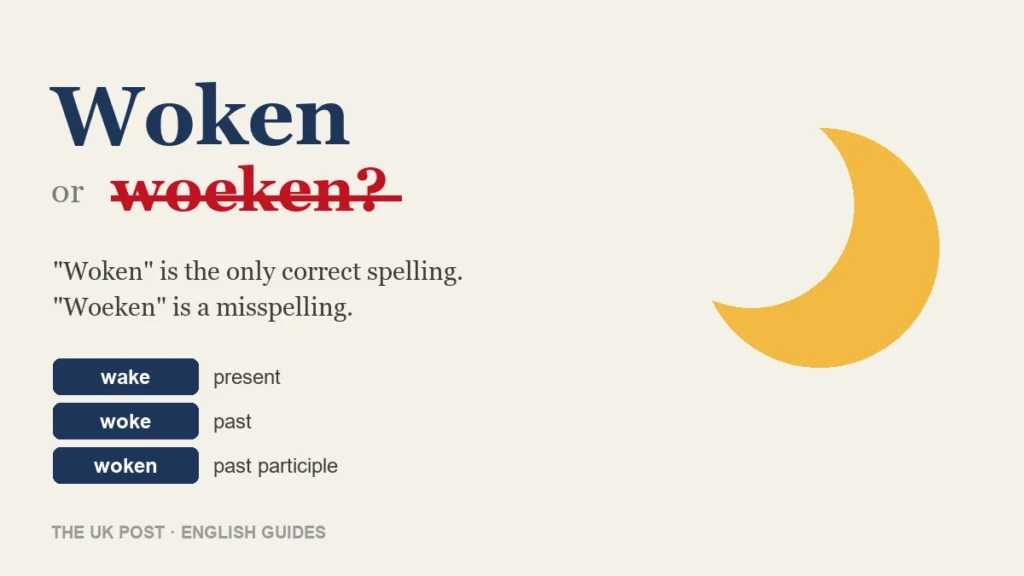
Short answer: the correct spelling is “woken”. “Woeken” is a misspelling and does not appear in any standard dictionary. “Woken” is the past participle of the verb “wake”, the form you use after “have”, “has”, “had” or “was”: “I was woken by the alarm” or “She has woken up”. The full set is wake, woke, woken. People write “woeken” because the “oh” sound is often spelled “oe”, as in “toe”, “foe” and “woe”. In “woken”, though, the vowel is spelled with a plain “o”, just like “spoken”, “broken” and “frozen”.
Woken, Woke, Waked or Awoken? The Forms at a Glance
| Verb | Present | Past | Past participle |
|---|---|---|---|
| wake | wake / wakes | woke (also waked) | woken (also waked; “woke” is colloquial) |
| awake | awake / awakes | awoke | awoken |
| awaken | awaken / awakens | awakened | awakened |
| waken | waken / wakens | wakened | wakened |
For everyday British English, you only need the first row: wake, woke, woken.
How to Use “Woken” Correctly
Use woke on its own for the simple past, and woken after a form of “have” or “be”:
- I woke up at six. (simple past)
- I have woken up at six every day this week. (present perfect)
- The baby had already woken when we got home. (past perfect)
- We were woken by the storm. (passive)
A quick test: if you can put “have” or “was” in front of it, you need “woken”. “I have woke up” is common in casual speech, and some dictionaries record “woke” as a colloquial past participle, but in writing it will look like a mistake to most British readers.
Why Do People Write “Woeken”?
English has several ways to spell the long “oh” sound. Words such as toe, foe, hoe and especially woe use “oe”, so a writer who hears “WOH-kun” can easily reach for “woe” plus “-ken”. But “woken” belongs to a family of past participles that all use a single “o” before a consonant and “-en”:
- speak, spoke, spoken
- break, broke, broken
- freeze, froze, frozen
- choose, chose, chosen
- wake, woke, woken
The silent “e” rule also explains it: the “o” in “woken” is already long because only one consonant follows it, as in “token” and “joker”. There is no need for an extra “e”.
Woken vs Waked: What Our Data Shows
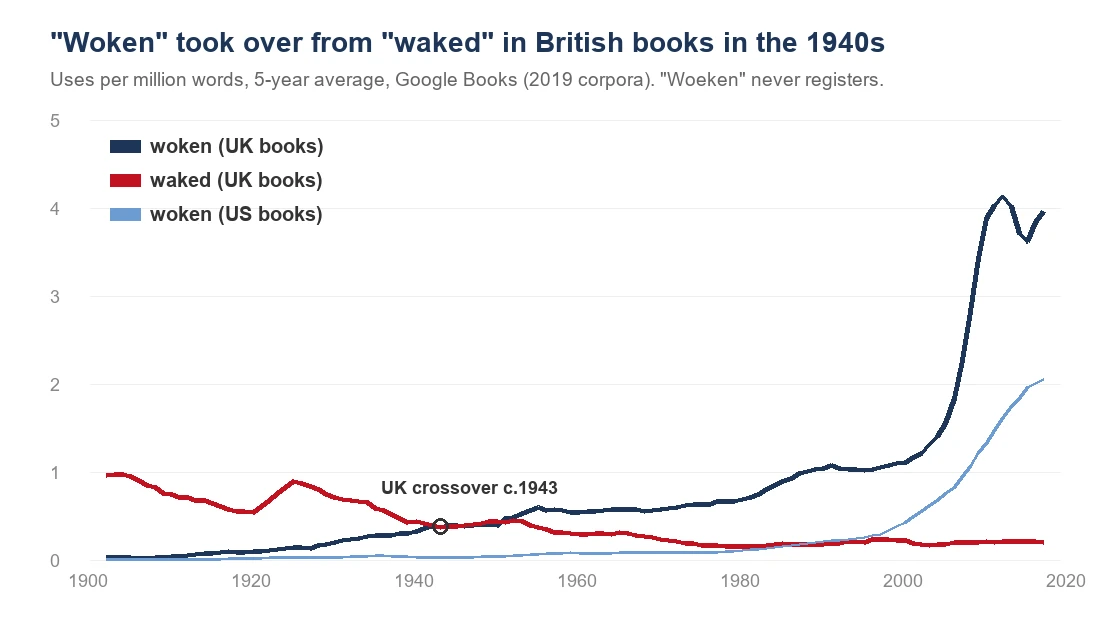
We checked Google Books’ British and American English collections, which run to 2019. “Woeken” does not register at all in either. The more interesting story is how “woken” replaced the older form “waked”:
- In British books in the 1900s, “waked” was used about 36 times as often as “woken”.
- “Woken” overtook “waked” in British books around 1943.
- American writers kept “waked” much longer: “woken” did not overtake it in American books until about 1987.
- By the 2010s, “woken” was about 20 times as common as “waked” in British books and about 8 times as common in American books.
- British books also used “woken” more than twice as often as American books in the 2010s, per million words. Americans more often write “awakened”.
- Middle EnglishTwo related verbs, waken and wakien, merge into modern wake.
- 1900s“Waked” is about 36 times as common as “woken” in British books.
- c. 1943“Woken” overtakes “waked” in British books.
- c. 1987“Woken” overtakes “waked” in American books.
- 2017The OED (June) and Merriam-Webster (September) add the slang adjective “woke”.
- 2010s“Woken” is about 20 times as common as “waked” in British books; “woeken” never appears.
Woken vs “Woke”: The Slang Meaning
“Woke” has a second life as an adjective meaning alert to racial or social injustice, from the African American English phrase “stay woke”. The Oxford English Dictionary added this sense in June 2017, and Merriam-Webster followed in September 2017. In British politics and media it is now often used disapprovingly, as in “woke culture”.
This slang sense has nothing to do with “woken”. If you mean someone has stopped sleeping, use “woken”; if you are describing political attitudes, the word is “woke”.
How to Pronounce “Woken”
In British English, “woken” is pronounced WOH-kun (/ˈwəʊkən/), with two syllables and the stress on the first. In American English it sounds almost the same (/ˈwoʊkən/). The spelling has no “e” after the “o”, whichever accent you have.
Test Yourself
Choose the right word for each sentence. Your score appears at the bottom.
1. Which spelling is correct?
2. "I was ___ by the neighbour's dog."
3. "I ___ up late this morning."
4. "Has the baby ___ yet?"
5. Which word does NOT follow the same pattern as woke/woken?
My Advice
Remember the family: spoke and spoken, broke and broken, woke and woken. If you can say “have spoken”, you can say “have woken”, and it is spelled the same way. If you are not sure whether to write “woke” or “woken”, try putting “have” in front; if it fits, use “woken”. For more spelling traps like this, see our guide to commonly confused words, and our pages on verbiage or verbage , recurring or reoccurring and yeah, yea or yay.
Frequently Asked Questions
Is it woken or woeken?
Woken. “Woeken” is a misspelling.
Is “woeken” a word?
No. It does not appear in standard dictionaries, and it does not register in Google Books’ British or American English collections.
What is the past tense of wake?
Woke. The past participle is woken: “I woke early” and “I have woken early”.
Is it “I have woke” or “I have woken”?
“I have woken” is the standard form. “I have woke” is heard in casual speech but looks wrong in writing.
Is “waked” correct?
Yes, but it is old-fashioned. “Waked” was more common than “woken” in British books until the 1940s, and is now rare.
What is the difference between woken and awoken?
Both mean roused from sleep. “Woken” (from wake) is more common in everyday British English; “awoken” (from awake) sounds more formal or literary.
Is it “woken up” or “woke up”?
Both are correct in different tenses: “I woke up at seven” (past) and “I have woken up” (present perfect).
How do you pronounce woken?
WOH-kun, with two syllables: /ˈwəʊkən/ in British English.
Why is woken spelled without an e?
Because the “o” is already long when only one consonant follows it, as in token and spoken.
Does “woke” mean the same as “woken”?
Not in standard English. “Woke” is the simple past of wake, and also a slang adjective meaning alert to social injustice.
Final Thoughts
“Woken” is the only correct spelling. Think of spoken, broken and frozen, keep the single “o”, and use “woken” after “have” or “was”. “Woeken” might look right because of “woe”, but no dictionary or book collection recognises it.
Sources: Our own analysis of Google Books Ngram data (British and American English 2019 collections, smoothing 0; data notes on file); Wiktionary entries for wake and woken; Oxford English Dictionary June 2017 update and Merriam-Webster September 2017 additions, as reported (Time, Washington Times).