Flyers or Fliers? The Right Spelling for Paper Leaflets
Flyer is the standard spelling for printed leaflets in the UK, and more common in the US too. When flier is used, and what the data shows.
 6 min read
Comments: 0Views: 2
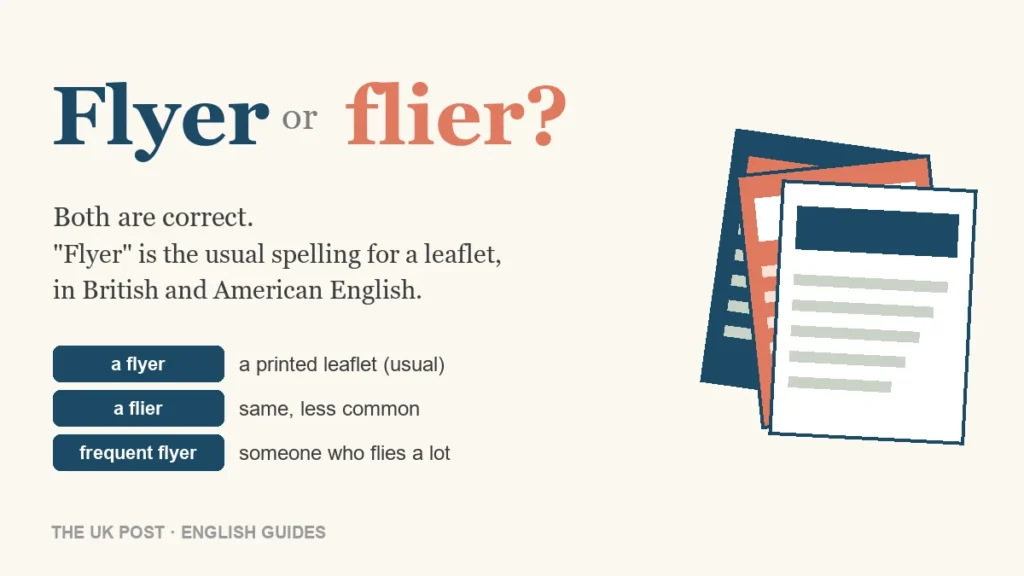
Short answer: for a printed leaflet, “flyer” is the standard spelling in British English, and it is the more common spelling in American English too. “Flier” is an accepted variant but far less common. UK printers, councils and businesses almost always say “flyers”. Even the American AP Stylebook, which once preferred “flier”, changed its guidance in 2017 to “flyer” for both handbills and people who fly, keeping “flier” only for the idiom “take a flier” (take a big risk). In British books of the 2010s, “a flyer” outnumbered “a flier” by more than three to one.
Flyer vs Flier at a Glance
| Meaning | British English | American English |
|---|---|---|
| A printed leaflet or handbill | flyer (flier rare) | flyer (flier also used) |
| A person who flies, e.g. a passenger or pilot | flyer: “frequent flyer” | flyer, sometimes flier |
| A very successful person | high flyer (high flier also seen) | high flyer |
| A risky gamble | – | “take a flier“ |
| A small flyer handed out in the street | also leaflet or handbill | also handbill or circular |
Flyers or Fliers for Paper Leaflets?
If you are ordering printed handouts to promote a gig, a business or a local event, write flyers. It is the spelling used by UK print shops and online printers, and it is what your customers will search for. “Fliers” is not wrong, and you will see it in some American newspapers, but to British readers it can look like a mistake.
In British English you can also use leaflet, which is often a little more formal or official (“an NHS leaflet”, “a council leaflet”), while a flyer is usually a single promotional sheet. In our data, “leaflet” is still more common than “flyer” in British books, but its use has fallen by about two-thirds since the 1970s, while “flyer” has more than doubled since the 1990s.
What Our Data Shows
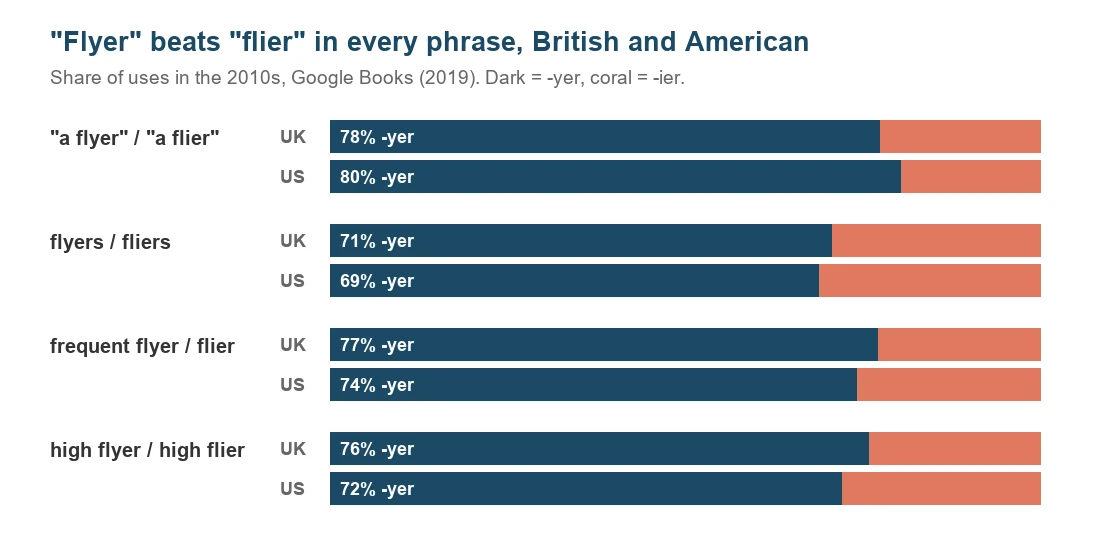
We analysed Google Books’ British and American English collections, which run to 2019:
- In the 2010s, “a flyer” was about 3.4 times as common as “a flier” in British books, and about four times as common in American books.
- “Flyers” outnumbered “fliers” about 2.4 to 1 in British books, and “frequent flyer” beat “frequent flier” about 3.5 to 1.
- Americans once leaned the other way: “fliers” was ahead of “flyers” in American books in the 1950s, before “flyer” took over from the late 1960s.
- Single-word counts include pilots, birds and trains as well as leaflets, but the phrase “a flyer”, which is mostly about handouts, shows the same pattern.
- 1950s“Fliers” leads “flyers” in American books; British books are almost level.
- Late 1960s“Flyers” takes the lead in American books.
- 1970s“Leaflet” peaks in British books.
- 1980s-90s“Frequent flyer” spreads with airline loyalty schemes.
- 2017The AP Stylebook switches to “flyer” for handbills and people who fly.
- 2010s“A flyer” leads “a flier” about 3.4 to 1 in British books.
Why Are There Two Spellings?
Both words come from “fly” plus the “-er” ending for a person or thing that does something. English normally changes “y” to “i” before a suffix, as in cry, crier and dry, drier, which gives “flier”. But with one-syllable words ending in “y”, English often keeps the “y” before “-er”, as in shyer and slyer, which gives “flyer”. Both patterns were used for a long time, and over the 20th century “flyer” won out, helped by aviation (“frequent flyer” programmes) and the printing trade.
A similar split exists with dryer and drier: many writers use “dryer” for the machine (“a tumble dryer”) and “drier” for the comparative (“the towels are drier now”).
How to Use Flyer in a Sentence
- “We handed out 500 flyers for the car boot sale.”
- “She designed a flyer for her dog-walking business.”
- “As a frequent flyer, he has elite status with the airline.”
- “She was a high flyer at university.”
- American idiom: “He took a flier on a risky stock.”
Test Yourself
Choose the right word for each sentence. Your score appears at the bottom.
1. You're ordering printed handouts for a UK event. Which spelling?
2. Which phrase do airlines usually use?
3. Where does the AP Stylebook still use 'flier'?
4. Which British word can replace 'flyer' for an official information sheet?
5. Which is the plural of flyer?
My Advice
Use flyer and flyers for leaflets and for people who fly. It is the clear British standard, the major American style guide agrees, and it matches what people type into search engines. Keep “flier” for the American idiom “take a flier”, or if you are following a house style that still prefers it. For more spelling pairs, see our guide to commonly confused words, and our pages on especially or specially, cue or queue and hunny or honey.
Frequently Asked Questions
Is it flyers or fliers for paper leaflets?
Flyers is the standard spelling in British English and the more common one in American English.
Is flier or flyer correct in the UK?
Flyer. “Flier” is accepted but rare in British English.
Is flier wrong?
No, it is an accepted variant, mainly American. But “flyer” is more common in both countries.
What does the AP Stylebook say?
Since 2017 it has preferred “flyer” for handbills and for people who fly, and “flier” only in “take a flier”.
Is it frequent flyer or frequent flier?
Frequent flyer is far more common and is used by most airlines.
Is it high flyer or high flier?
Both are used, but “high flyer” is about three times as common in British books.
What is the difference between a flyer and a leaflet?
A flyer is usually a single promotional sheet; a leaflet can be folded or have several pages and often gives information.
What does “take a flier” mean?
It is an American idiom meaning to take a risk or gamble on something.
How do you spell the plural of flyer?
Flyers.
Why does flyer keep the y?
Short one-syllable words ending in “y” often keep it before “-er”, as in shyer and slyer. Both patterns exist, but “flyer” became the standard.
Final Thoughts
Flyer is the spelling to use for leaflets and for people who fly, in Britain and increasingly in America. Flier is a less common variant that survives mainly in “take a flier”. If you are printing handouts for a British audience, it’s flyers every time.
Sources: Our own analysis of Google Books Ngram data (British and American English 2019 collections; notes on file); AP Stylebook 2017 changes, as reported (Poynter, Quick and Dirty Tips).