Hunny or Honey? What Hunny Means and How to Spell It
Honey is the only standard spelling; hunny is a playful informal version, best known from Winnie the Pooh's jars. What it means and when to use it.
 6 min read
Comments: 0Views: 2
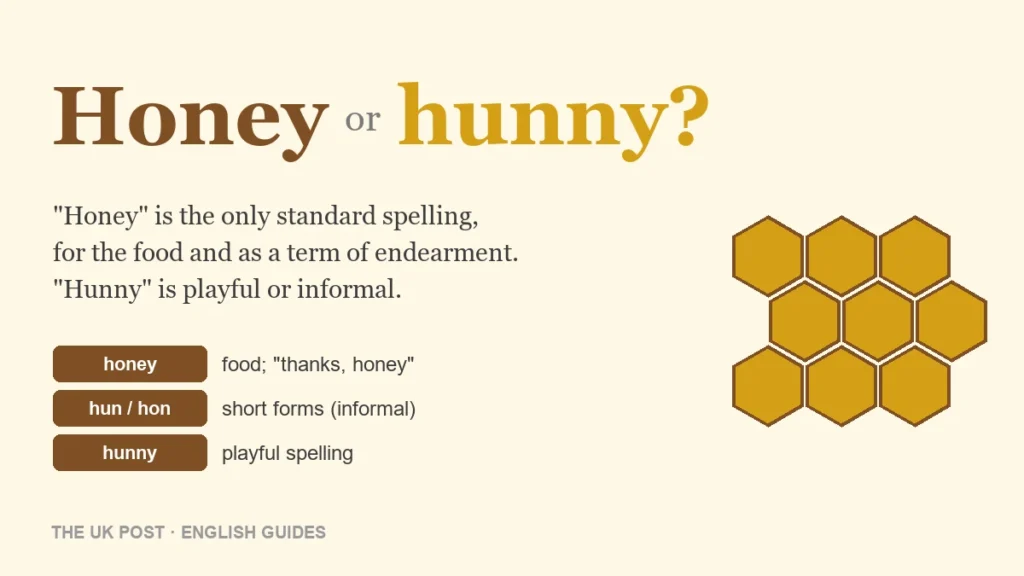
Short answer: “honey” is the only standard spelling, both for the sweet food made by bees and as a term of endearment (“Thanks, honey”). “Hunny” is not in standard dictionaries as a separate word. It is a playful, informal spelling used in texts and on social media (“love you hunny”), and it is best known from the “HUNNY” jars of Winnie the Pooh in Disney’s films and merchandise. Interestingly, A. A. Milne’s original 1926 book spells the word “honey” throughout. So if you are writing anything formal, a recipe or a food label, write honey. Keep “hunny” for jokey messages to people who know you.
Honey vs Hunny at a Glance
| honey | hunny | |
|---|---|---|
| Standard spelling? | Yes | No: informal, playful |
| The food | “a jar of honey” | Only as a joke or brand style |
| Term of endearment | “Thanks, honey.” | “Night night hunny x” (texts) |
| Short forms | hon, hun (both informal) | |
| Pronunciation | HUN-ee: both spellings sound the same | |
What Does “Hunny” Mean?
“Hunny” means the same as “honey” when it is used as an affectionate name for someone: a partner, a friend or a child. People spell it this way on purpose to look cute, casual or jokey, much as they write “luv” for “love” or “babe” and “hun” in texts. It is a spelling that tells the reader, “I’m not being serious.”
It is not a misspelling of the food in standard English. A café menu, a recipe or a product label with “hunny” will look either deliberately whimsical or wrong.
Winnie the Pooh and the “HUNNY” Jar
Most people know “hunny” from Winnie the Pooh, whose honey pots carry the label “HUNNY” in Disney’s cartoons, films and huge range of merchandise. The joke is that Pooh, a “Bear of Very Little Brain”, cannot spell.
The character is British through and through: A. A. Milne wrote the stories for his son, Christopher Robin, and set them in a version of Ashdown Forest in East Sussex. Winnie-the-Pooh was first published in London by Methuen on 14 October 1926. In Milne’s text the word appears as “honey” every time; we checked the full 1926 book. It is the “HUNNY” label, best known from Disney’s versions, that made the playful spelling famous. Winnie-the-Pooh entered the public domain in the United States in 2022 but remains in copyright in the UK.
Hunny in Print: What Our Data Shows
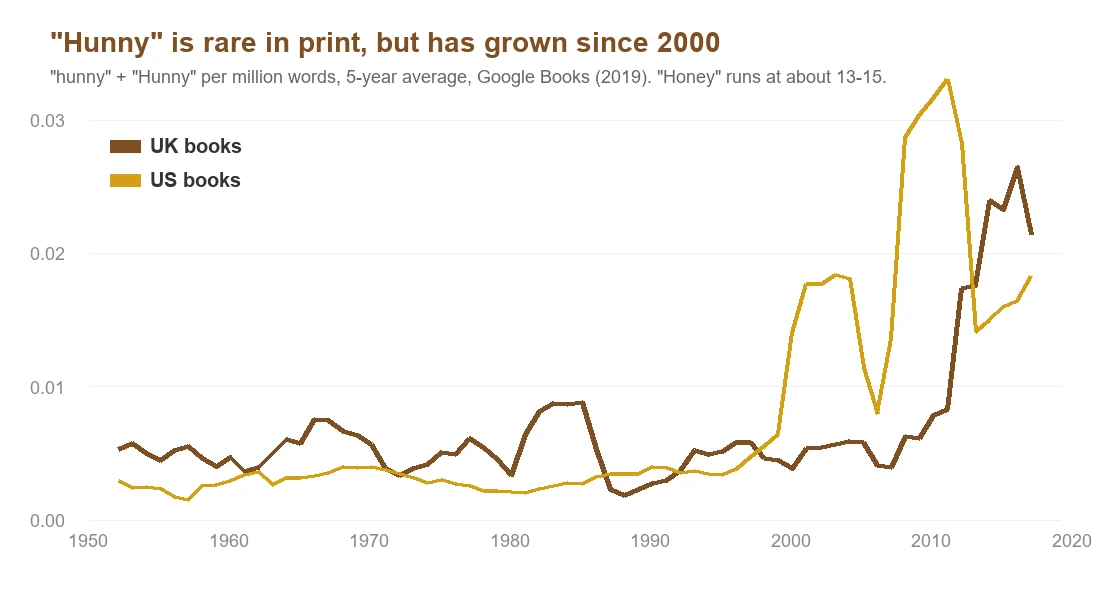
We checked Google Books’ British and American English collections, which run to 2019:
- “Hunny” is extremely rare in print. In British books of the 2010s, “honey” was used about 700 times as often.
- Even so, “hunny” roughly quadrupled in British books between the 2000s and the 2010s, as texting styles and informal dialogue made their way into fiction.
- Most printed uses are in dialogue, names, brand names and Pooh-related books, rather than as a standard word.
Honey, Hun, Hon and Other Terms of Endearment
“Honey” as an affectionate name has been used for centuries and is especially common in American English. In Britain you are more likely to hear a whole regional range of terms:
- Love: across much of England (“Alright, love?”).
- Duck: the East Midlands and Staffordshire (“Ey up, me duck”).
- Pet: the North East.
- Hen: Scotland.
- Hun or hon: short for honey, common in texts and on social media.
- Darling, babe and sweetheart: widespread.
Spelling tip: the short form is “hun” or “hon”, never “hunn”. And because “Hun” with a capital H also refers to the ancient Huns, keep it lower case in a message.
Test Yourself
Choose the right word for each sentence. Your score appears at the bottom.
1. Which spelling belongs on a jar label in a shop?
2. Your friend texts "night hunny x". Is that wrong?
3. How does A. A. Milne's 1926 text spell the word?
4. Which is a Scottish term of endearment?
5. What is the informal short form of honey?
My Advice
Write honey in anything that matters: recipes, menus, labels, cards to people you don’t know well, and any formal writing. “Hunny” is fine as a deliberate, playful choice with friends and family, and in a Pooh-themed birthday banner it is practically compulsory. For more spelling pairs, see our guide to commonly confused words, and our pages on flyers or fliers, yeah, yea or yay and that or which.
Frequently Asked Questions
What does hunny mean?
It is a playful spelling of “honey”, usually as an affectionate name for someone: “Love you, hunny.”
Is hunny a real word?
Not in standard dictionaries. It is an informal spelling of “honey”.
How do you spell hunny correctly?
The standard spelling is honey: H-O-N-E-Y.
Why does Winnie the Pooh spell it hunny?
The “HUNNY” label on Pooh’s honey pots, best known from Disney’s versions, is a joke about the bear’s poor spelling. Milne’s original 1926 text uses “honey”.
Is it hun or hon?
Both are informal short forms of “honey”. “Hun” is very common in British texts; “hon” is more common in American English.
Is calling someone honey rude?
It depends on context and tone. Between friends or partners it is affectionate, but from a stranger, particularly at work, it can sound patronising.
How do you pronounce honey?
HUN-ee. “Hunny” is pronounced exactly the same.
Can I use hunny on a menu or label?
Only if you want a deliberately playful style. For food labels and recipes, use “honey”.
Where is the Hundred Acre Wood?
It is based on Ashdown Forest in East Sussex, near where A. A. Milne lived.
What are British alternatives to honey as a pet name?
Love, duck (East Midlands), pet (North East), hen (Scotland), darling or babe.
Final Thoughts
Honey is the only standard spelling, whether you are spreading it on toast or saying goodnight to someone you love. Hunny is a playful twist, made famous by Pooh’s honey pots, that belongs in texts and party banners rather than on labels or in formal writing.
Sources: Our own analysis of Google Books Ngram data (British and American English 2019 collections; notes on file); A. A. Milne, Winnie-the-Pooh (Methuen, 1926), full text checked via Standard Ebooks; Wikipedia article on Winnie-the-Pooh (publication and copyright status).