Cue or Queue? (And Why Que Is Wrong)
Cue means a signal or a snooker stick, queue means a line of people, and que is not English. Plus queuing or queueing, with UK data.
 7 min read
Comments: 0Views: 2
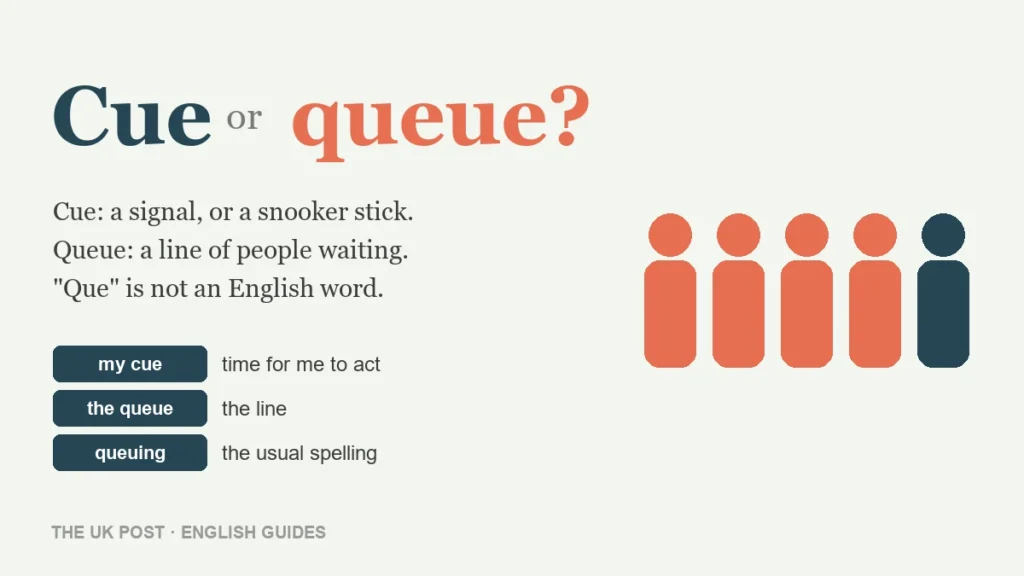
Short answer: a “cue” is a signal for someone to act (“that’s my cue to leave”) or the stick used in snooker and pool. A “queue” is a line of people or things waiting, and in British English it is also a verb: “We queued for an hour.” “Que” is not an English word; it is Spanish and French for “that” or “what”. So “that’s my cue” is right, and “that’s my queue” or “that’s my que” are mistakes. For the “-ing” form, both queuing and queueing are accepted. Our analysis shows “queueing” was actually the more common British spelling until about 1990, but “queuing” now leads by about five to one.
Cue vs Queue vs Que at a Glance
| Word | Meaning | Example |
|---|---|---|
| cue (noun) | A signal to act or speak; a hint | “The music was her cue to walk on stage.” |
| cue (noun) | The stick used in snooker, pool and billiards | “He chalked his cue.” |
| cue (verb) | To give a signal; to get a recording ready | “Cue the applause.” / “Cue up the next song.” |
| queue (noun) | A line of people or things waiting | “The queue for the toilets was huge.” |
| queue (verb) | To wait in a line | “We queued outside the bakery.” |
| que | Not English (Spanish and French) | – |
“That’s My Cue”: Signals and Snooker
In the theatre, a cue is the line or action that tells an actor it is their turn. From there it came to mean any signal or hint, so “that’s my cue to leave” means “that’s my signal to go”. You will also hear “on cue” (exactly when expected: “The bus arrived right on cue”), “take your cue from someone” (follow their example) and “cue the…” as a jokey way of saying something predictable happens next: “Cue groans from the audience.”
The origin of the theatre “cue” is uncertain. One popular theory is that it comes from the letter “Q”, once written in actors’ scripts as short for the Latin quando, “when”, but this has never been proven. The snooker cue is a different story: it is a variant spelling of “queue”, from the French word for “tail”, because the thin end of the stick looked like a tail.

Queue: the Very British Word
A queue is a line of people, vehicles or tasks waiting their turn. It comes from French queue, “tail”, from Latin cauda, and the “line of people” sense spread in English in the 19th century. It is one of the most British words there is. Americans usually “stand in line”, although “queue” is used in the US in computing (“the print queue”) and for streaming lists. In our data, “in the queue” appeared about twice as often in British books as in American books in the 2010s.
It also works as a verb in British English: you queue, queue up or join the queue, and the great British crime is to jump the queue.

Queuing or Queueing?
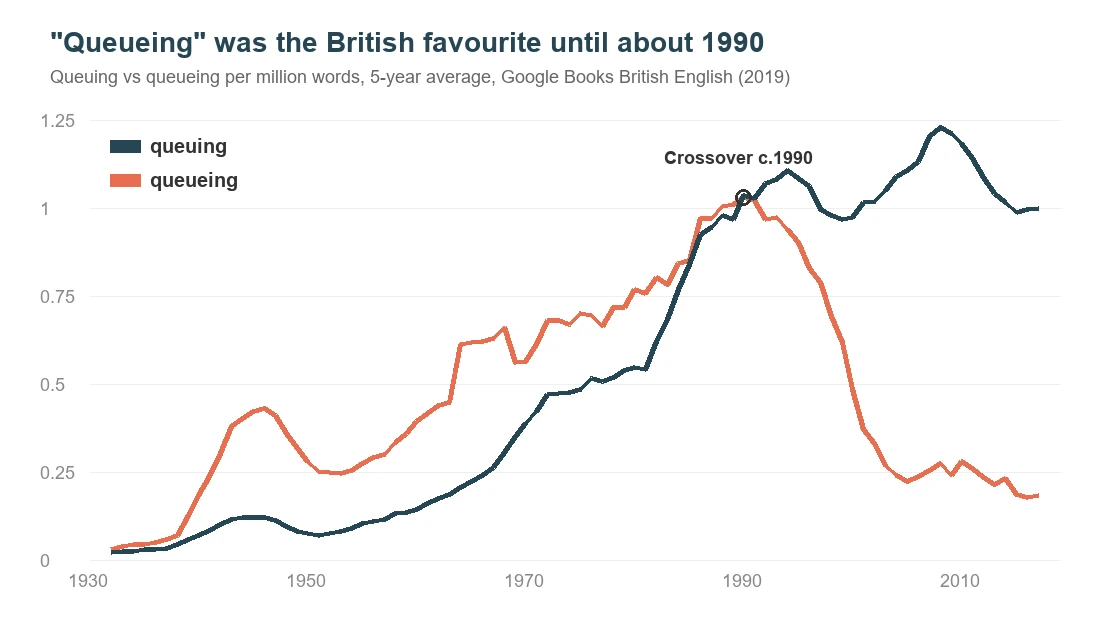
Both spellings are correct. “Queueing” keeps the final “e” of “queue” and has the unusual distinction of containing five vowels in a row (u-e-u-e-i). “Queuing” follows the usual rule of dropping a silent “e” before “-ing”, as in make, making. Our analysis of Google Books’ British English collection, which runs to 2019, shows how the preference flipped:
- In the 1960s, “queueing” was used more than twice as often as “queuing” in British books.
- The two met around 1990, and “queuing” has led ever since.
- By the 2010s, “queuing” was about five times as common as “queueing” in British books, and almost twice as common in American books.
- Computing is the exception: “queueing theory”, the mathematics of waiting lines, still often keeps the “e”.
For “cue”, the forms are cueing (more common) or cuing, and cued in the past tense.
- 19th centuryThe “line of people” sense of queue spreads in English.
- 1960s“Queueing” is used more than twice as often as “queuing” in British books.
- c. 1990“Queuing” overtakes “queueing” in British books.
- c. 1997The same switch happens in American books.
- 2010s“Queuing” leads about 5 to 1 in British books; “my cue” outnumbers “my queue” about 50 to 1.
Why People Write “Que”
“Que” turns up as a lazy shortening of “queue”, or because writers know it from Spanish and French: “¿Qué pasa?” or “Qu’est-ce que c’est?”. It is never correct in English for a line or a signal. In “my cue”, the word is only three letters: c-u-e.
Test Yourself
Choose the right word for each sentence. Your score appears at the bottom.
1. "The lights went down. That was our ___ to stop talking."
2. "There was a long ___ at the post office."
3. Which spelling is NOT correct?
4. What do you call the stick used in snooker?
5. "Someone tried to jump the ___."
My Advice
If it is a signal, it is a cue. If you are waiting in it, it is a queue. A handy trick: a queue is long, and so is the word, with five letters waiting in line behind the “q”. For the “-ing” form, “queuing” is now the safer choice, although “queueing” is not wrong. For more pairs that trip people up, see our guide to commonly confused words, and our pages on envision or invision, smelled or smelt and especially or specially.
Frequently Asked Questions
Is it “that’s my cue” or “that’s my queue”?
“That’s my cue.” A cue is a signal to act; a queue is a line of people.
What does “that’s my cue” mean?
It means “that’s my signal” to do something, often to leave: “The baby’s crying, that’s my cue to go.”
Is “que” a word in English?
No. “Que” is Spanish and French. In English, use “cue” or “queue”.
Is it queuing or queueing?
Both are correct. “Queuing” is more common today; “queueing” was the usual British spelling until around 1990.
What is the past tense of queue?
Queued: “We queued for tickets.”
Is it cueing or cuing?
Both are accepted; “cueing” is more common in British books.
What do Americans say instead of queue?
Usually “line”, as in “stand in line”, though “queue” is common in computing and streaming.
Why is a snooker stick called a cue?
It is a variant of “queue”, from the French for “tail”, because the thin end looked like a tail.
What does “on cue” mean?
At exactly the right or expected moment: “Right on cue, it started to rain.”
What does “jump the queue” mean?
To push in ahead of people who were waiting before you; figuratively, to get something before others who have a better claim.
Final Thoughts
Cue is a signal or a snooker stick, queue is a line of people, and “que” belongs in Spanish or French. Remember that you take your cue and join the queue, and that “queuing” is now the more common spelling.
Sources: Our own analysis of Google Books Ngram data (British and American English 2019 collections; notes on file); Wiktionary entries for cue and queue; standard British usage guidance.