Envision or Invision? The Correct Spelling (and Envisage)
Envision is the correct spelling and invision is a misspelling. How envision and envisage compare in British English, plus the InVision app.
 6 min read
Comments: 0Views: 2
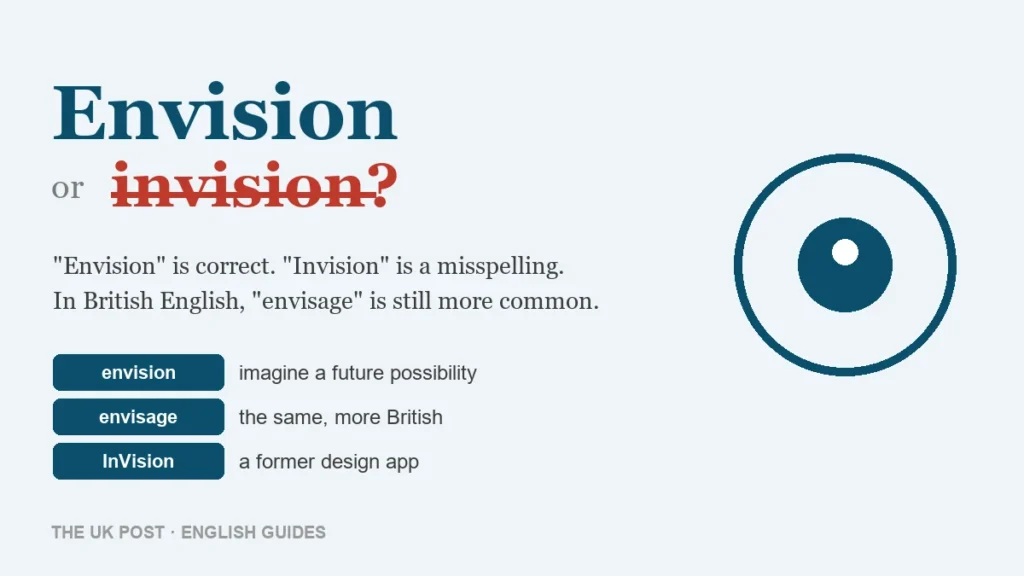
Short answer: the correct spelling is “envision”, with an “e”. “Invision” is a misspelling and is not an English word. “Envision” means to imagine something as a future possibility: “I envision a bigger office within two years.” The confusion comes partly from the “in” sound and partly from InVision, a well-known design software company that closed its platform at the end of 2024. In British English there is also a third option: envisage, which means much the same thing. It is still used more often than “envision” in British books, while Americans switched to “envision” in the 1960s.
Envision, Invision and Envisage at a Glance
| Word | Correct? | Meaning | Example |
|---|---|---|---|
| envision | Yes | To imagine a future possibility | “She envisions a career in medicine.” |
| envisage | Yes (more common in the UK) | To imagine, foresee or plan for | “The plan envisages 200 new homes.” |
| invision | No | A misspelling of envision | – |
| InVision | Brand name | A design and prototyping platform, closed at the end of 2024 | “We built the prototype in InVision.” |
Why Is It Envision, Not Invision?
“Envision” is made from the prefix en-, meaning “to put into” or “to cause to be”, plus vision. The same prefix appears in enable, enlarge, encourage and endanger. Because the word is about seeing something in your mind, it is easy to assume it starts with “in”, and in quick speech “en-” and “in-” can sound identical.
English has a few genuine en-/in- pairs that make this more confusing, such as enquire and inquire, both accepted in British English, or ensure and insure, which have different meanings. But “envision” has no accepted “in-” form.
A memory trick: you envision the end result.
Envision vs Envisage: the British Twist
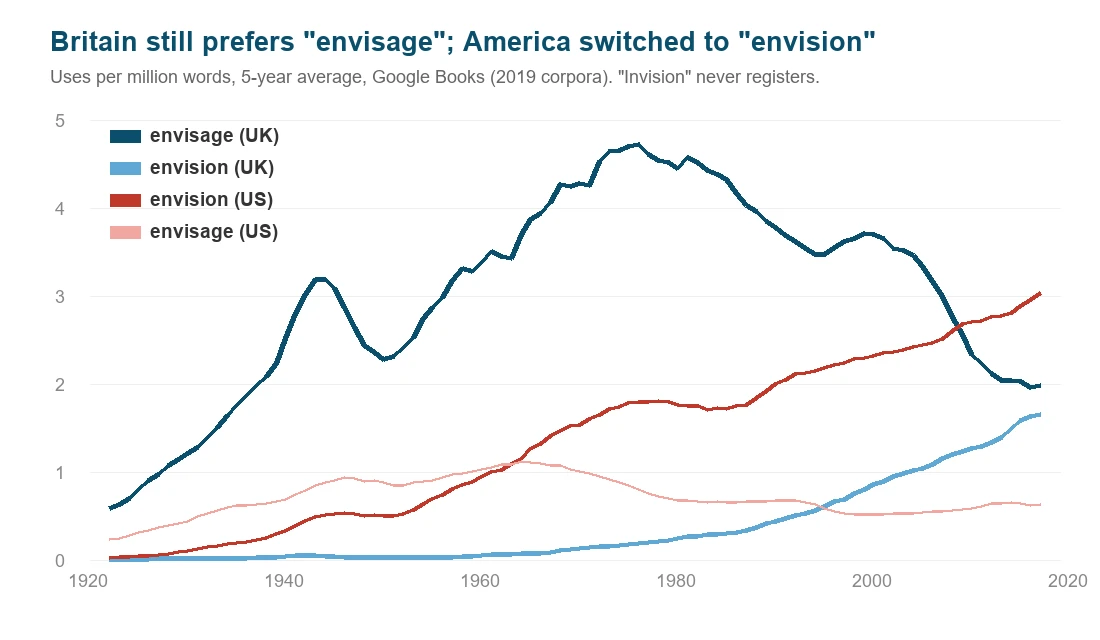
“Envisage” comes from French envisager, built on visage, “face”: literally to look something in the face. “Envision” is the younger word. Our analysis of Google Books’ British and American English collections, which run to 2019, shows a striking split:
- American books switched from “envisage” to “envision” around 1963. By the 2010s, Americans wrote “envision” about 4.6 times as often as “envisage”.
- British books still favour “envisage”. In the 2010s it was used about 1.4 times as often as “envision”, and “envisaged” was about twice as common as “envisioned”.
- The gap is closing fast. In the 1970s British writers used “envisage” about 26 times as often as “envision”.
- “Invision” barely registers in either collection: about one use per billion words.
In practice, both “envisage” and “envision” are correct in the UK. “Envisage” suits formal or official writing, especially for plans and proposals (“the scheme envisages a new bypass”), while “envision” often feels a little more imaginative or aspirational (“I envision a world without hunger”).
- 1920s“Envisage” spreads in British books; “envision” is still rare.
- c. 1963“Envision” overtakes “envisage” in American books.
- 1970sBritish books use “envisage” about 26 times as often as “envision”.
- 2010sUK: envisage still leads about 1.4 to 1. US: envision leads 4.6 to 1.
- Jan 2024InVision announces it will close its design platform.
- 31 Dec 2024InVision accounts close.
What Was InVision?
InVision was a popular platform for designing and prototyping websites and apps, used by many product teams in the 2010s. Its capital “V” spelling, a play on “in” and “vision”, helped spread the misspelling “invision”. In January 2024 the company announced that it would discontinue its design collaboration services, and accounts closed on 31 December 2024, with its Freehand whiteboard tool sold to Miro. Reports linked the decision to competition from rivals such as Figma.
So if you are searching for “invision” today, you are either misspelling “envision” or looking for a service that no longer exists.
How to Use Envision
- Envision + noun: “We envision a greener city centre.”
- Envision + -ing: “I can’t envision living anywhere else.”
- Envision + that clause: “They envision that the work will take a year.”
- Past form: envisioned. Noun: envisioning (rare), though “vision” usually does the job.
Plain alternatives work well too: imagine, picture, foresee, expect or plan.
Test Yourself
Choose the right word for each sentence. Your score appears at the bottom.
1. Which spelling is correct?
2. Which word is still slightly more common in British books?
3. "The council's plan ___ 500 new homes." Which is most natural in formal British English?
4. What is the past tense of envision?
5. Which prefix does envision share with enlarge and enable?
My Advice
Always write “envision” with an “e”. In British formal writing, especially reports, planning documents and anything official, “envisage” is still the more natural choice, and if in doubt, “imagine” or “expect” is often simplest of all. For more spelling traps, see our guide to commonly confused words, and our pages on smelled or smelt, verbiage or verbage and cue or queue.
Frequently Asked Questions
Is it envision or invision?
Envision. “Invision” is a misspelling.
Is invision a word?
No. It is not in standard dictionaries. InVision, with a capital V, was the name of a design software company.
What does envision mean?
To imagine something as a future possibility: “I envision opening my own café.”
What is the difference between envision and envisage?
They mean almost the same thing. Envisage is more common in British English and suits formal plans; envision is standard in American English.
Is envision British or American?
It is used in both, but it is far more common in American English. British writers still use envisage slightly more.
What is the past tense of envision?
Envisioned: “The architect envisioned a glass roof.”
What happened to InVision?
The company closed its design collaboration platform on 31 December 2024, after announcing the decision in January 2024.
How do you pronounce envision?
en-VIZH-un, with the stress on the second syllable.
What is another word for envision?
Imagine, picture, foresee, envisage or visualise.
Why do people spell it invision?
Because “en-” and “in-” sound alike in speech, the word is about seeing “in” your mind, and the InVision brand made the spelling familiar.
Final Thoughts
“Envision” is the only correct spelling; “invision” is a slip helped along by a famous app. In Britain, “envisage” remains a perfectly good, and still slightly more common, alternative. Remember: you envision the end result.
Sources: Our own analysis of Google Books Ngram data (British and American English 2019 collections; notes on file); InVision’s January 2024 shutdown announcement and support notices, as reported (Silicon Republic, LogRocket, Fast Company); Miro on Freehand.