Pricey or Pricy? Which Spelling Is Correct?
Both pricey and pricy are correct, but pricey is the usual spelling. How to use pricier and priciest, plus British alternatives like dear.
 6 min read
Comments: 0Views: 3
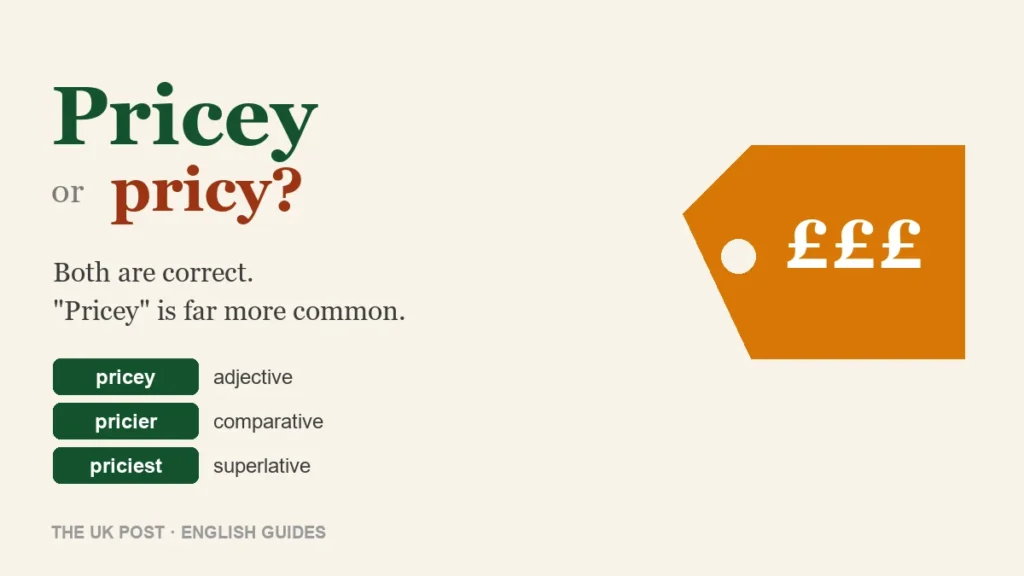
Short answer: both “pricey” and “pricy” are correct, but “pricey” is by far the more common spelling in British and American English, and it is the one to use. It is an informal word meaning expensive: “That restaurant is a bit pricey.” The comparative and superlative are the same for both spellings: pricier and priciest (not “priceyer”). In British books in the 2010s, “pricey” appeared about 24 times as often as “pricy”. If you want an alternative, British English has the handy word “dear”, as in “petrol’s dear at the moment”.
Pricey vs Pricy at a Glance
| pricey | pricy | |
|---|---|---|
| Correct? | Yes, the main spelling | Yes, a less common variant |
| Meaning | Expensive (informal) | |
| Comparative | pricier (or more pricey) | |
| Superlative | priciest (or most pricey) | |
| Pronunciation | PRY-see, /ˈpraɪsi/ | |
| Ratio in UK books, 2010s | 24 | 1 |
Why Is “Pricey” Spelled With an E?
“Pricey” is simply price plus the suffix -y, the same ending that turns rain into rainy. Normally, a silent “e” is dropped before “-y” (ice becomes icy, bone becomes bony), which is why “pricy” exists. But a few informal words keep the “e”, often so the base word stays recognisable, and “pricey” is one of them, along with matey and phoney. Over time, the “e” spelling won.
When you add “-er” or “-est”, the “ey” changes to “i”, exactly as it does in dicey, dicier, diciest:
- This hotel is pricey.
- That one is even pricier.
- It is the priciest hotel in town.
“Priceyer” and “priceyest” are mistakes. “More pricey” and “most pricey” are fine, though they sound a little less natural.
Pricey vs Pricy: What Our Data Shows
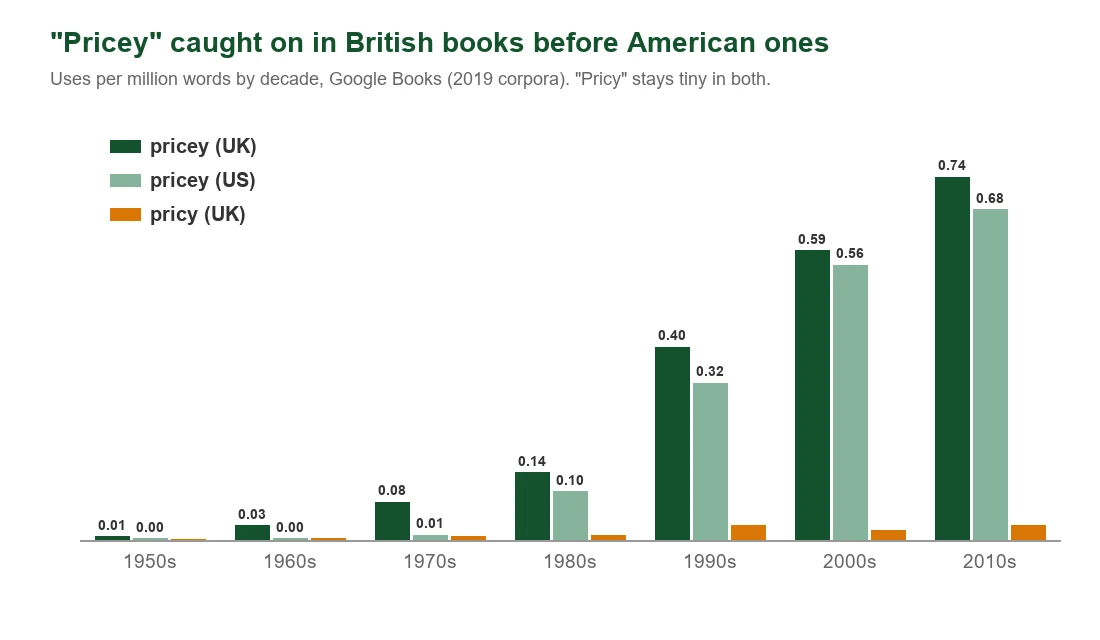
We checked Google Books’ British and American English collections, which run to 2019:
- “Pricey” has been the more common spelling in every decade on record, in both British and American books.
- By the 2010s, “pricey” was about 24 times as common as “pricy” in British books, and about 18 times as common in American books.
- The word caught on in Britain first. In the 1970s, “pricey” was used about eight times as often in British books as in American ones; American writers caught up in the 1980s and 1990s.
- British writers also use “pricier” more: about 0.17 uses per million words in the 2010s, compared with 0.10 in American books.
- Before 1950s“Pricey” is very rare in print.
- 1960sUse starts to climb in British books.
- 1970sBritish books use “pricey” about eight times as often as American books.
- 1980sAmerican writers take it up quickly.
- 1990sUse roughly triples in both countries.
- 2010s“Pricey” is 24 times as common as “pricy” in British books.
Is “Pricey” Informal?
Yes. Dictionaries label “pricey” informal. It is perfect in conversation, emails, reviews and most journalism (“pricey energy bills”), but in a formal report or academic essay, “expensive” or “costly” is usually better.
Other Words for Pricey
British English has a rich set of ways to say something costs too much:
- Dear: the classic British word: “Strawberries are dear in winter.”
- Steep: “£12 for a sandwich is a bit steep.”
- Expensive and costly: neutral and safe in formal writing.
- Exorbitant or extortionate: much too expensive.
- Daylight robbery or a rip-off: informal and indignant.
- Costs an arm and a leg: an informal idiom.
- Upmarket: expensive in a stylish way: “an upmarket deli”.
- Spendy: mainly American; American books use it about three times as often as British ones.
And for the opposite: cheap, inexpensive, affordable, good value, a bargain and the very British cheap as chips.
Test Yourself
Choose the right word for each sentence. Your score appears at the bottom.
1. Which spelling is more common?
2. "This café is ___ than the one next door."
3. Which word is best in a formal report?
4. In British English, "petrol is ___" can mean petrol is expensive.
5. Which word follows the same pattern as pricey/pricier?
My Advice
Write “pricey”, and you will never be wrong. Remember the pattern of dicey, dicier and diciest for the comparative forms, and swap in “expensive” when the tone needs to be formal. If you are writing for a British audience, “dear” is a lovely, natural alternative. For more spelling pairs, see our guide to commonly confused words, plus yeah, yea or yay, woken or woeken and smelled or smelt.
Frequently Asked Questions
Is it pricey or pricy?
Both are correct, but “pricey” is much more common and is the safer choice.
What does pricey mean?
Expensive. It is an informal word: “The tickets were a bit pricey.”
Is pricy a real word?
Yes. Dictionaries list it as a less common alternative spelling of “pricey”.
What is the comparative of pricey?
Pricier, or “more pricey”. The superlative is priciest, or “most pricey”.
Is “priceyer” correct?
No. The correct form is “pricier”.
How do you pronounce pricey?
PRY-see: /ˈpraɪsi/.
Is pricey British or American?
Both. Our data shows it became common in British books first, in the 1960s and 1970s.
What is another word for pricey?
Expensive, costly, dear, steep or upmarket. For “much too expensive”, try exorbitant or extortionate.
Is pricey a formal word?
No, it is informal. Use “expensive” or “costly” in formal writing.
What does “dear” mean when talking about prices?
Expensive. “Petrol is dear” is a common British way of saying petrol is expensive.
Final Thoughts
“Pricey” and “pricy” are both accepted, but “pricey” is the clear winner in British and American writing. Keep the “e” in pricey, drop it in pricier and priciest, and choose “expensive” when you need to sound formal.
Sources: Our own analysis of Google Books Ngram data (British and American English 2019 collections; notes on file); Wiktionary entries for pricey and pricy.