Hosting for Banks: Cloud, Colocation and the UK Rules Explained
Where banks run their systems and why: on-premises, colocation, private and public cloud, plus the UK rules on outsourcing, resilience and the 2026 Critical Third Parties regime.
 8 min read
Comments: 0Views: 2
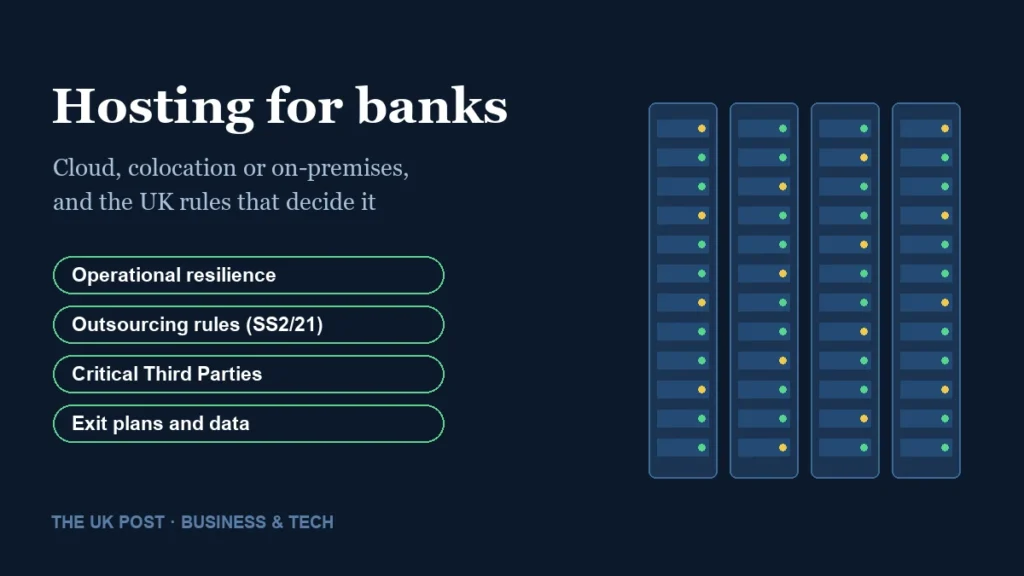
Short answer: banks host their systems in a mix of their own data centres, specialist colocation facilities, private clouds and the big public clouds (AWS, Microsoft Azure, Google Cloud and Oracle), and most now run a hybrid of all four. In the UK the choice is shaped less by technology than by regulation: the PRA’s outsourcing and third-party risk rules (SS2/21), the operational resilience rules that required banks to stay within “impact tolerances” for important services by 31 March 2025, data protection law, and the new Critical Third Parties regime, under which HM Treasury designated Microsoft, Google Cloud, Amazon Web Services and Oracle for direct oversight from 13 July 2026. A bank can outsource the hosting, but never the accountability.
What “Hosting for Banks” Means
Hosting is where a bank’s applications and data physically run: core banking ledgers, payments, mobile apps, fraud and anti-money laundering systems, data analytics and internal tools. Unlike most businesses, banks must be able to show regulators exactly where critical systems run, who can access them, how quickly they can recover from an outage, and how they would leave a provider if they had to.
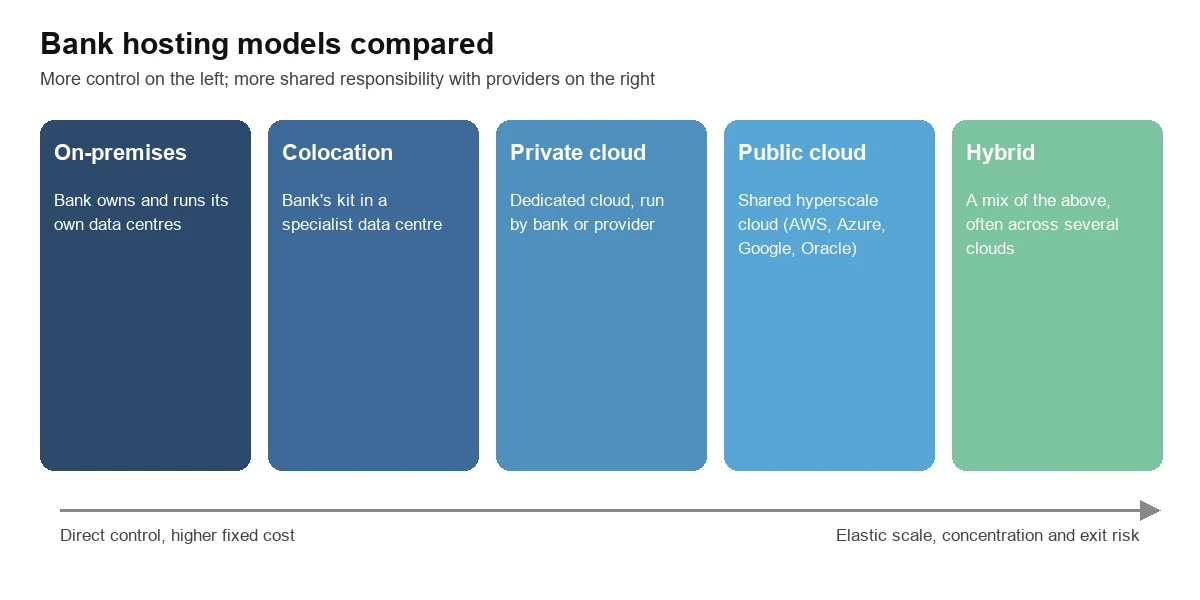
| Model | What it is | Strengths | Trade-offs |
|---|---|---|---|
| On-premises | The bank owns and runs its own data centres | Maximum control; long-established for core systems | High fixed cost; slower to scale and modernise |
| Colocation | The bank’s own servers in a specialist data centre | Strong physical security, power and connectivity without owning buildings | Bank still manages hardware and software |
| Private cloud | Cloud technology dedicated to the bank | Cloud-style automation with more isolation | Less elastic and often costlier than public cloud |
| Public cloud | Shared hyperscale platforms | Elastic scale, rapid innovation, global resilience zones | Concentration risk, exit planning, shared responsibility |
| Hybrid and multi-cloud | A combination, often across several providers | Flexibility; keeps sensitive or legacy systems close | Complexity; needs strong integration and skills |
Digital-only banks have often been built on public cloud from day one, while long-established banks typically run core ledgers on-premises or in colocation and move customer-facing apps, analytics and new services to the cloud.
The UK Rules That Shape Bank Hosting
Outsourcing and third-party risk (PRA SS2/21)
The Prudential Regulation Authority’s supervisory statement on outsourcing and third-party risk management sets expectations for banks and insurers using external providers, including the cloud. In practice, banks must assess how “material” an arrangement is, carry out due diligence, agree contracts that give the bank and regulators access, audit and information rights, manage sub-outsourcing, plan for business continuity and, importantly, have tested exit plans in case a provider fails or the relationship ends.
Operational resilience
Under the PRA and FCA operational resilience rules, banks must identify their “important business services”, such as making payments, set impact tolerances (the maximum disruption they can tolerate) and show they can stay within them in severe but plausible scenarios. The deadline to be able to do so was 31 March 2025; since then resilience has been an ongoing obligation. Hosting decisions, from data centre locations to cloud regions and failover design, sit at the heart of this.
The Critical Third Parties regime
Because so many firms rely on the same few providers, the Financial Services and Markets Act 2023 gave the Bank of England, PRA and FCA powers to oversee “critical third parties” directly. HM Treasury made the first designations in July 2026, with oversight starting on 13 July 2026, covering Microsoft, Google Cloud, Amazon Web Services and Oracle. Oversight applies to the services they provide to the financial sector, and regulators have been clear that it does not replace banks’ own outsourcing and resilience responsibilities.
Data protection and international rules
UK GDPR applies to customer data, including international transfers if data is stored or accessed outside the UK. Banks with EU operations must also meet the EU’s Digital Operational Resilience Act (DORA). Payment card data falls under the PCI DSS industry standard.

What Banks Look for in a Hosting Provider
How a UK bank chooses and governs hosting
- Resilience: multiple data centres or availability zones, tested failover, and recovery times that fit the bank’s impact tolerances.
- Security: strong encryption with bank-controlled keys, identity and access controls, 24/7 monitoring, and independent certifications such as ISO/IEC 27001 and SOC 2 reports.
- Location and data residency: clarity about where data is stored and processed, including UK regions where needed.
- Regulatory contract terms: audit and access rights for the bank and its regulators, incident reporting, sub-outsourcing controls and termination assistance.
- Exit and portability: realistic, tested plans to move workloads elsewhere, avoiding lock-in where possible.
- Connectivity: low-latency, private links to payment systems, exchanges and other banks.
- Sustainability: energy efficiency and renewable power, increasingly part of banks’ own climate commitments.
Risks Banks Must Manage
- Concentration risk: if one cloud region or provider fails, many firms can be hit at once. Major cloud outages, including a large one in October 2025, have shown how widely disruption can spread.
- Shared responsibility gaps: the provider secures the platform; the bank must configure and secure what it runs on it. Misconfiguration is a common cause of incidents.
- Legacy complexity: decades-old core systems can be hard to move, and running old and new side by side adds risk.
- Skills and cost control: cloud bills can grow quickly without good governance.
Hosting matters for every system a bank runs, including the monitoring tools described in our guide to AML AI software and the networks behind every cash machine withdrawal.

Why It Matters to Customers
When a bank’s app or card payments stop working, it is often a hosting or IT change problem. Under the operational resilience rules, banks must plan to keep important services running, and the FCA and PRA expect them to communicate clearly during outages. If an outage costs you money, complain to your bank first, and if you are not happy with the response, you can go to the Financial Ombudsman Service.
My advice for anyone working on a bank hosting decision: start from the important business services and their impact tolerances, not from a preferred technology. The right answer is the one you can prove to the regulator, test under stress and exit if you have to.
For a wider view of how UK organisations use digital records to show compliance, see our guide to digital facilities management.
Frequently Asked Questions
Where do banks host their systems?
In a mix of their own data centres, colocation facilities, private clouds and public clouds. Most large banks now use a hybrid approach.
Can UK banks use public cloud?
Yes. Regulators allow it, provided banks meet outsourcing, operational resilience, data protection and security requirements and keep accountability.
What is PRA SS2/21?
The PRA’s supervisory statement on outsourcing and third-party risk management, setting expectations for due diligence, contracts, access and audit rights, business continuity and exit plans.
What are critical third parties?
Providers that HM Treasury designates because their failure could threaten financial stability. The first, designated from 13 July 2026, are Microsoft, Google Cloud, Amazon Web Services and Oracle.
What is an impact tolerance?
The maximum level of disruption a firm can tolerate to an important business service, such as how long payments can be unavailable.
Do banks have to keep data in the UK?
Not always, but they must comply with UK GDPR on international transfers and know exactly where data is held. Many choose UK regions for sensitive data.
What is colocation?
Renting space, power, cooling and connectivity in a specialist data centre to house your own servers.
What is an exit plan in bank outsourcing?
A documented, tested plan to move a service away from a provider, or bring it back in-house, without unacceptable disruption.
Does DORA apply to UK banks?
DORA is EU law. It applies to UK banking groups’ EU-regulated entities, not to purely UK operations.
What happens if my bank’s systems go down?
Contact your bank and keep records of any losses. If you are not satisfied with its response, you can take your complaint to the Financial Ombudsman Service.
Final Thoughts
Bank hosting has moved from owned data centres towards hybrid cloud, and UK regulation has followed, from SS2/21 and operational resilience to direct oversight of the biggest cloud providers in 2026. The technology choice matters, but the real test is whether a bank can keep vital services running, prove it to regulators, and walk away from a provider if it must.
Sources: PRA supervisory statements SS2/21 (outsourcing and third-party risk management) and SS1/21 (operational resilience); FCA operational resilience pages and insights; HM Treasury and FCA announcements on Critical Third Party designations (July 2026); law-firm commentary on the CTP regime; Financial Services and Markets Act 2023; ICO guidance on international transfers; Financial Ombudsman Service.