
Short answer: neither is better for everyone. An iPhone suits you if you already use Apple gadgets, want a simple phone that works the same way every year and care about resale value. An Android phone suits you if you want more choice on price, more ways to customise your phone, or one of the longest written update promises on the market (seven years from Google and Samsung).
Android phone versus iPhone is not a fair fight between two single products. Android is Google’s operating system, and it runs on phones from many makers, including Samsung, Google Pixel, Motorola, OnePlus and Xiaomi. iPhone is Apple’s own phone, and it only runs Apple’s iOS. So the real differences are price, customisation, software updates, security, cameras, battery life and the other gadgets you own.
This guide is written for UK buyers. Prices are in pounds, include VAT and come from official UK store pages where we could check them. We compare the two platforms first, then use named phones as examples. Last verified: 7 November 2026. Prices and update policies change often, so check the maker’s page before you buy.
Quick answer: which should you pick?
Pick an iPhone if you’d like…
- to link up with an Apple Watch, AirPods, Mac or iPad
- a simple phone with one maker looking after hardware and software
- better resale value in most UK estimates
Pick an Android phone if you’d like…
- more choice of price, size and design
- more control over how the phone looks and works
- a seven-year update promise on a Pixel or Galaxy S phone
Always check: the exact model, the storage size, the date security updates end and the full price with VAT.
In this guide
- Quick comparison at a glance
- What is the difference between Android and iPhone?
- Which is better for different users?
- Memory, RAM and storage
- Software updates and long-term support
- Security and privacy
- Ecosystem, messaging and connectivity
- Camera quality
- Battery life and charging
- Performance, display and AI
- Customisation and ease of use
- Price, value and resale
- Repairs and durability
- Android vs iPhone in the UK and worldwide
- Which should you choose?
- FAQs
- How we compared them
Android vs iPhone: Quick Comparison at a Glance
This table shows platform-level differences. Individual phones vary, especially on Android, so treat it as a starting point.
| Feature | Android | iPhone |
|---|---|---|
| Operating system | Android (Google) | iOS (Apple) |
| Who makes the phones | Many brands, including Samsung, Google, Motorola, OnePlus and Xiaomi | Apple only |
| Price range | Budget to premium | Mostly premium. The iPhone 17 is £899 (256GB) on Apple’s UK store |
| Customisation | More flexible, but it varies by maker | More controlled, with some personalisation |
| Where you get apps | Google Play, plus other stores and sideloading | App Store. The EU allows rival stores; the UK is still reviewing app-store rules |
| Storage | Depends on the model. Some budget and mid-range phones take a microSD card | Fixed when you buy. No card slot |
| RAM | Published by the maker. Pixel 10, Pixel 11 and Galaxy S26 all have 12GB | Not published by Apple. Third-party listings say 8GB for the iPhone 17 |
| Software updates | Up to 7 years on Pixel and Galaxy S phones. Less on many cheaper phones | No fixed promise. iOS 27 runs on phones back to the 2019 iPhone 11 |
| Messaging | Google Messages, RCS, WhatsApp | iMessage, RCS, WhatsApp |
| Smartwatches | Wear OS and Galaxy Watch, depending on the phone | Apple Watch works with iPhone only |
| Share of UK mobile web traffic (Aug 2026) | 48.55% | 51.43% |
What Is the Difference Between Android and iPhone?
What Is Android?
Android is a mobile operating system led by Google. Its core is open source, which is why so many companies can use it. Each maker adds its own look and extra features, such as Samsung’s One UI or the cleaner Pixel software. That is why an Android phone from one brand can feel quite different from another, and why update support differs too.
What Is an iPhone?
An iPhone is a phone designed by Apple that runs iOS, Apple’s own software. Apple controls the chip, the hardware and the software together. The upside is a consistent experience across models. The downside is less choice, and fewer ways to change how things work.
Android vs iOS: The Main Difference
The main difference is control. Apple controls everything on an iPhone. Google shares Android with many makers, who decide the hardware, the price and how long updates last. So comparing “Android” with one iPhone model is misleading. A fair test compares phones at a similar price, such as the examples below.
| Phone | UK price (checked Nov 2026) | RAM | Storage | microSD | Update promise |
|---|---|---|---|---|---|
| iPhone 17 | £899 (256GB), £1,099 (512GB) | Not published (8GB in third-party listings) | 256GB, 512GB | No | No fixed promise |
| Google Pixel 11 | £879 list price (256GB). Google’s UK store showed an offer from £649 | 12GB | 256GB, 512GB | No | 7 years OS and security |
| Google Pixel 10 | £699 (128GB), £799 (256GB) | 12GB | 128GB, 256GB | No | 7 years OS and security |
| Samsung Galaxy S26 | £879 at launch (256GB), £1,049 (512GB). Samsung has raised prices since, so check | 12GB | 256GB, 512GB | No | 7 years OS and security |
One more thing to know: Apple announced the iPhone 18 Pro and Pro Max on 9 September 2026, with UK prices starting at £1,199. Reports say the standard iPhone 18 will not arrive until spring 2027, so the iPhone 17 is still Apple’s main mid-range flagship for now.
Android vs iPhone: Which Is Better for Different Types of Users?
| If you are… | Worth considering | Why |
|---|---|---|
| A first-time smartphone user | Either | Pick the one your family or friends can help you with |
| An older user | Either | Both have large text, magnifiers and emergency features. iPhone adds Assistive Access |
| A parent buying for a child | Either | Apple has Screen Time. Google has Family Link |
| A student on a budget | Often Android | More low-cost choices and more price points |
| A gamer | Depends on the model | Look at chip, cooling, refresh rate and game availability |
| A business user | Either | Both work with Microsoft 365 and Google Workspace |
Android vs iPhone for Beginners
Both are easy to learn. An iPhone is the same everywhere, so a friend can help you with any model. On Android, menus can differ slightly between Samsung, Pixel and other brands, but Pixel and Galaxy phones are also simple to set up. The best tip for a beginner is to choose the phone the people around you already use.
Android vs iPhone for Seniors
Both platforms offer bigger text, display zoom, a magnifier, voice control and emergency SOS tools. iPhone also has Assistive Access, which strips the phone down to a few large buttons. Some Android makers include an easy mode with larger icons. Family support matters most here: if your relatives use iPhones, an iPhone makes remote help easier, and the same goes for Android.
Android vs iPhone for Kids and Teenagers
Apple’s Screen Time and Family Sharing let parents set limits and approve apps. Google’s Family Link lets you create a supervised account for a child under 13 (the age is 13 in the UK), set daily limits and a bedtime, and manage apps. Family Link works best when the child’s own phone is an Android phone. Neither tool makes a phone fully safe, so also check the settings inside games such as Roblox and social apps like Snapchat, which has millions of users.
Android vs iPhone for Students
Note-taking, Microsoft Office and Google Workspace apps all work on both. The difference is mostly money. Android has more low-cost phones, while a used iPhone often sells for more when you finish your course. File sharing is easier than it used to be, because Quick Share now works with AirDrop on many Android phones (see the ecosystem section).
Android vs iPhone for Gaming
Top phones from both sides run big games well. Android has more choice, including gaming-focused phones with extra cooling and fast screens. iPhones give a steady experience because games are tested on a small number of devices. Before you buy, check that your favourite game is on the platform you choose, because availability can change by country, and big names such as Fortnite, which has a huge player count have moved on and off platforms over the years.
Android vs iPhone for Business Users
Email, Microsoft 365, Google Workspace and file apps work well on both. For company phones, both platforms support device management tools. On the Android side, Google’s Android Enterprise Recommended programme asks makers to publish security-update details. If your team uses Apple laptops, iPhones link in neatly. If your team uses Windows and Google tools, either works.
Android vs iPhone: Memory, RAM and Storage
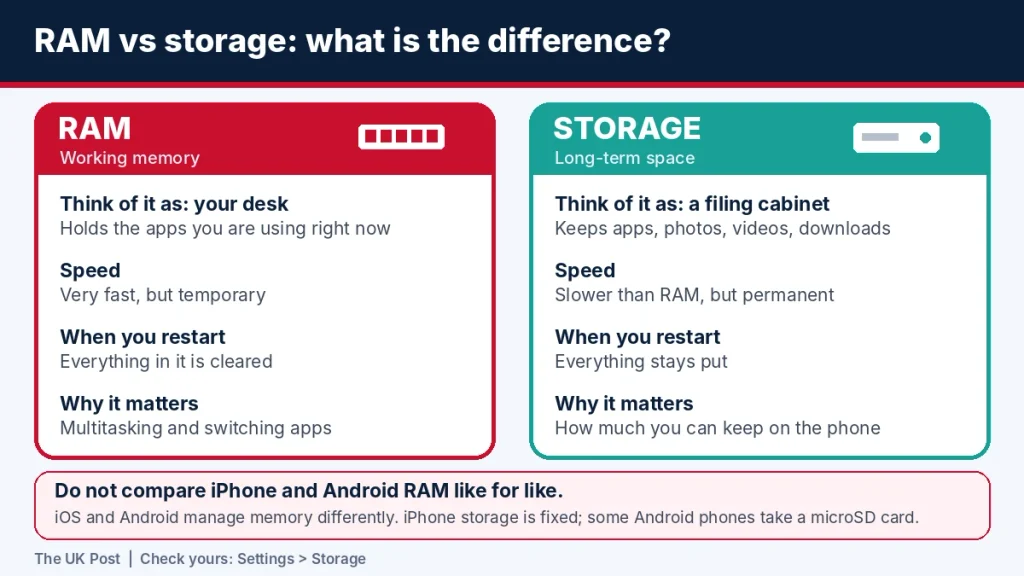
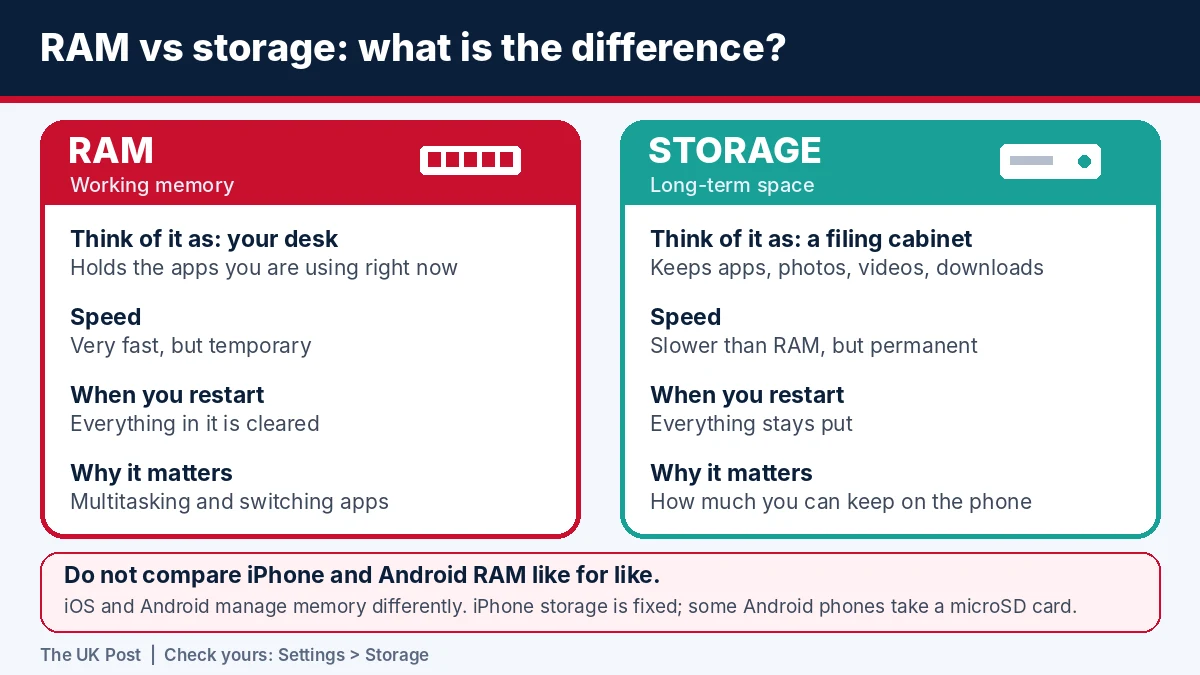
Many guides mix these two up, so here is the simple version. RAM is the phone’s short-term working space. Storage is where your files live.
How Much RAM Does an iPhone Have Compared With Android?
Apple does not publish the iPhone 17’s RAM on its UK store page. Third-party listings say 8GB. Google lists 12GB for the Pixel 10 and Pixel 11, and Samsung’s Galaxy S26 has 12GB. Do not read that as “Android is faster”. iOS and Android manage memory in different ways, so the same RAM number does not give the same result. Look at real-world reviews for the model you want instead.
Does Android Have More Storage Than iPhone?
Storage depends on the model, not the platform. Today’s example phones start at 128GB or 256GB. The real difference is what extra storage costs, as this chart shows.
Cost of the next storage step (UK launch or list prices)
Can You Expand Storage on Android and iPhone?
iPhones cannot take a memory card. Most flagship Android phones have dropped the microSD slot too: the Pixel 10 does not have one, and neither does the Galaxy S26. A microSD slot is now mostly a budget and mid-range feature, so check the spec sheet of the exact model. On either platform you can add space with cloud storage, or with a USB-C drive on newer iPhones.
Android vs iPhone: Software Updates and Long-Term Support
How Often Do Android Phones Receive Updates?
It depends on the maker and the price. Google promises seven years of OS and security updates for the Pixel 8 and later, counted from when the phone first went on sale in the US. Samsung gives the same seven years on its Galaxy S26 line. Cheaper Android phones from some makers get as little as three years of Android upgrades and four years of security updates. Updates also roll out in stages, so you may not get them on day one.
How Long Do iPhones Receive Software Updates?
Apple does not publish a fixed number of years. In practice, iPhones get long support: iOS 27, released in September 2026, runs on every iPhone that ran iOS 26, going back to the iPhone 11 from 2019. Not every feature comes to older phones. For example, Apple Intelligence needs an iPhone 15 Pro or newer.
Android vs iPhone: Which Offers Longer Software Support?
Years of software support
The seven-year promises are the only written commitments from the big names, and they are strong. Apple has not matched them in writing, but its record is also long. A promise only helps if the phone survives that long, since batteries wear out. Before buying, find the “updates until” date on the maker’s page.
Android vs iPhone: Security and Privacy
Both are secure when kept up to date. Neither is immune. Most real-world problems come from scams, weak passwords and unsafe apps, not from the phone itself.
Is Android More Secure Than iPhone?
Android has strong protection too: Google Play Protect scans apps, permissions can be turned off one by one, and Pixel phones add a Titan M2 security chip. The weak spot is fragmentation. A phone that no longer gets updates is the biggest risk, so check the update date on any Android phone you buy.
Is iPhone More Secure Than Android?
iPhones use a Secure Enclave for sensitive data, run apps in sandboxes and check apps before they appear on the App Store. Apple also controls updates directly, so most supported iPhones get fixes at the same time. That is a real advantage, but it does not make an iPhone scam-proof.
Android vs iPhone: Which Is Better for Privacy?
Both give you privacy tools. iPhone has App Tracking Transparency, which asks apps for permission to track you. Android has a privacy dashboard and one-time permissions. Apple blocks more by default, while Android gives you more settings to change. In both cases, check which apps can see your location, photos and contacts.
Can You Install Apps Outside the Official App Store?
On Android, yes. You can install apps from other stores or direct downloads (sideloading), and the phone warns you first. On iPhone, the App Store is still the main route in the UK. The EU forced Apple to allow rival app stores, but the UK has not gone that far. The UK regulator, the CMA, named Apple and Google as having “strategic market status” in October 2025 and is still looking at app-store rules. See the CMA case page for updates.
Which Phone Is Better at Protecting Against Malware?
Neither platform is immune. Malware spreads mainly through fake apps, phishing links and phones that no longer get updates. The safest habits are the same on both: keep the phone updated, use official app stores, check what permissions an app asks for, and never tap links in unexpected texts.
Android vs iPhone: Ecosystem, Messaging and Connectivity
Apple Ecosystem vs Android Ecosystem
Apple’s strength is how well its gadgets work together: iPhone, Mac, iPad, Apple Watch and AirPods. On Android, the picture is less tidy but wider. Google services such as Gmail, Maps and Photos link everything, and Samsung adds its own ecosystem with Galaxy Watch, Buds and tablets. If you already own several Apple gadgets, an iPhone is the easy choice. If you don’t, you are free to choose either.
iMessage vs Android Messaging: What Is the Difference?
iMessage only works between Apple devices. Texting between an iPhone and an Android phone used to mean basic SMS, but RCS has improved this a lot. RCS adds typing indicators, read receipts and better photos and video. Here is how it has changed:
| When | What changed between iPhone and Android |
|---|---|
| 2024 (iOS 18) | Apple added RCS to the Messages app |
| May 2026 (iOS 26.5) | End-to-end encrypted RCS arrived in beta between iPhone and Android. MacRumors report |
| September 2026 (iOS 27) | Inline replies and better photo reactions. 9to5Google report |
Chats between the two still show as green bubbles on the iPhone, and you may need to switch RCS on in Settings. Many people avoid the issue by using WhatsApp, which works the same on both.
AirDrop vs Quick Share
AirDrop is Apple’s file-sharing tool. Quick Share is the Android version. In November 2025 Google made Quick Share work with AirDrop on the Pixel 10. It then reached the Pixel 9 in February 2026, the Galaxy S26 in March 2026, and in June 2026 Google widened it to more Samsung, Pixel, OnePlus, Xiaomi, Vivo, OPPO and Honor phones. To send from an iPhone, the Android phone must be in Quick Share receive mode, and the iPhone’s AirDrop set to “Everyone for 10 minutes”. Phones that don’t support it can use a QR code instead. See MacRumors for the device list.
Smartwatch and Earbud Compatibility
An Apple Watch works only with an iPhone. Wear OS watches and Galaxy Watches work with Android, and some Samsung features need a Samsung phone. AirPods work with Android as normal Bluetooth earbuds, but you lose extras such as automatic switching between Apple devices.
Which Platform Offers Better Cloud Integration?
iCloud is built into iPhone, and Google Drive and Google Photos are built into Android. You can use Google’s apps on an iPhone too. iCloud is harder to use on Android, as it is mostly limited to a website. If you plan to switch someday, keeping photos in Google Photos makes that easier.
Android vs iPhone: Camera Quality
Which Takes Better Photos?
It depends on the model. Both platforms have excellent cameras, and the differences are about style. iPhones tend to give natural, steady results, while Pixel and Galaxy phones often push brighter, punchier images. Zoom is a big difference at some prices: the Pixel 10 has a telephoto lens, while the standard iPhone 17 does not.
DXOMARK camera scores
Notice that the cheaper iPhone 17 matches a far dearer Galaxy S26 Ultra here. Price does not always equal photo quality, so read tests for the exact phones you are comparing.
Which Is Better for Video Recording?
iPhones are known for steady, consistent video, and DXOMARK’s testers praised that consistency on the iPhone 17 Pro. Some Galaxy phones record 8K video and have strong zoom. For social video, either works well. Test the phone in low light before you commit, as results vary.
Which Is Better for Content Creators?
Many creators like iPhones for steady video and a wide choice of editing apps, while Android phones offer more lens and zoom variety and easier file moves to Windows. If you make short videos, our guides on the best time to post on TikTok and how much YouTube pays show how to turn good clips into reach and income.
Android vs iPhone: Battery Life and Charging
Which Has Better Battery Life?
Neither platform wins outright. Battery life depends on the phone’s size, screen and chip, and the test method. In Tom’s Guide’s lab tests, the standard iPhone 17 lasted 12 hours 47 minutes and the Pixel 10 lasted 13 hours 13 minutes. The biggest phones lasted longest.
Battery life in one lab test (hours:minutes)
Different tests give different rankings. In a separate PhoneBuff drain test, the iPhone 17 Pro Max lasted 29 hours 5 minutes against 27 hours 50 minutes for the Galaxy S25 Ultra and 26 hours 45 minutes for the Pixel 10 Pro XL (BGR report). Maker claims, such as Apple’s “up to 30 hours of video playback” for the iPhone 17, are test results from the maker, so do not compare them across brands.
Android vs iPhone Charging Speeds
All modern iPhones and most Android phones now use USB-C. Wired and wireless speeds vary by model, not by platform. For example, Google says the Pixel 11 can reach up to 55% in about 30 minutes on a wired charger. Always check the maker’s charging figures, and whether a charger is in the box, before you buy.
Which Phone Has Better Battery Health Over Time?
All phone batteries wear out. Wear depends mainly on how you charge and how hot the phone gets, not on the platform. Both iPhone and many Android phones show battery health in Settings. Apple’s AppleCare+ plan includes a free battery replacement if capacity falls below 80%, and independent repair shops also offer replacements.
Android vs iPhone: Performance, Display and AI
| Spec | iPhone 17 | Pixel 10 | Galaxy S26 (UK) |
|---|---|---|---|
| Chip | Apple A19 | Google Tensor G5 | Samsung Exynos 2600 in Europe and the UK |
| Screen | 6.3-inch OLED, 2622 x 1206, 460 ppi | 6.3-inch OLED, 1080 x 2424, 422 ppi | 6.3-inch AMOLED, 2340 x 1080 |
| Refresh rate | Up to 120Hz | Up to 120Hz | Up to 120Hz |
| Battery size | About 3,692mAh (estimate) | About 4,907mAh | 4,300mAh |
| Water resistance | IP68 | IP68 | IP68 |
Processor and Performance Comparison
All of these phones are fast enough for everyday use, gaming and multitasking. Apple’s chips often score highly in tests, but you cannot fairly compare scores across iOS and Android because the software and cooling differ. For most people the difference is not noticeable.
Android vs iPhone Display Quality
Top phones on both sides have bright, sharp OLED screens with smooth 120Hz motion. A higher resolution number does not mean a better screen, because brightness, colour accuracy and refresh rate matter as much.
Which Is Better for Heavy Multitasking?
Android phones keep more apps in RAM and offer split-screen on phones, and Samsung adds DeX for a desktop-style mode. iPhones switch apps quickly but have no split-screen on the phone. If you want to run two apps side by side, Android has the edge.
AI Features on Android and iPhone
Google puts Gemini features on Pixel, Samsung has Galaxy AI, and Apple has Apple Intelligence on the iPhone 15 Pro and newer. Availability depends on country, language and model, so check before you rely on a feature. Chatbots such as ChatGPT work on both platforms; our Grammarly vs ChatGPT comparison shows how AI writing helpers differ.
Android vs iPhone: Customisation and Ease of Use
| Area | Android | iPhone |
|---|---|---|
| Home screen | Choose a launcher, icon packs and widget layouts | Move apps and widgets freely, with a tidy app library |
| Lock screen | Varies by maker | Custom wallpapers, widgets and styles |
| Default apps | Change many defaults, such as browser, keyboard and launcher | Can change some, such as browser and mail |
| Files | Full file manager and USB access | Files app, more limited |
| Quick settings | Pull-down panel, varies by maker | Control Centre, same on every iPhone |
Which Operating System Is Easier to Use?
There is no proven winner. iOS is more uniform, so everything is in the same place on every iPhone. Android gives you more control but also more menus. If you like to tinker, Android feels freer. If you want things to just work, iPhone feels simpler.
Android vs iPhone: Price, Value and Resale
Are Android Phones Cheaper Than iPhones?
Yes, usually, because Android spans every price. A Pixel 9a, for example, starts from about £285 on PriceSpy UK, while the cheapest new iPhone 17 is £899 at Apple. At the flagship end, prices are close. Prices rose in 2026 because memory chips cost more: Samsung put its S26 price rises down to this, and the iPhone 17 went from £799 at launch to £899 on Apple’s UK store.
256GB price comparison (UK, pounds including VAT)
Which Offers Better Value for Money?
A simple way to judge value is cost per year of use. If you keep a phone for seven years, the 256GB models above work out like this before resale. The iPhone figure assumes seven years of use, which Apple does not promise, although the iPhone 11 shows it can happen.
| Phone (256GB) | Price | Cost per year over 7 years |
|---|---|---|
| Google Pixel 10 | £799 | £114 |
| Google Pixel 11 (list) | £879 | £126 |
| Samsung Galaxy S26 (launch) | £879 | £126 |
| Apple iPhone 17 | £899 | £128 |
Android vs iPhone: Resale Value and Trade-In
iPhones usually keep more of their value. One UK estimate puts iPhones at 50% to 60% of their price after two years, against 35% to 45% for Galaxy S phones (Selectra, May 2026). Treat that as an estimate, as figures differ between studies. Samsung and Google flagships hold value better than cheaper Android phones. Both Apple and Samsung offer trade-in deals on their UK sites, and the value drops fast if the screen is cracked or the battery is worn.
Total Cost of Ownership
- Purchase price: including VAT, SIM-free or on a contract.
- Storage upgrade: see the chart above, as the next size costs £100 to £200.
- Accessories: case, screen protector and charger if one isn’t included.
- Repairs and battery: check the maker’s UK repair price list.
- Insurance: from the maker, your network or your home insurance.
- Finance: Apple UK showed the iPhone 17 256GB at £29.96 a month for 30 months at 0% APR, and Samsung UK showed the Galaxy S26 256GB at £29 a month plus £5 upfront on O2. Offers need credit approval and change often, so check the total you will repay.
Android vs iPhone: Repairs and Durability
Which Is More Durable?
The flagship examples in this guide all have an IP68 rating for water and dust resistance. Real durability depends on the glass, frame and how you use the phone, so a case and screen protector help on any model.
Android vs iPhone Repair Costs
We could not confirm current UK repair prices for every phone, so we have not guessed. Apple, Google and Samsung each publish UK repair or service prices. Check the price for a screen and a battery before you buy, and ask whether independent repair shops in your area support the phone.
Which Is Easier to Repair?
Repairability varies by model, not by platform. Look for independent repairability scores and official self-repair programmes for your exact phone. In the UK you also have legal rights: if a phone is faulty, the seller must repair or replace it, and in the first six months it is up to the seller to prove it wasn’t faulty when sold. You usually have six years to claim (five in Scotland). Read more at GOV.UK.
Android vs iPhone in the UK and Worldwide
Android vs iPhone in the UK
UK shelf prices include 20% VAT, so the price you see is the price you pay. You can buy SIM-free from Apple, Google, Samsung and retailers, or take a phone on a contract with a network. SIM-free lets you change network freely, while contracts spread the cost. Apple and Samsung both offer trade-ins, and UK consumer law protects you on faulty goods whichever you choose. If you travel, check roaming charges and eSIM support before you go. Our smart travel hacks guide covers staying connected abroad.
Prices, tax and features differ in India, the US and other countries, so this guide uses UK pricing only.
Android vs iPhone Market Share in the UK and Worldwide
UK mobile OS share, August 2026
iOS 51.43%
Android 48.55%
Worldwide mobile OS share, October 2026
iOS 27.61%
Android 72.36%
So the iPhone leads in the UK, while Android leads worldwide. Share numbers depend on what is being measured, so do not mix them:
| Measure | What it counts | Good for |
|---|---|---|
| Web-traffic share | Visits to websites from each system (Statcounter) | Seeing what people use online |
| Shipment share | Phones sold into shops in a period | Seeing what is being sold |
| Revenue share | Money spent on phones | Seeing the premium market |
| Installed base | Phones in use today | Seeing how many people use each system |
Android vs iPhone: Which Should You Choose?
Choose Android If…
- you want more phones to choose from, at more prices
- your budget is tight or flexible
- you like customising how your phone looks and works
- you want a seven-year update promise from Google or Samsung
- you need a microSD slot (on a supported model)
- you want to install apps from outside the main store
Choose iPhone If…
- you already use an Apple Watch, AirPods, Mac or iPad
- you like one maker looking after the hardware and software
- you want a consistent experience that is the same on every model
- you care about resale value and trade-in
- you prefer Apple’s default privacy and app approach
Android vs iPhone: Final Decision Matrix
| Your priority | Platform to consider |
|---|---|
| Budget flexibility | Android |
| Greater customisation | Android |
| Hardware variety | Android |
| Google services | Android |
| Expandable storage | Selected Android models only |
| Apple ecosystem and Apple Watch | iPhone |
| Consistent software experience | iPhone |
| Resale value | iPhone, in most estimates |
| Long-term software support | Compare specific models: Pixel and Galaxy S promise 7 years, iPhone has a long record |
Our bottom line
Choose the ecosystem you will be happy in for years, then choose the exact model by price, storage and update date. If you are not tied to either, a Pixel 10, Galaxy S26 or iPhone 17 are all good, safe options for UK buyers.
FAQs About Android Phones Versus iPhones
Which Is Better, Android or iPhone?
Neither is better for everyone. In 2026, an iPhone suits people in the Apple ecosystem who want simplicity and resale value. Android suits people who want choice on price, customisation and a seven-year update promise from Google or Samsung. Pick the exact phone, not just the platform.
Why Do People Prefer iPhones Over Android Phones?
Common reasons are the Apple ecosystem, a simple and consistent experience, long software support in practice and better resale value. In the UK, iOS made up 51.43% of mobile web traffic in August 2026 (Statcounter).
Why Is Android Cheaper Than iPhone?
Many companies make Android phones and compete at every price, from budget to premium. Apple sells fewer models and mostly premium ones. Cheaper Android phones often have lower-end parts or shorter update promises, so compare the update date, not only the price.
Do iPhones Have More RAM Than Android Phones?
No. Apple does not publish the iPhone 17’s RAM, and third-party listings say 8GB. The Pixel 10, Pixel 11 and Galaxy S26 each have 12GB. The figures are not a fair comparison, because iOS and Android manage memory differently.
Can an iPhone Use Google Apps?
Yes. Gmail, Google Maps, Google Photos, Google Drive, Chrome and YouTube all have iPhone versions on the App Store.
Is Android More Customisable Than iPhone?
Generally yes. Android lets you change launchers, icon packs and many default apps, although it varies by maker. iPhones allow widgets, home screen layouts and lock screen changes, but with tighter limits.
Which Is Better for Gaming, Android or iPhone?
Both run top games well. Look at the chip, cooling, refresh rate and whether your games are on that platform. Android has more gaming-focused phones, while iPhones give a steady experience.
Which Has a Better Camera, Android or iPhone?
It depends on the model. In DXOMARK’s tests, the iPhone 17 scored 157, tying the Galaxy S26 Ultra, and the iPhone 17 Pro scored 168. Read tests for the exact phones you are comparing.
Which Has Better Battery Life?
It depends on the model and the test. In Tom’s Guide tests, the iPhone 17 lasted 12:47 and the Pixel 10 lasted 13:13, while the iPhone 17 Pro Max (17:54) beat the Galaxy S25 Ultra (17:14). Bigger phones generally last longer.
Is iPhone Safer Than Android?
Both have strong built-in security and neither is immune. Keep the phone updated, use official app stores and be careful with links and messages. Check the update date on any phone you buy.
Can Android and iPhone Users Message Each Other?
Yes. RCS adds typing indicators, read receipts and better photos between the two, and end-to-end encryption is in beta where networks support it. iMessage still only works between Apple devices, and RCS chats show as green bubbles. WhatsApp works on both.
Can You Transfer Data From Android to iPhone?
Yes. Apple’s Move to iOS app can move contacts, photos and calendars. App data, some subscriptions and eSIM details may need moving by hand, so back up first.
Can You Switch From iPhone to Android Easily?
Fairly easily. Android setup can copy data from an iPhone, and Samsung has Smart Switch. iMessage chats and Apple-only subscriptions do not move over. Turn off iMessage before moving your SIM, so texts reach you.
Do Android Phones Last Longer Than iPhones?
Not by platform. Life depends on updates, battery wear and build. Pixel and Galaxy S phones promise seven years of updates. Apple gives no fixed number, but iOS 27 still supports the 2019 iPhone 11.
Which Phone Has Better Resale Value?
iPhones usually do. One UK estimate (Selectra, May 2026) puts iPhones at 50% to 60% of their price after two years and Galaxy S phones at 35% to 45%. Treat it as an estimate.
Can You Expand iPhone Storage?
No, iPhones have no memory card slot, so pick the right size when you buy. You can use iCloud or a USB-C drive on newer iPhones to hold more.
Is Android More Popular Than iPhone Worldwide?
Yes, by web traffic: Android 72.36% and iOS 27.61% worldwide in October 2026 (Statcounter). In the UK, iOS leads with 51.43% against Android’s 48.55% (August 2026).
How We Compared Android Phones and iPhones
- Date: research and prices checked on 7 November 2026.
- Sources: official UK pages from Apple, Google and Samsung for prices and specs, plus Statcounter for market share.
- Independent tests: we used named tests (Tom’s Guide, PhoneBuff, DXOMARK) and say which phones they covered. We did not run our own hands-on tests.
- Maker claims vs tests: maker battery and update figures are labelled as claims or promises, not results.
- Examples: named phones are examples at stated prices, not rankings. Some tests cover last year’s models.
- Gaps: we could not confirm UK repair prices, so we haven’t quoted them.
- Affiliate links: there are none in this guide. If that changes, we will say so here.
- Updates: we review this guide every quarter, and after major Apple, Google and Samsung launches.
Sources
- Apple UK: iPhone 17 buy page
- Google Store UK: Pixel 10 and Pixel 11
- Samsung UK: Galaxy S26
- Google: Pixel software update policy
- Statcounter: UK mobile OS share and worldwide
- Tom’s Guide: iPhone 17 battery life results and BGR: PhoneBuff battery test
- Notebookcheck: DXOMARK camera leaderboard
- MacRumors: iOS 26.5 RCS encryption, 9to5Google: iOS 27 RCS replies and MacRumors: Quick Share and AirDrop
- CMA: Apple’s mobile platform and GOV.UK: faulty goods
- Google: Get started with Family Link
- 9to5Google: Galaxy S26 price rise and Selectra: Samsung Galaxy UK guide