Machine Shop Cost Estimating: How to Price a Machining Job
A step-by-step guide to pricing machined parts, from a true hourly rate to set-up, cycle time, material and mark-up, with a free estimator and a worked UK example.
 7 min read
Comments: 0Views: 2
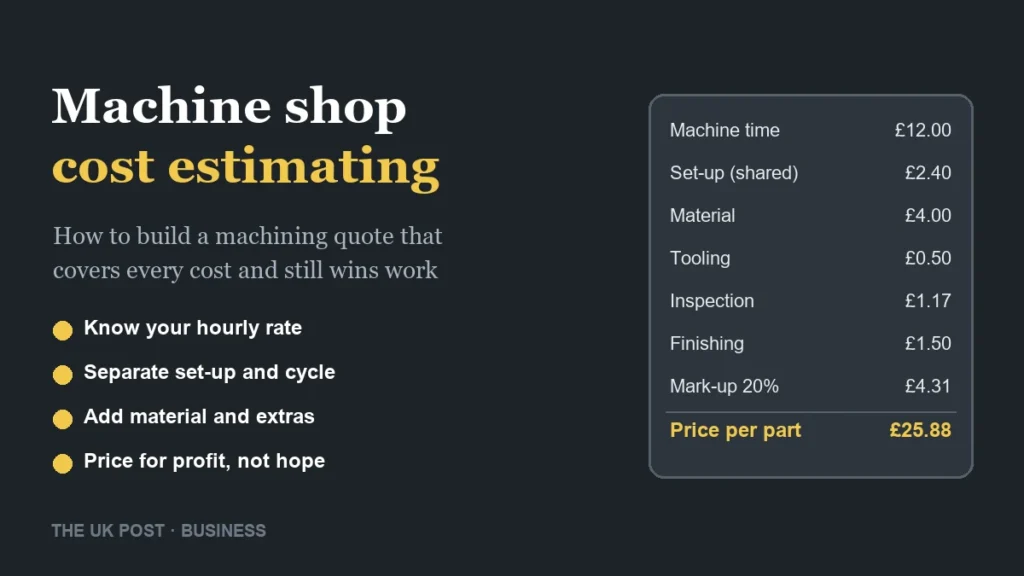
Short answer: to estimate the cost of a machined part, work out your machine shop’s true hourly rate, multiply it by the cycle time per part, add the set-up time shared across the batch, then add material, tooling, inspection, finishing and delivery, and finally apply your mark-up. The formula is: price per part = (machine rate × cycle time) + (machine rate × set-up time ÷ quantity) + material + other per-part costs, plus mark-up. The two most common mistakes are underestimating your hourly rate and forgetting that set-up costs fall sharply as batch size rises. Use the estimator below to test a quote in seconds.
Step 1: Work Out Your Machine Hourly Rate
Your hourly rate must cover everything it costs to keep a machine and its operator running, not just wages. A typical build-up:
| Cost element | How to calculate | Illustrative figure |
|---|---|---|
| Machine depreciation or finance | Purchase price ÷ years of use ÷ productive hours a year | £150,000 ÷ 7 years ÷ 2,100 hours ≈ £10.20/hr |
| Operator | Hourly wage plus employer National Insurance, pension and holiday | about £20/hr |
| Power | Average kW drawn × electricity price per kWh | 15 kW × £0.25 ≈ £3.75/hr |
| Maintenance and coolant | Annual maintenance ÷ productive hours | about £3/hr |
| Overheads | Rent, rates, insurance, software, admin, sales ÷ productive hours across machines | about £20/hr |
| Total machine rate | Add them up and round | about £57/hr, rounded to £60 |
These figures are illustrative, not benchmarks: a five-axis machining centre and a manual lathe have very different rates, and rents, wages and energy prices vary across the UK. The crucial number is productive hours. A machine that is only cutting 60% of the time costs more per productive hour than one running at 85%, so be honest about utilisation, including idle time, breakdowns and quoting time.
Step 2: Estimate Set-Up and Cycle Time
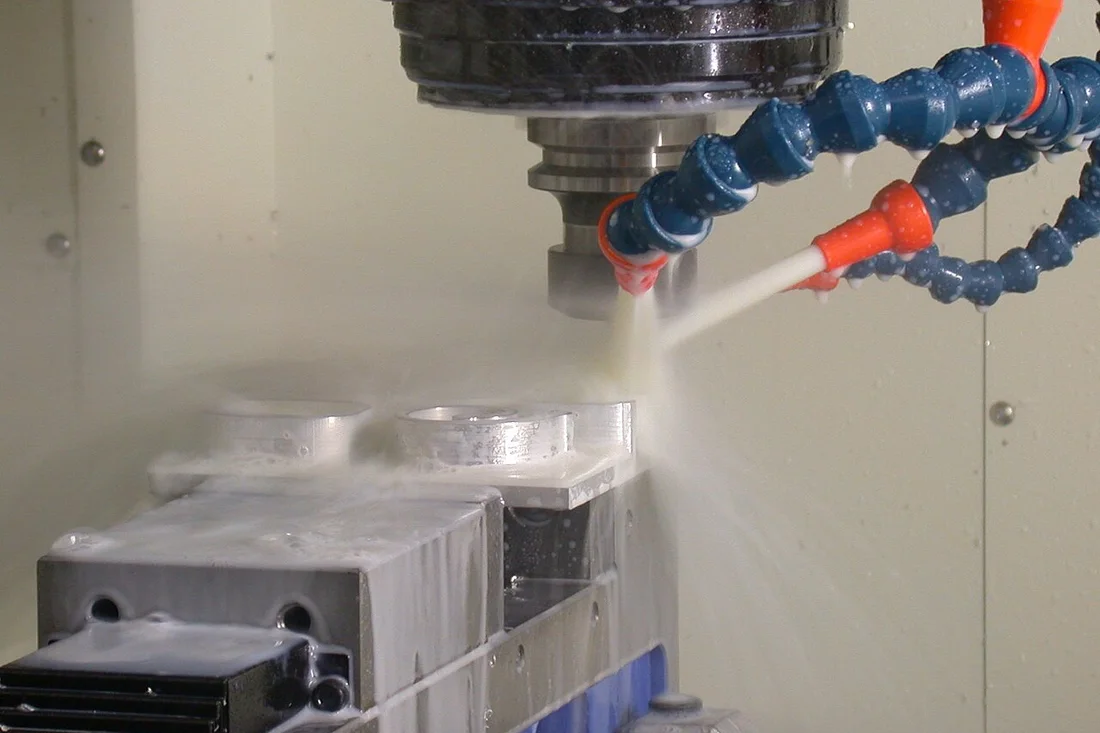
- Set-up time: loading programs, fitting fixtures and tools, setting offsets and proving the first part. It is a fixed cost per batch, whether you make 5 parts or 500.
- Cycle time: the time to machine one part, including loading and unloading. CAM software gives a good estimate; for manual work, use time studies or past jobs.
- Programming: for new parts, CAM programming time can be significant. Charge it separately as a one-off or build it into the first order.
Because set-up is shared across the batch, the price per part for a run of 10 can be several times the price for a run of 500. Showing customers a price break table often wins larger orders.
Step 3: Add Material and Other Per-Part Costs
- Material: the stock size you actually buy (not the finished part), plus cutting allowance and scrap, at today’s supplier price. Metal prices move, so date your quotes.
- Tooling wear: cutters, inserts and drills, spread across parts.
- Inspection: first-article inspection, in-process checks and paperwork such as material certificates.
- Finishing: anodising, plating, heat treatment and painting, often subcontracted, plus transport to the finisher.
- Packaging and delivery.
Step 4: Apply Your Mark-Up
Add a mark-up on cost for profit and risk. Make sure you understand the difference between mark-up (added to cost) and margin (the share of the selling price that is profit): a 20% mark-up gives a margin of about 16.7%. Higher-risk jobs, tight tolerances, exotic materials and rush orders justify a higher mark-up. (Online sellers face the same floor-price maths; see our guide to the Amazon Automate Pricing tool.)
Try the Estimator
Enter your own numbers. It runs in your browser and nothing is saved or sent.
Estimate
A Worked Example
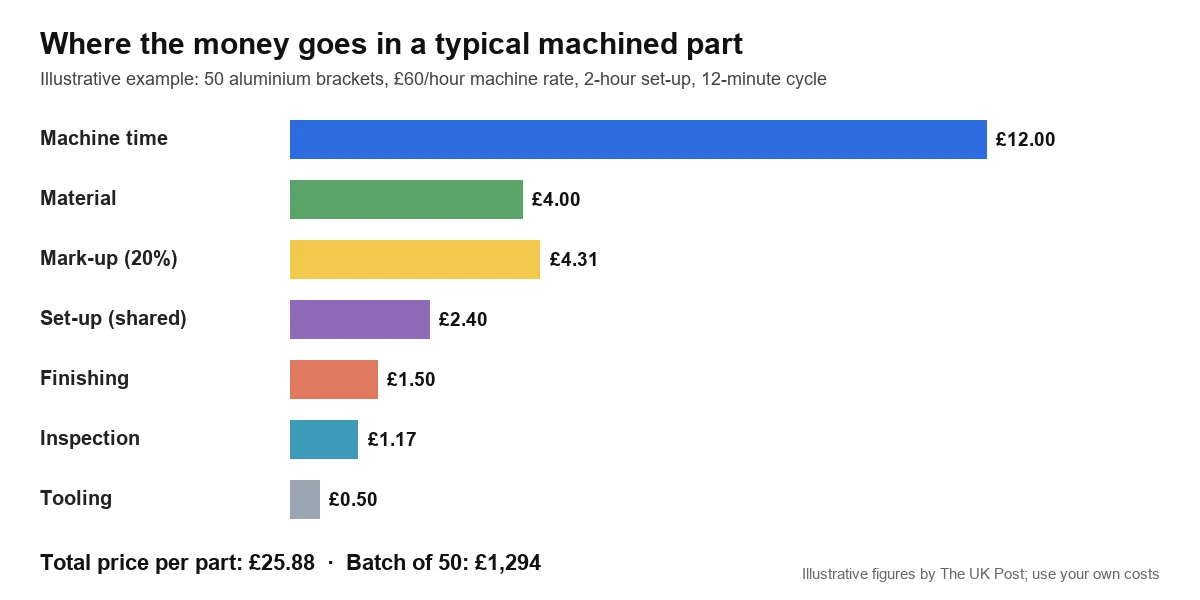
A customer wants 50 aluminium brackets. The shop’s machine rate is £60 an hour, set-up takes 2 hours, cycle time is 12 minutes, material is £4 a part, tooling £0.50, inspection £1.17 (2 minutes at £35 an hour) and anodising £1.50. With a 20% mark-up:
- Machine time: 0.2 hours × £60 = £12.00
- Set-up shared: 2 × £60 ÷ 50 = £2.40
- Material, tooling, inspection, finishing: £7.17
- Cost per part: £21.57; with 20% mark-up: £25.88
- Batch of 50: £1,294 (plus VAT if you are registered)
At a quantity of 10, the shared set-up rises to £12 a part, and the price jumps to about £37.40 each. That difference is why price breaks matter.
Building a machining quote in six steps
Common Estimating Mistakes
- Using wages as the hourly rate and forgetting machines, power and overheads.
- Assuming 100% utilisation.
- Ignoring set-up and programming on small batches.
- Quoting finished weight instead of stock size for material.
- Forgetting inspection, certificates and subcontract transport.
- Not tracking actual times against quoted times, so mistakes repeat.
- Leaving quotes open-ended when material prices are volatile: add a validity period.
My advice: after every job, compare actual hours and costs with your estimate. A simple spreadsheet of “quoted versus actual” will improve your quoting faster than any software, and it shows you which customers and parts actually make money.
For low-volume prototypes, 3D printing can be cheaper than machining; our guide to PLA+ filament covers the most popular material. Many machine shops also make precision parts for sensors such as strain gauge load cells, and if a fastener lets you down on the shop floor, see our guide to removing a stripped screw.
Frequently Asked Questions
How do you calculate machining cost?
Machine hourly rate × cycle time per part, plus set-up cost divided by quantity, plus material and other per-part costs, then add your mark-up.
What is a typical machine shop hourly rate in the UK?
It varies widely by machine type, region and overheads. Calculate your own from depreciation, labour, power, maintenance and overheads divided by productive hours.
Why are small batches so expensive?
Set-up and programming are fixed costs per batch, so spreading them over fewer parts raises the price per part.
Should programming time be charged separately?
Often, yes, as a one-off charge for new parts, so repeat orders are not overcharged.
What is the difference between mark-up and margin?
Mark-up is added to cost; margin is profit as a share of the selling price. A 20% mark-up equals about a 16.7% margin.
How do I estimate cycle time?
Use CAM software simulations for CNC work, and time studies or past jobs for manual work, adding loading and unloading time.
How should I price material?
On the stock size you buy, plus cutting allowance and scrap, at current supplier prices, with a quote validity period.
Should quotes include VAT?
Business customers usually expect prices excluding VAT, clearly stated. If you are VAT-registered, add VAT on the invoice.
Is estimating software worth it?
For busy shops, yes: it speeds up quoting and keeps rates consistent. But it is only as good as the hourly rates and times you feed it.
How can I win more quotes without cutting prices?
Offer price breaks, faster lead times, clear quotes with options, and design-for-manufacture suggestions that reduce the customer’s cost.
Final Thoughts
Good machine shop estimating is mostly honest arithmetic: a true hourly rate, realistic times, every per-part cost and a mark-up that reflects risk. Get those right, show customers how quantity changes the price, and track actual against quoted on every job. Your quotes will be more competitive and, more importantly, profitable.
Sources: Standard engineering cost-estimating methods (machine hour rate, set-up amortisation and mark-up); HMRC guidance on VAT for businesses; GOV.UK guidance on employer costs (National Insurance and workplace pensions). Example figures are illustrative and not benchmarks.