Especially or Specially? How to Use Especially in a Sentence
Especially means particularly and specially means for a particular purpose. Examples, the comma before especially, and UK usage data.
 6 min read
Comments: 0Views: 1
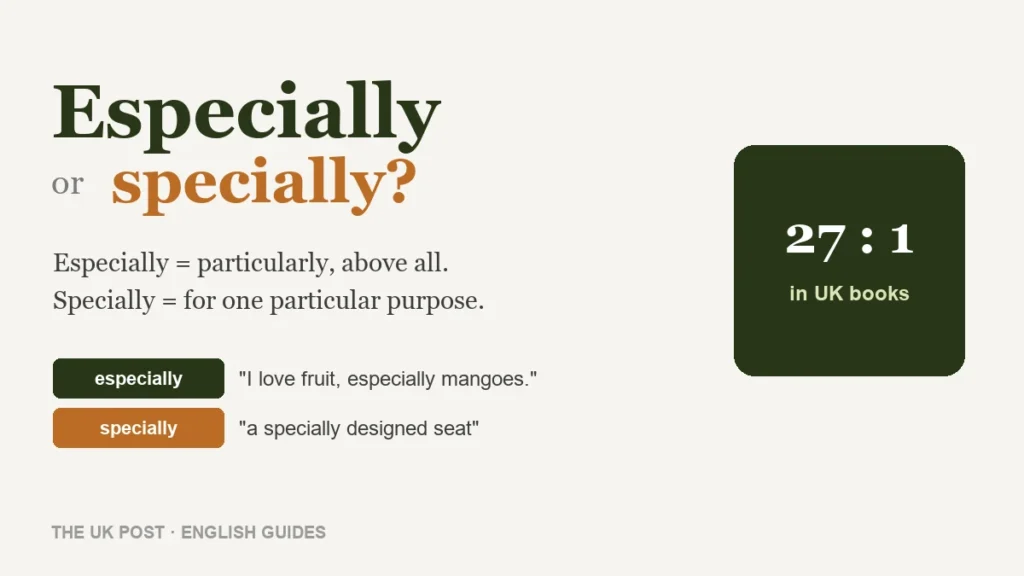
Short answer: “especially” means particularly or above all: “I love Italian food, especially pasta.” “Specially” means for one particular purpose: “a specially designed wheelchair”. A quick test: if you can swap in “particularly”, use especially; if you can swap in “for this purpose”, use specially. In practice “especially” is far more common: in British books of the 2010s it appeared about 27 times as often as “specially”. The two do overlap in one phrase: “made especially for you” and “made specially for you” are both used, and in British books “made especially” now leads about three to one.
Especially vs Specially at a Glance
| especially | specially | |
|---|---|---|
| Meaning | Particularly; above all; more than usual | For a particular purpose; in a special way |
| Swap test | “particularly” | “for this purpose” / “specifically” |
| Example | “It’s cold, especially at night.” | “The room was specially adapted.” |
| Typical partners | especially when, especially if, especially for | specially designed, specially trained, specially made |
| UK books, 2010s | especially is used about 27 times as often | |
Especially in a Sentence
“Especially” singles something out from a group or makes a point stronger. Here is how it typically works:
- Singling out: “I enjoy all sports, especially football.”
- With a condition: “Wear a coat, especially if it’s raining.”
- With a time: “The roads are busy, especially when schools finish.”
- Before an adjective: “It was an especially hard winter.” (meaning unusually hard)
- Before a verb: “I especially liked the ending.”
- In a negative: “I’m not especially hungry.” (not very)
Put “especially” just before the word or phrase it emphasises. “I especially like tea” is natural; “Especially I like tea” is not.
Specially in a Sentence
“Specially” is about purpose: something was done in a special way for one particular use or person.
- “The bus has a specially designed ramp.”
- “The dogs are specially trained to detect drugs.”
- “She had the dress specially made.”
- “I came specially to see you.” (just for that reason)
Our data shows “specially” holding firm in this sense: “specially designed” was about eight times as common as “especially designed” in British books of the 2010s.
Do You Need a Comma Before “Especially”?
Usually, yes, when “especially” adds an extra point at the end of a sentence:
- “Roads can be icy in winter, especially at night.”
- “Children love the museum, especially the dinosaur gallery.”
The comma shows that the “especially” phrase is extra information. You do not need a comma when “especially” sits inside the main clause, as in “I especially enjoyed the music” or “It was especially cold.” And in formal writing, avoid starting a sentence with a bare “Especially…” fragment, as in “Especially in winter.” Join it to the previous sentence with a comma instead.
What Our Data Shows
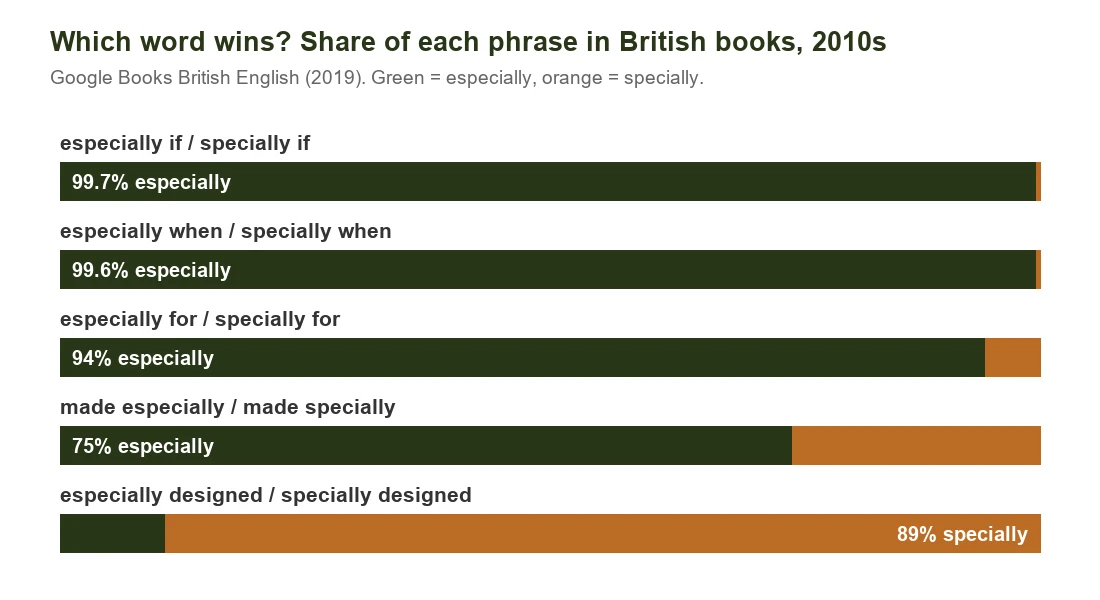
We analysed Google Books’ British and American English collections, which run to 2019:
- “Specially” has declined sharply: its use in British books fell by about 88% between the 1900s and the 2010s, while “especially” held steady.
- In phrases meaning “particularly”, “especially” wins almost every time. “Especially when” outnumbers “specially when” by more than 250 to 1.
- In phrases about purpose, “specially” keeps its ground: “specially designed” beats “especially designed” about 8 to 1.
- “Made specially” was more common than “made especially” in British books in the 1950s, but “made especially” has led since the 1980s; by the 2010s it was ahead about 3 to 1. In American books the lead is about 7 to 1.
- 1900s“Specially” is about a third as common as “especially” in British books.
- 1950s“Made specially” is still more common than “made especially” in British books.
- 1980s“Made especially” takes the lead.
- 2010s“Especially” leads 27 to 1 overall, but “specially designed” still beats “especially designed” 8 to 1.
The Grey Area: “Made Especially for You”
Strict usage guides say purpose belongs to “specially”, so “a cake made specially for you” is the traditional choice. But “made especially for you” is now the more common phrase in both British and American books, and few readers would call it wrong. If you are writing formally or for an exam, “specially” is the safer choice for purpose; in everyday writing, either will do.
Test Yourself
Choose the right word for each sentence. Your score appears at the bottom.
1. "I like all fruit, ___ strawberries."
2. "The car was ___ adapted for a wheelchair user."
3. Where does the comma go? "Drive carefully especially at night."
4. "I'm not ___ hungry."
5. Which is the correct spelling?
My Advice
Use the swap test every time: “particularly” means especially, “for this purpose” means specially. If you are unsure, “especially” is the more common word by a long way, but don’t use it in fixed purpose phrases such as “specially designed” or “specially trained”. For more pairs that trip people up, see our guide to commonly confused words, and our pages on cue or queue, pricey or pricy and flyers or fliers.
Frequently Asked Questions
What is the difference between especially and specially?
Especially means particularly or above all. Specially means for a particular purpose.
How do you use especially in a sentence?
Place it before the word it emphasises: “I love the coast, especially in spring,” or “It was especially busy today.”
Is it “made especially for you” or “made specially for you”?
Both are used. Traditional usage prefers “specially” for purpose, but “made especially for you” is now more common in books.
Do you put a comma before especially?
Usually, when it introduces an extra point at the end of a sentence: “It’s cold, especially at night.”
Can you start a sentence with especially?
You can start with “Especially” if the sentence is complete, but avoid fragments such as “Especially in winter.” in formal writing.
How do you spell especially?
E-S-P-E-C-I-A-L-L-Y, with a double L.
Is “specially” a real word?
Yes. It means for a particular purpose: “specially trained staff”.
What does “not especially” mean?
Not very or not particularly: “I’m not especially keen.”
Which is more common, especially or specially?
Especially, by about 27 to 1 in British books of the 2010s.
What is another word for especially?
Particularly, notably, above all or in particular.
Final Thoughts
Especially points at the most important item; specially explains a purpose. Remember the swap test: “particularly” means especially, “for this purpose” means specially. Use a comma before an “especially” phrase at the end of a sentence, and you will rarely go wrong.
Sources: Our own analysis of Google Books Ngram data (British and American English 2019 collections, phrase searches; notes on file); standard British usage guidance.