Smelled or Smelt? Which Is Correct in British English?
Both smelled and smelt are correct in British English, while Americans use smelled. How to choose, what the data shows, and similar verbs.
 7 min read
Comments: 0Views: 3
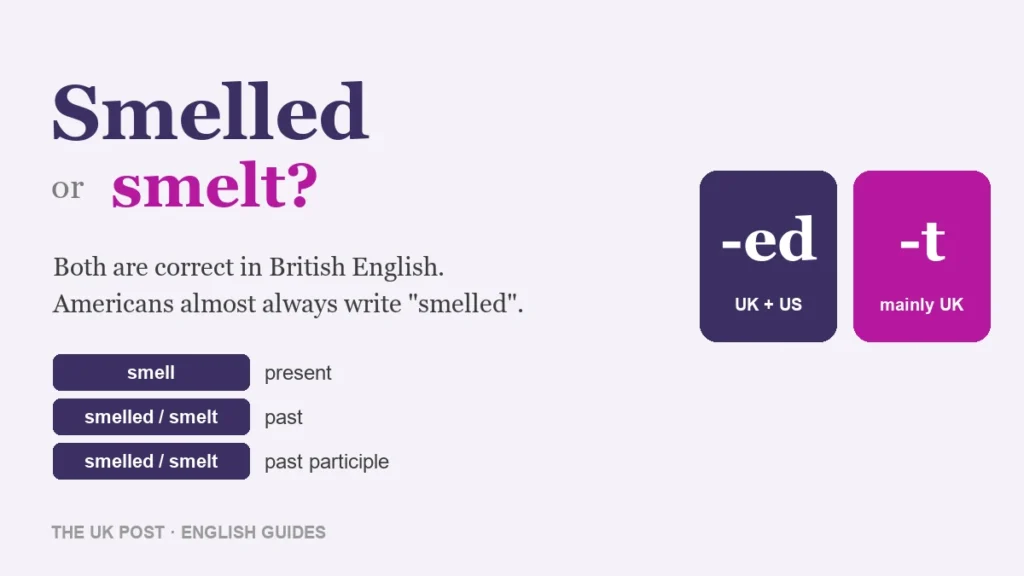
Short answer: in British English, both “smelled” and “smelt” are correct as the past tense and past participle of “smell”: “The kitchen smelt of toast” and “The kitchen smelled of toast” are both fine. In American English, “smelled” is almost always used, and “smelt” can look like a mistake. Our analysis of Google Books shows that British writers have shifted too. “Smelt” was the usual British form until around 1980, but “smelled” has since taken the lead, and by the 2010s “smelled of” was about three times as common as “smelt of” in British books. Whichever you choose, use it consistently. And remember that “smelt” is also a small fish and a verb meaning to extract metal from ore.
Smelled vs Smelt at a Glance
| smelled | smelt | |
|---|---|---|
| Correct in British English? | Yes | Yes |
| Correct in American English? | Yes, the standard form | Rare; often flagged as an error |
| Past tense | “It smelled lovely.” | “It smelt lovely.” |
| Past participle | “I have smelled it.” | “I have smelt it.” |
| UK books, 2010s (“smelled of” vs “smelt of”) | About 3 | to 1 |
| US books, 2010s | About 13 | to 1 |
How to Use Smelled and Smelt
“Smell” has two past forms, and in British English they are interchangeable:
- The bakery smelt / smelled of fresh bread. (simple past)
- I have never smelt / smelled anything like it. (present perfect)
- The milk had smelt / had smelled off for days. (past perfect)
There is no difference in meaning. The only rule is consistency: if you write “smelt” in one paragraph, don’t switch to “smelled” in the next. If your writing is for an American audience, or your organisation follows a US style guide, use “smelled”.
Smelled vs Smelt: What Our Data Shows
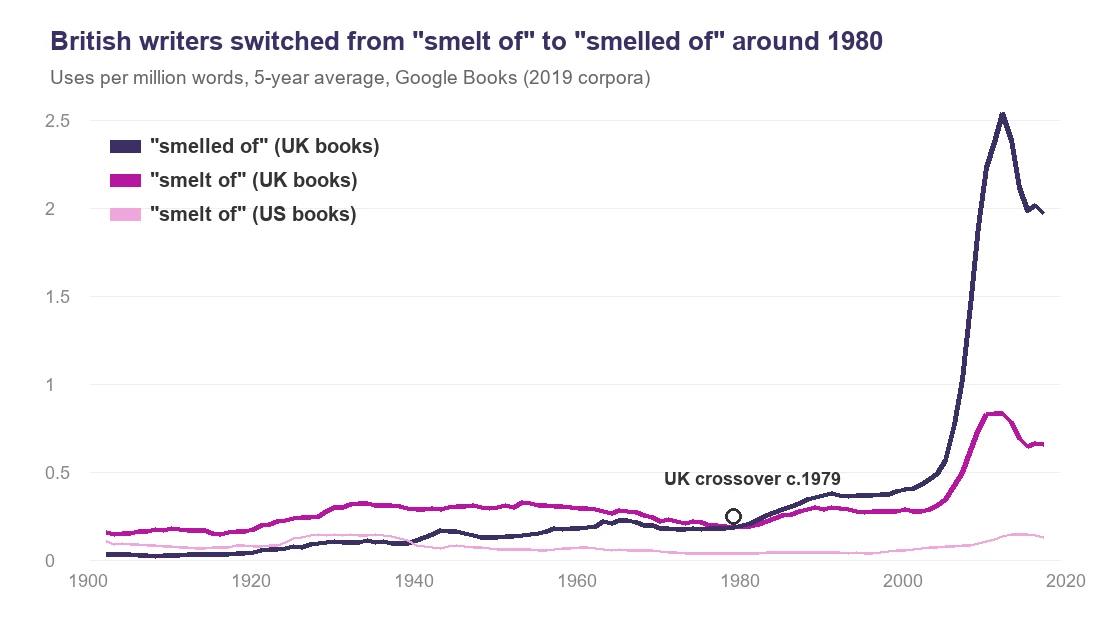
Because “smelt” is also a fish and a metalworking verb, we compared phrases that can only be the past tense of smell, such as “smelt of”, “it smelt” and “had smelt”, in Google Books’ British and American English collections, which run to 2019:
- In British books of the 1900s, “smelt of” was about five times as common as “smelled of”.
- “Smelled of” overtook “smelt of” in British books around 1979, “it smelled” passed “it smelt” around 1976, and “had smelled” passed “had smelt” around 1988.
- By the 2010s, “smelled of” was about three times as common as “smelt of” in British books.
- In American books, “smelled” was already dominant by the 1950s, and by the 2010s “smelled of” was about 13 times as common as “smelt of”.
Part of the British shift may reflect the growing number of American-edited and international books in the collection, but the trend is clear: “smelled” is now normal in British writing, while “smelt” remains perfectly correct.
- 1900s“Smelt of” is about five times as common as “smelled of” in British books.
- 1950s“Smelled” is already dominant in American books.
- c. 1976“It smelled” passes “it smelt” in British books.
- c. 1979“Smelled of” passes “smelt of” in British books.
- c. 1988“Had smelled” passes “had smelt” in British books.
- 2010s“Smelled of” leads about 3 to 1 in British books and 13 to 1 in American books.
The Same Pattern: Learnt, Spelt, Burnt and More
“Smell” belongs to a group of verbs that have both a “-t” and an “-ed” past form in British English. Here is how they compare in British books in the 2010s:
| Verb | -ed form | -t form | Usual US form |
|---|---|---|---|
| smell | smelled | smelt | smelled |
| learn | learned (more common) | learnt | learned |
| spell | spelled (slightly more common) | spelt | spelled |
| burn | burned (more common) | burnt | burned |
| dream | dreamed (more common) | dreamt | dreamed |
| spoil | spoiled (more common) | spoilt | spoiled |
| leap | leaped | leapt (more common) | both |
The “-t” forms are still very much alive in Britain, particularly as adjectives: burnt toast, a spoilt child, spilt milk. Note that “learned” pronounced as two syllables (LER-nid) is a different word, meaning “very knowledgeable”: “a learned professor”.
Smelt: the Fish and the Furnace
“Smelt” has two other meanings that have nothing to do with noses:
- A fish: the European smelt, or sparling (Osmerus eperlanus), is a small silvery fish found in some British estuaries. It is famous for smelling faintly of cucumber, so you could truthfully say “the smelt smelt of cucumber”.
- A verb: to smelt is to extract metal from ore by heating and melting it, as in an iron smelter. Its past tense is “smelted”.

Test Yourself
Choose the right word for each sentence. Your score appears at the bottom.
1. In British English, which is correct? "The hall ___ of polish."
2. You are writing for an American website. Which should you use?
3. What is the past tense of smelt, meaning to melt ore?
4. Which British adjective uses the -t form?
5. Which is NOT a correct past form in British English?
My Advice
If you are writing for British readers, use whichever form feels natural, and stick with it. I find “smelt” has a pleasingly British ring in fiction and personal writing, while “smelled” is the safer choice for anything that might be read internationally or edited to US style. For more pairs like this, see our guide to commonly confused words, and our pages on woken or woeken, pricey or pricy and envision or invision.
Frequently Asked Questions
Is it smelled or smelt?
Both are correct in British English. American English almost always uses “smelled”.
Is smelt a real word?
Yes. It is a past form of “smell” in British English, a small fish, and a verb meaning to extract metal from ore.
What is the past tense of smell?
Smelled or smelt in British English; smelled in American English.
Is “smelled” British or American?
Both. It is standard in American English and is now more common than “smelt” in British books too.
Is it “has smelt” or “has smelled”?
Both are correct in British English: “The room has smelt damp for weeks” or “has smelled damp”.
Which is more common in the UK, smelled or smelt?
In British books, “smelled” has been more common since around 1980. By the 2010s, “smelled of” was about three times as common as “smelt of”.
Why does my spellchecker flag smelt?
It is probably set to American English. Switch it to English (UK) and “smelt” will be accepted.
Is learnt or learned correct?
Both are correct in British English; “learned” is more common in print. Americans use “learned”.
What does a smelt fish smell like?
The European smelt is known for its faint smell of cucumber.
What is the past tense of smelt (metal)?
Smelted: “The ore was smelted in a furnace.”
Final Thoughts
Smelled and smelt are both correct in British English, and the choice is yours. “Smelled” is now the more common form in Britain and the standard one in America, while “smelt” keeps a distinctly British flavour. Pick one, stay consistent, and save “smelted” for the furnace.
Sources: Our own analysis of Google Books Ngram data (British and American English 2019 collections, phrase searches; notes on file); Wiktionary entries for smell and smelt; standard British usage guidance.