Chief Technical Examiner (CTE): India’s Contract Watchdog Explained for UK Readers and Businesses
What India's Chief Technical Examiners do, how contracts are selected for intensive examination, the timelines that follow, and the irregularities examiners find most.
 10 min read
Comments: 0Views: 4
A Chief Technical Examiner (CTE) is a senior engineer in India’s Central Vigilance Commission (CVC), the country’s main anti-corruption watchdog. The CTE’s team inspects Indian government building projects and purchasing contracts for poor workmanship, overpayments and corruption. The nearest British comparison would be a mix of the National Audit Office and a government counter-fraud unit, but focused on construction and procurement and able to inspect the work on site.
Why does this matter in Britain? Under the UK–India trade agreement, which UK government guidance says entered into force on 15 July 2026, British companies can now bid for many Indian central government contracts. Those are exactly the contracts a CTE can examine. This guide explains what the CTE is, how its inspections work, and what UK businesses should know before winning work in India.
Chief Technical Examiner at a Glance
| Details | |
|---|---|
| What it is | The technical (engineering) wing of India’s Central Vigilance Commission |
| Formal name | Chief Technical Examiners’ Organisation (CTEO) |
| Set up | 1957, in India’s then Ministry of Works, Housing and Supply |
| Part of the CVC since | 1964 |
| Led by | Two Chief Technical Examiners, both senior engineers |
| Main job | “Intensive examination” of public contracts: a deep inspection of one contract from tender to finished work |
| Covers | Indian central government ministries, state-owned companies and public sector banks |
| Rough UK comparison | National Audit Office crossed with a counter-fraud unit, for construction and procurement |
| Why UK firms should care | UK suppliers can now bid for many Indian central government tenders under the UK–India trade deal |
What Does a Chief Technical Examiner Do?
India’s Central Vigilance Commission oversees the integrity of central government departments and state-owned companies. It is not a police force. It supervises the vigilance (anti-corruption) officers inside each organisation and advises on cases. The CTE’s organisation is its specialist engineering arm. There are two CTEs, who split the work:
- One CTE covers civil engineering works, landscaping and horticulture, and services contracts.
- The other covers electrical and mechanical works, the purchase of goods, and IT procurement.
They are supported by Technical Examiners and Assistant and Junior Technical Examiners, all engineers. Their main tasks are:
- Intensive examinations of selected contracts, explained below;
- technical advice to the Commission on corruption cases involving public contracts, and on procurement policy;
- technical help for investigators, for example on whether a building matches its specification;
- training and guidance, so that problems found in one organisation are not repeated in others.
A Short History
The CTE’s organisation is older than the Commission it now sits in. It was created in 1957 to audit the work of India’s Central Public Works Department, which builds and maintains central government property. An anti-corruption committee chaired by K. Santhanam then recommended a national watchdog, and the Central Vigilance Commission was set up in February 1964, with the CTE’s organisation moved under it. The Commission gained statutory independence under India’s Central Vigilance Commission Act 2003.

How the CTE Compares With UK Watchdogs
Britain has no single body that does exactly what the CTE does. Its work overlaps with several UK organisations:
| UK body | What it does | Overlap with the CTE |
|---|---|---|
| National Audit Office (NAO) | Audits central government spending and reports to Parliament on value for money | Both scrutinise public projects, but the NAO reviews programmes rather than inspecting individual building sites |
| Public Sector Fraud Authority | Cabinet Office unit that helps departments find and recover fraud and error | Both look for overpayments and loss of public money |
| Procurement Review Unit | Oversees how public bodies follow the Procurement Act 2023 | Both check that contracts are awarded properly |
| Serious Fraud Office | Investigates and prosecutes serious fraud, bribery and corruption | Serious cases found by the CTE may be investigated by India’s police; the CTE itself does not prosecute |
Why It Matters to UK Businesses
The UK–India Comprehensive Economic and Trade Agreement includes a government procurement chapter. According to the UK government’s export guidance, it gives British suppliers access to tenders from 51 Indian central government ministries and departments and around 28 central state-owned companies, such as railways, health, finance and energy. The UK government estimates this covers around 40,000 tenders a year, worth over £38 billion.
| Type of contract | Threshold for UK bidders |
|---|---|
| Goods and services | About ₹5.5 crore (around £480,000) |
| Construction | About ₹62 crore (around £5.3 million) |
Defence, home affairs, IT and space ministries are excluded, as are contracts let by India’s state governments. Tenders open to UK suppliers are published on India’s Central Public Procurement Portal (eprocure.gov.in). Under India’s “Make in India” rules, a UK bidder with at least 20% UK content counts as a “Class-II local supplier”. Full details are in the UK government’s guide to government procurement opportunities in India.
Any of these contracts can later be selected for a CTE examination. A British firm that wins Indian government work should expect the same level of scrutiny as an Indian contractor, including checks on site, on records and on payments. Technology suppliers should note that IT purchases by covered ministries fall under the CTE’s remit too. If you sell technology to large public buyers, our look at B2B marketing for technology companies explains what tends to win long, committee-led deals.
What Is an Intensive Examination?
An intensive examination (IE) is a detailed inspection of a single contract, covering every stage: why the work was needed, the cost estimate, the tender, the award, the work on site, the quality of materials, and every payment. According to CVC guidance, it aims to find:
- departures from the official procurement rules;
- failures to follow the contract’s own conditions;
- breaches of legal requirements;
- poor quality, overpayments and similar losses;
- weaknesses that call for wider changes to the system.
An examination is not an accusation. Many end with corrections and money recovered from the contractor, rather than disciplinary action. Where examiners see signs of wrongdoing, the case goes to the organisation’s vigilance officer for investigation.
How Contracts Are Chosen for Examination
Each organisation’s Chief Vigilance Officer sends the CTE a quarterly list of ongoing contracts above set values, and the CTE picks from these. Contracts can also be chosen on a vigilance officer’s recommendation, because of their size, or on the Commission’s orders after a complaint. Indian figures use crore (10 million rupees) and lakh (100,000 rupees). The pound figures below are approximate conversions.
| Type of contract | Reported to the CTE above | Roughly in pounds |
|---|---|---|
| Civil works and turnkey projects | ₹5 crore | £440,000 |
| Goods and purchasing | ₹5 crore | £440,000 |
| Public-private partnerships | ₹5 crore | £440,000 |
| Sale of goods, scrap or land | ₹5 crore | £440,000 |
| Electrical and mechanical works | ₹1 crore | £87,000 |
| Consultancy and service contracts | ₹1 crore | £87,000 |
| Medical equipment | ₹50 lakh | £44,000 |
| Horticulture and landscaping | ₹10 lakh | £8,700 |
Pound figures are based on the exchange rate implied by UK government guidance (₹5.5 crore to about £480,000) and will change with the rupee.
What Happens During and After an Examination
A Technical Examiner visits the site and checks the files, with officials from the buying organisation present. The organisation must provide records such as payments under each bill, how much cement and steel was used compared with what the design required, and the results of material tests. The examiner’s report is approved by the CTE and sent to the organisation, which must reply to each point. The CVC sets strict deadlines:
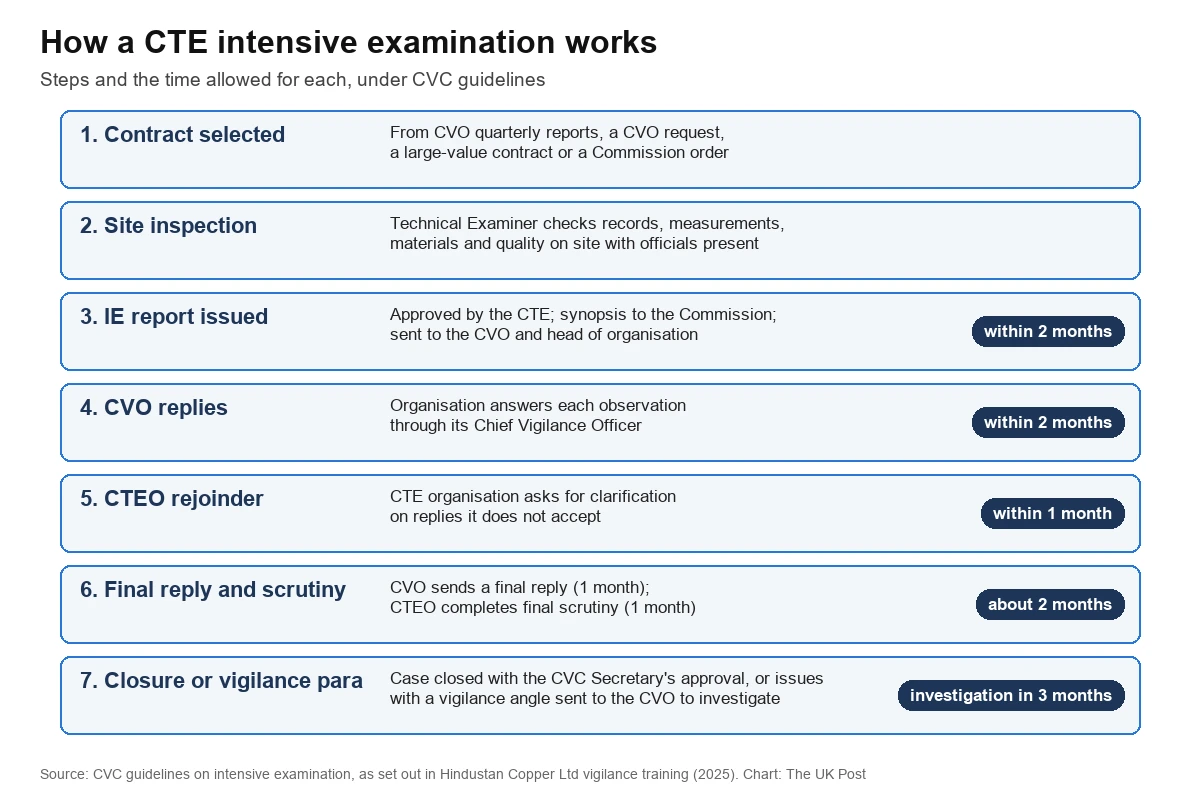
| Stage | Time allowed |
|---|---|
| CTE issues the examination report | 2 months after the inspection |
| The organisation replies through its vigilance officer | 2 months |
| CTE responds to the reply | 1 month |
| The organisation sends its final reply | 1 month |
| CTE completes final checks | 1 month |
| Investigation of any suspected wrongdoing | 3 months |
For a contractor, the practical results can include being asked to put defective work right and having overpayments recovered from future bills. CVC guidance specifically lists recovery of overpayments from contractors as one of the organisation’s duties after an examination.
Common Problems CTE Examiners Find
CVC training material lists warning signs at each stage of a contract. For a UK reader, many will sound familiar from British procurement scandals:
- Avoiding open competition: using single or limited tenders without good reason, or inviting firms with shared directors.
- Splitting contracts into smaller orders to keep each below an official’s approval limit.
- Tailored criteria: defining “similar work” or specifications so narrowly that only one bidder qualifies, or naming a single brand.
- Weak estimates: cost estimates not based on recent prices or official rate schedules.
- Inconsistent evaluation: accepting a bidder’s experience in one tender after rejecting it in another, or undisclosed links between evaluators and bidders.
- Shell suppliers: payments to a firm whose registered office is only a mailbox, or bidders who appear to have agreed prices.
- Poor contract management: missing performance guarantees, unapproved subcontracting, and site records that do not match the bills paid.
What UK Suppliers Should Do
- Keep complete records of every measurement, delivery, test and variation, signed off by the buyer’s engineer.
- Get every change approved in writing before doing extra or different work.
- Test materials as the contract requires, at approved laboratories, and keep the certificates.
- Check that invoices match measured work, because overpayments can be clawed back after an examination.
- Use local advice. India’s procurement rules, including the General Financial Rules 2017 and the Ministry of Finance’s 2022 procurement manuals, differ from the UK’s Procurement Act 2023. The Department for Business and Trade’s India team can help with market entry, and our guide to starting an import-export business in the UK covers the basics of selling abroad, from commodity codes to Incoterms.
Frequently Asked Questions
What is a Chief Technical Examiner?
A senior engineer in India’s Central Vigilance Commission who leads inspections of government construction and procurement contracts to detect poor quality, overpayments and corruption.
Is there a Chief Technical Examiner in the UK?
No. The UK has no direct equivalent. The National Audit Office, the Public Sector Fraud Authority and the Procurement Review Unit each cover part of what India’s CTE does.
Can UK companies bid for Indian government contracts?
Yes, for many central government contracts, under the UK–India trade agreement. UK guidance gives thresholds of about £480,000 for goods and services and about £5.3 million for construction. Defence, home affairs, IT, space and state-level contracts are excluded.
Can a UK company’s contract in India be examined by the CTE?
Yes. Contracts with covered Indian central government bodies can be selected for an intensive examination, whoever the contractor is.
What is a CTE intensive examination?
A detailed inspection of one contract, covering the estimate, tender, award, site work, materials and payments, to find rule breaches, poor quality and overpayments.
When was the CTE organisation set up?
In 1957. It became part of India’s Central Vigilance Commission when the Commission was created in 1964.
What do crore and lakh mean?
They are Indian number units. One lakh is 100,000, and one crore is 10 million. So ₹5 crore is 50 million rupees, roughly £440,000.
Sources
- UK government: Government procurement opportunities in India (trade deal access, thresholds, covered bodies)
- GOV.UK: UK–India trade deal conclusion summary
- Central Vigilance Commission, official website
- Hindustan Copper Ltd: Training workshop on CTE-type intensive examination, 2025 (CTE history, selection thresholds, timelines and warning signs under CVC guidelines)
- Central Vigilance Commission, Wikipedia
- India Post stamp, 2014, Wikimedia Commons (Government Open Data Licence – India)