Chief Technical Examiner (CTE): Role, Intensive Examination Process and Common Findings
What India's Chief Technical Examiners do, how contracts are selected for intensive examination, the timelines that follow, and the irregularities examiners find most.
 11 min read
Comments: 0Views: 2
A Chief Technical Examiner (CTE) is a senior engineer who heads the technical wing of India’s Central Vigilance Commission (CVC). The Chief Technical Examiners’ Organisation (CTEO) checks government construction works and procurement contracts for irregularities, poor quality, overpayments and corruption. Its main tool is the “intensive examination”: a detailed inspection of a selected contract, from the tender papers to the work on site. There are two CTEs. One covers civil works, horticulture and services. The other covers electrical and mechanical works, goods and IT procurement.
This guide explains where the CTEO came from, how contracts are picked for examination, what happens during and after an inspection, the timelines organisations must meet, and the irregularities examiners most often find. It is written for engineers, vigilance officers, contractors and students preparing for public-administration exams.
Chief Technical Examiner at a Glance
| Details | |
|---|---|
| Full name | Chief Technical Examiners’ Organisation (CTEO), Central Vigilance Commission |
| Set up | 1957, under the then Ministry of Works, Housing and Supply |
| Under the CVC since | 1964, on the recommendation of the Santhanam Committee |
| Headed by | Two Chief Technical Examiners, both senior engineers of Chief Engineer rank |
| Supported by | Technical Examiners (TEs), Assistant Technical Examiners (ATEs) and Junior Technical Examiners (JTEs) |
| Main job | Intensive examination of public procurement contracts |
| Covers | Central government ministries and departments, public sector undertakings, public sector banks and other organisations under the CVC’s jurisdiction |
| Based at | Satarkata Bhavan, GPO Complex, INA, New Delhi |
History of the CTE Organisation
The CTEO is older than the Central Vigilance Commission itself. It was set up in 1957 under the then Ministry of Works, Housing and Supply, with a mandate to carry out financial and technical audits of works by the Central Public Works Department (CPWD).
The Committee on Prevention of Corruption, chaired by K. Santhanam, recommended a central anti-corruption body. Its recommendations led to the creation of the Central Vigilance Commission in February 1964, and the CTE’s organisation was brought under the new Commission the same year. The CVC became a statutory body under the Central Vigilance Commission Act, 2003, which gave it independence from the executive.
Over time, the CTEO’s remit has widened from CPWD buildings to every kind of public procurement: roads, railways, power plants, hospital equipment, IT systems, services contracts and even the sale of scrap and land.

Structure: Who Does What
The organisation is led by two Chief Technical Examiners, who split the work by type of procurement:
| CTE | Responsible for |
|---|---|
| CTE (Civil) | Civil works, horticulture works and procurement of services |
| CTE (Electrical and Mechanical) | Electrical and mechanical works, procurement of goods, and IT-related procurement |
Each CTE leads a team of Technical Examiners, Assistant Technical Examiners and Junior Technical Examiners. These are engineers, usually drawn on deputation from engineering services and public sector organisations, who carry out the inspections and draft the reports.
Functions of the Chief Technical Examiner
- Intensive examination of procurement contracts: the organisation’s core work, explained in detail below.
- Advising the Commission: giving technical advice on vigilance cases involving public procurement, and on procurement policy.
- Technical support for investigations: helping the Commission, Chief Vigilance Officers (CVOs) and the CBI on technical questions, such as whether work matches its specification.
- Examining complaints: looking into complaints about construction works and contracts when the Commission asks.
- Training and guidance: sharing lessons through workshops, seminars and published guidelines, so that the same mistakes are not repeated across organisations.
What Is an Intensive Examination?
An intensive examination (IE) is a detailed technical and financial check of a single contract, covering every stage: the need for the work, the estimate, the tender, the award, the execution on site, the quality of materials and the payments made. According to CVC guidance, its aims are to detect:
- departures from the prescribed procurement policy and procedures;
- failures to follow the conditions of the contract;
- failures to follow statutory rules and norms;
- quality compromises, overpayments and similar losses;
- weaknesses in the system that call for wider improvements.
An IE is not an accusation. Many examinations end with technical corrections and recoveries rather than disciplinary action. But where the examiners find signs of wrongdoing, the case can be passed to the organisation’s CVO for a vigilance investigation.
How Contracts Are Selected for Examination
The CTEO picks contracts in four main ways:
- Quarterly progress reports from CVOs. Every organisation’s Chief Vigilance Officer must report its ongoing contracts above set values each quarter. The CTEO chooses from these lists.
- A specific recommendation by a CVO who suspects a problem with a contract.
- Large-value contracts chosen for their size and risk.
- An order from the Commission, often following a complaint.
These are the minimum contract values that must be included in the quarterly reports, according to CVC guidance:
| Type of procurement | Minimum value for reporting |
|---|---|
| Civil works and turnkey contracts | ₹5 crore |
| Stores and purchase | ₹5 crore |
| Public-private partnership (cost or revenue value) | ₹5 crore |
| Sale of goods, scrap or land | ₹5 crore |
| Electrical and mechanical works | ₹1 crore |
| Consultancy and non-consultancy service contracts | ₹1 crore |
| Medical equipment | ₹50 lakh |
| Horticulture works | ₹10 lakh |
| Supply of medicines | The four highest-value contracts |
The Intensive Examination Process and Timelines
Once a contract is selected, a Technical Examiner inspects the records and the work on site, with the organisation’s officials present. The examiner then drafts a report, which the CTE approves. A synopsis goes to the Commission, and the report goes to the CVO and the head of the organisation. The CVC sets deadlines for each stage that follows:
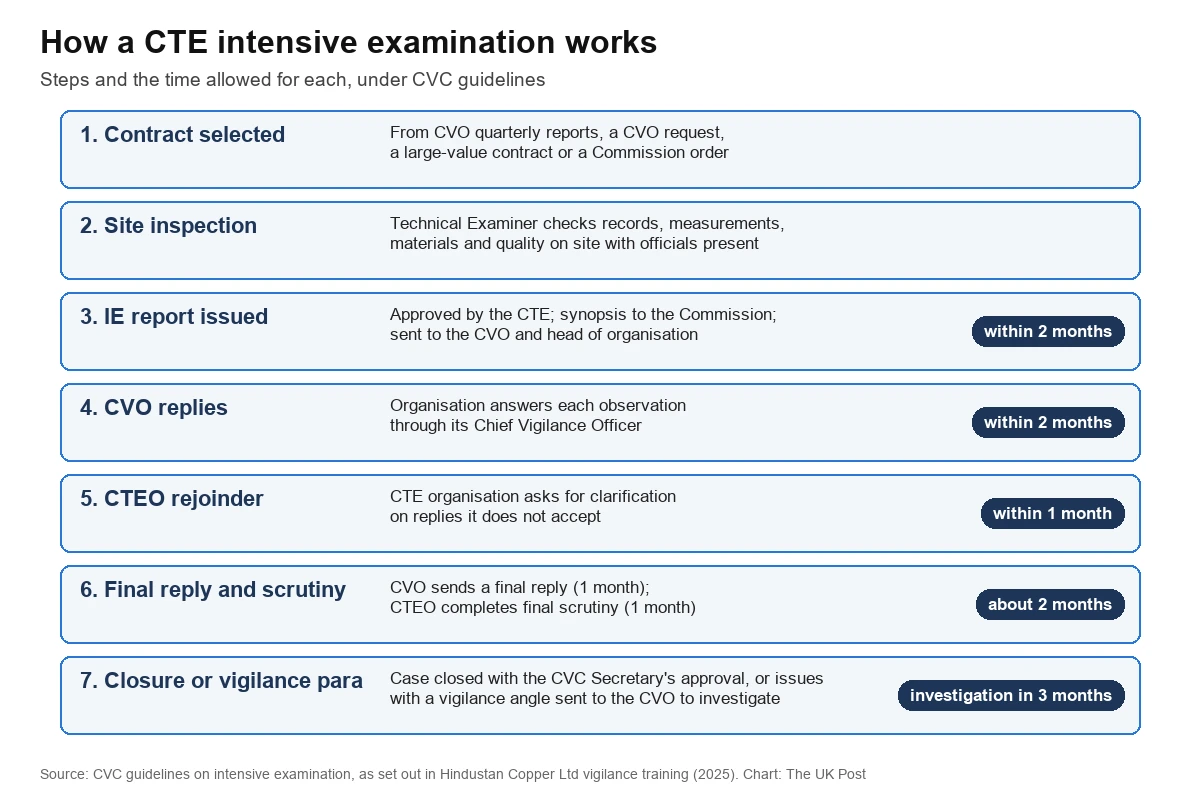
| Stage | Time allowed |
|---|---|
| CTEO issues the IE report, with a synopsis or presentation to the Commission | 2 months from the inspection |
| CVO replies to the observations in the report | 2 months from the report |
| CTEO sends a rejoinder to the CVO’s reply | 1 month from the reply |
| CVO sends a final reply to the rejoinder | 1 month from the rejoinder |
| CTEO completes final scrutiny | 1 month from the final reply |
| CVO submits an investigation report on any vigilance para from the Commission | 3 months from receiving the para |
A case is closed with the approval of the CVC’s Secretary once the observations are settled. Observations that suggest a vigilance angle, meaning possible misconduct rather than an honest mistake, are referred to the CVO for investigation.
What an Organisation Must Do During a CTE Inspection
CVC guidance places clear duties on the organisation being examined:
- make sure a representative of the CVO is present throughout;
- make sure the officials who handled the procurement and the work on site are available to answer questions;
- put right any defects in works, goods or services that the examiners find;
- recover any overpayments from the contractor.
Examiners usually ask for the information in standard formats (proformas) before or during the visit. These typically include a statement of payments made under each running bill, cement and steel consumption compared with the theoretical quantities required, a statement of material tests showing the tests required against those actually done and their results, and details of any liquidated damages imposed and actually recovered.
CTE-Type Intensive Examination by CVOs
The CTEO cannot examine every contract in India, so the CVC also requires each organisation’s Chief Vigilance Officer to carry out its own “CTE-type” intensive examinations. Under CVC guidance, a CVO should examine at least six contracts a year: two of high value, two of medium value and two of small value. The CVO must then make sure the organisation acts on the observations, including disciplinary action where needed. Where an officer covered by the Commission’s advice is involved, the CVO seeks the Commission’s first-stage advice.
Common Irregularities Found in CTE Examinations
CVC training material lists “red flags” that examiners look for at each stage of a contract. The most common are:
Choosing how to tender
- Using limited or single tenders without proper justification when an open tender was possible.
- Inviting firms that share directors or partners, or have known business links, to a limited tender.
- Deliberately letting a situation become an “emergency” to justify a limited or single tender.
Scope, quantities and estimates
- Splitting requirements into smaller orders to keep each one below a certain official’s financial powers.
- Leaving important items out of the scope, leading to large variations and new items soon after work starts.
- Estimates not based on the last accepted rate or last purchase price, or on official schedules of rates such as CPWD’s.
- Estimating with branded products but tendering with loose, general specifications, so cheaper materials can be supplied.
Eligibility criteria and specifications
- Defining “similar work” so narrowly that it favours one bidder, or so loosely that it is open to interpretation.
- Naming brands or features unique to one manufacturer in the specification.
- Specifications that differ from those used in the estimate, or that are outdated.
- Penalty clauses out of proportion to the contract, such as a tiny fixed penalty on a very large contract.
Tender evaluation
- Treating bidders’ experience certificates inconsistently, or accepting a bidder’s credentials in one tender after rejecting them in another with the same criteria.
- Accepting completion certificates that do not show the value of work actually done.
- Undisclosed family or business links between a member of the evaluation committee and a bidder.
- Payments to a firm whose registered office is only a mailbox, or bidders who appear to have agreed their prices together.
Contract management and execution
- Not collecting the performance security or insurance on time.
- Allowing subcontracting without written approval.
- Measurement books and field books that do not match each other or the running bills.
- Poor records of materials issued free by the department, such as cement and steel.
- Accepting goods that do not meet the specification, such as a basic product supplied in place of the specified one.
How to Prepare for a CTE Inspection
- Keep the full file together: need assessment, estimate with rate analysis, tender documents, evaluation reports, approvals, the agreement and all variations.
- Reconcile measurements: make sure the field book, measurement book and running bills agree.
- Prepare material reconciliation: cement and steel issued, used and recovered, against theoretical requirements.
- Have test records ready: the tests required by the contract and the relevant Indian Standards, those carried out, the laboratory used and the results.
- Check deductions: confirm that liquidated damages, taxes, labour cess and advances have been correctly recovered.
- Record every deviation: any change from the contract should have a written reason and the competent authority’s approval.
- Brief the officials involved so they can explain decisions on site.
The Rules the CTE Checks Against
Examiners measure each contract against the procurement rules in force when it was awarded. For central government bodies these include the General Financial Rules, 2017, the Ministry of Finance’s manuals for procurement of works, goods, and consultancy and other services (updated in 2022), the organisation’s own procurement manual, standard bidding documents, and the CVC’s own circulars and guidelines on public procurement.
Frequently Asked Questions
What is a Chief Technical Examiner?
A Chief Technical Examiner is a senior engineer who heads the technical wing of India’s Central Vigilance Commission. The CTE’s organisation inspects government works and procurement contracts to detect irregularities, quality problems and corruption.
When was the CTE organisation set up?
In 1957, under the then Ministry of Works, Housing and Supply. It was brought under the Central Vigilance Commission in 1964, following the Santhanam Committee’s recommendations.
How many Chief Technical Examiners are there?
Two. One handles civil works, horticulture and services. The other handles electrical and mechanical works, goods and IT procurement.
What is a CTE intensive examination?
A detailed inspection of a selected contract, covering the estimate, tendering, award, execution, quality and payments, to find departures from rules, poor quality and overpayments.
What is a CTE-type intensive examination?
An intensive examination carried out by an organisation’s own Chief Vigilance Officer using the CTE’s methods. CVC guidance asks CVOs to examine at least six contracts a year: two high-value, two medium-value and two small-value.
How long does an organisation have to reply to a CTE report?
Two months from the date of the intensive examination report, followed by one month to reply to any rejoinder from the CTE’s organisation.
Which contracts must be reported to the CTE?
CVOs report ongoing contracts above set values every quarter, for example civil works above ₹5 crore, electrical and mechanical works above ₹1 crore, medical equipment above ₹50 lakh and horticulture works above ₹10 lakh.
Can a CTE examination lead to disciplinary action?
Yes. Most observations end in corrections or recoveries, but where there are signs of misconduct, the case is referred to the CVO for a vigilance investigation, which can lead to disciplinary action.
Sources
- Central Vigilance Commission, official website (circulars and guidelines on intensive examination)
- Hindustan Copper Ltd: Training workshop on CTE-type intensive examination, 2025 (CTEO history, selection criteria, timelines and red flags)
- Central Vigilance Commission, Wikipedia (founding, CVC Act 2003, headquarters)
- India Post stamp, 2014, Wikimedia Commons (Government Open Data Licence – India)