Most B2B technology deals are decided before the buyer tells anyone they are buying. Google and the National Research Group surveyed 2,063 senior leaders and found that 82% ultimately chose a product from their “Day 1 List” — the shortlist of vendors they already knew and trusted before the formal process began.
That one number should reorganise a marketing plan. If four fifths of buyers pick from a list they wrote in their heads beforehand, then the contest is for a place on that list, not for the enquiry form.
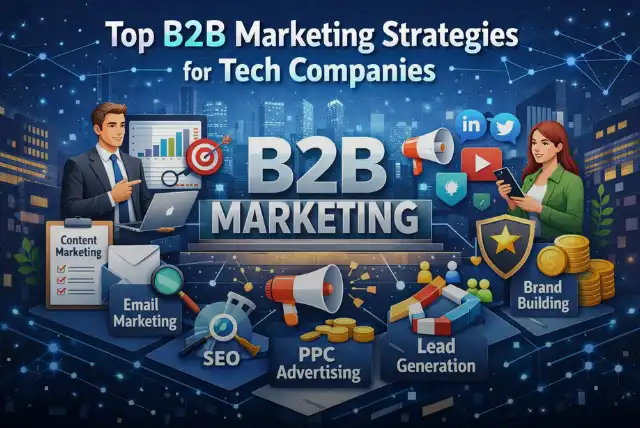
Here are ten strategies for B2B technology marketing, with the evidence behind each one — and an honest note about where the evidence comes from.
Last updated: 20 October 2026. This version removes several unsourced statistics and copied passages from the earlier text — both listed at the end.
The numbers that matter
- Day 1 List: 82% buy from a shortlist they had before starting
- Search: 94% of online searchers used Google Search
- AI: 60% use AI tools somewhere in the journey
- Speed: 77% finish in twelve weeks or less
- Loyalty: 58% switched vendors in six months
- Sales reps: 67% now favour a rep-free experience
- After the sale: 83% use Google and YouTube post-purchase
- Note: the main study is US-based — see the caveat below
What this article covers
- The Day 1 List, and why it changes the plan
- How buyers actually research
- Where AI sits in the journey
- Twelve weeks, and the end of loyalty
- The five rules of engagement
- Ten strategies, with the evidence
- B2B against B2C
- Where this data comes from — and its limits
- Corrections made to this page
- Frequently asked questions
The Day 1 List, and Why It Changes the Plan
Buyers do not start neutral. They begin with a shortlist of vendors they already know and trust — what the Google study calls the Day 1 List — and the formal process largely confirms it.
Google / National Research Group, “Understanding the Empowered Buyer”, October 2025. US, Q2 2025, n=2,063 B2B buyers and decision makers.
What this does to a budget. Spending that only works once a buyer is actively looking is competing for the 18%. Spending that makes you known and credible before anyone is looking is competing for the 82%. Most B2B technology firms have that ratio backwards.
The study frames it as two separate jobs: earning a place on the list, and staying on it. Those need different work. The first is brand, proof and visibility over time. The second is everything that happens after the signature.
How Buyers Actually Research
When buyers do start looking, here is where they go.
| Touchpoint | Share of buyers | What it means for you |
|---|---|---|
| Google Search | 94% of those who searched online | Search is not one channel among many. It is the substrate |
| Visited a brand’s website | 63% | Your site is a research tool, not a brochure. Make the product legible |
| Watched a tutorial | 60% | Show it working. YouTube is doing demo duty |
| Used AI tools | 60% | Your product is being summarised by a model you do not control |
| Used social media when researching | 59% | Peer and creator voices, not just your own channels |
Google / NRG B2B New Buyer Journey Study, US, Q2 2025, n=2,063. Figures are of all surveyed buyers except Google Search, which is of those who searched for a product online.
Note how little of this involves a salesperson. Gartner’s survey of 646 B2B buyers, fielded in August and September 2025, found 67% now favour a rep-free experience, up from 61% a year earlier. The seller has not disappeared — they have moved later, into complex deals.
Where AI Sits in the Journey
60% of B2B buyers use AI tools during the purchase process, with tools like ChatGPT or Gemini used to extend vendor lists, summarise content and surface competitors. But it is not spread evenly.
Google / NRG, October 2025. 60% of buyers use AI somewhere in the journey; this is where they use it.
Use peaks at consideration — exactly the stage where a shortlist gets built or broken. If an AI assistant describes your product wrongly, or leaves it out, you lose deals you will never hear about.
- 84% said AI tools speed up their process. The window to influence a decision is getting shorter.
- Buyers check the machine. Google Search was the top tool used to validate AI findings, at 63%.
- One buyer in the study put it exactly: AI “gets you 60-70% of the way there”, and they used Google to make sure it was not wrong.
- Gartner found 45% used AI tools during a recent purchase — a lower figure from a different sample, which is a reminder that these numbers are estimates, not constants.
If you are working out where AI fits in your own operation rather than your buyers’, our guides to artificial intelligence in business and the role of artificial intelligence cover that side.
Twelve Weeks, and the End of Loyalty
Two things follow from this, and both are uncomfortable.
- Long nurture sequences are out of step with how fast buyers move. If three quarters of journeys finish inside twelve weeks, a six-month drip campaign is arriving after the decision.
- Inertia is no longer a retention strategy. More than half of buyers switched vendor within six months. Being the incumbent buys you very little.
- Retention is now a marketing job, not just a success one. 83% use Google and YouTube after purchase to understand what they bought, 68% say that uncovered new use cases or more value, and 88% of those buyers say they are extremely or very likely to recommend the product.
The Five Rules of Engagement
The study distils what keeps a vendor on the list into five words. They are not profound, which is rather the point — most B2B technology marketing fails on them anyway.
| Rule | What it means in practice |
|---|---|
| Clarity | Say what the product does in a sentence a buyer could repeat to a colleague |
| Proof | Named customers, real numbers, demonstrations. Buyers arrive prepared and ask harder questions than they used to |
| Relevance | Content aimed at the specific problem, not a general audience |
| Simplicity | Short and useful beats glossy and overproduced. The study is explicit that buyers do not want polished assets |
| Peer validation | Other people’s opinions, including niche creators and “workfluencers”, not just your own claims |
Google / NRG, “Understanding the Empowered Buyer”, October 2025.
Ten Strategies, With the Evidence
Each of these ties back to a figure above rather than to received wisdom.
| Strategy | Why, and the evidence |
|---|---|
| 1. Content that demonstrates | Short, clear and useful beats glossy. 63% visited a brand’s website and 60% watched a tutorial — show the product doing the job |
| 2. Search, across the whole journey | 94% of online searchers used Google Search, and 83% return to Google and YouTube after buying. Optimise for post-purchase questions too |
| 3. Being on the Day 1 List | 82% buy from a shortlist they had before the process started. This is a brand job, and it happens months before any enquiry |
| 4. Making AI answers correct about you | 60% use AI tools to build vendor lists. If your product is described wrongly or missed entirely, you are losing deals you never see |
| 5. Proof, not adjectives | “Proof” is one of the study’s five rules. Named customers, real numbers and specifics — buyers arrive well prepared and ask harder questions |
| 6. Peer validation | 59% used social media when researching. Review sites, niche creators and customer voices carry weight that vendor copy does not |
| 7. Account-based marketing | Sales and marketing agreeing a target list and treating those accounts individually. Suits high-value technology deals where the buying group is large |
| 8. Email you own | The only audience no platform can take away. Segment it, keep it short, and send something worth opening rather than bulk sends |
| 9. Paid, split by job | Social and video to create demand; search to capture it. Cognism has published roughly a 65/35 split between the two — useful as a reference point, not a rule |
| 10. Keeping the customer | 58% switched vendors in six months. Post-purchase content is retention work — and 88% of buyers who use Google tools after buying say they would recommend the product |
Figures from Google/NRG unless otherwise stated. The paid split is Cognism’s published approach, included as a reference point.
For the adjacent disciplines, see our guides to small business advertising ideas, social media growth strategies, effective social media management and AI-powered video production — the last of which matters more than it used to, given that 60% of buyers watch a tutorial.
B2B Against B2C
| Aspect | B2B marketing | B2C marketing |
|---|---|---|
| Who buys | Businesses and organisations — often a group | Individual consumers, usually one person |
| Decision basis | Business case, risk, proof — but emotion still decides between close options | Preference, price, immediacy |
| Cycle length | 77% within twelve weeks, but with several people involved | Often minutes |
| Deal size | Larger, fewer, renewable | Smaller, many, one-off |
| Where research happens | Search, vendor sites, tutorials, AI tools, peers | Search, social, reviews, retail sites |
| What wins | Being on the shortlist before the process starts | Being in front of the buyer at the moment of intent |
| Examples | Software platforms, coworking space, managed services | E-commerce, clothing, consumer apps |
Cycle figure from Google/NRG; the rest is a general comparison, not survey data.
The shared point: both are people. A business does not sign anything — a person does, and they are doing it with their own job on the line. For the wider commercial picture see e-commerce store optimisation and running an import-export business.
Where This Data Comes From — and Its Limits
The main study is American. Google and the National Research Group surveyed 2,063 senior leaders in the United States, quantitatively in June and July 2025, across enterprise, SaaS, web services and B2B retail. The Gartner figures come from a separate survey of 646 B2B buyers fielded in August and September 2025. These are not UK percentages. The behaviour they describe — shortlists formed early, AI in the research phase, short cycles, weak loyalty — is consistent with UK B2B buying, but we are not going to print US numbers as though they were British ones.
That caveat is the reason this page carries two sources rather than ten. A statistic with a sample size and a date attached is worth more than five with neither, and most B2B marketing statistics circulating online have neither.
Corrections Made to This Page
An earlier version of this article had problems that went beyond being out of date.
| What was there | What was wrong with it |
|---|---|
| Passages written in the first person as a marketing agency — “we use PPC for two things”, “Canberk Beker, our PPC boss”, “our team hires people to create content” | The UK Post is not a B2B marketing agency and Canberk Beker never worked here. That material belongs to Cognism, whose post this article closely followed. Removed, and attributed where still referenced |
| “Around 82% of B2B buyers start their search on Google” | A conflation of two different findings. The real 82% is the Day 1 List figure. The nearest genuine search statistic is that 94% of buyers who searched online used Google Search |
| “A good reputation affects almost 40% of B2B buying choices” | No source |
| “About 40% of B2B marketers plan to use it more” | No source |
| “A company saw huge organic traffic growth by focusing on keywords” | An unnamed company and an unmeasured result |
| “Social media is where you can find people and make friends” | Written for nobody. Rewritten throughout |
Audit carried out 20 October 2026.
Frequently Asked Questions
What is the single most important B2B marketing statistic?
82% of B2B buyers ultimately chose a product or service from their “Day 1 List” — the shortlist of vendors they already knew and trusted before the formal buying process began. It means most of the contest is decided before anyone raises a requirement.
Is SEO still worth it for B2B technology companies?
Yes, but for a sharper reason than usual. 94% of buyers who searched for a product online said they used Google Search, and 83% use Google and YouTube after purchase to get more out of what they bought. Search covers the whole journey, not just the middle.
How long does a B2B technology purchase take?
Shorter than most sales decks assume. 77% of buyers said their journey took twelve weeks or less, and 84% said AI tools speed the process up further.
Do B2B buyers actually use AI to choose vendors?
60% use AI tools during the purchase journey — to extend vendor lists, summarise content and surface competitors. Use peaks at the consideration stage, where 43% use it.
Does that mean AI has replaced search?
No. Buyers use AI and then check it. One buyer in the study put it plainly: AI “gets you 60-70% of the way there”. Google Search was the top tool used to validate AI findings, at 63%.
Do buyers still want to talk to a salesperson?
Less and less. Gartner’s survey of 646 B2B buyers found 67% favour a rep-free experience, up from 61% the year before. That does not remove the salesperson — it moves them later, into complex deals.
Is customer loyalty still worth anything?
Not as a default. 58% of B2B buyers who bought in the past six months reported switching vendors in that time. Inertia is no longer a retention strategy.
What content do B2B buyers actually want?
Short and useful, not glossy. 63% visited a brand’s website and 60% watched a tutorial on the product. Demonstrating the thing working beats describing it.
Should B2B tech companies bother with social media?
59% used social media during the research stage. For most technology firms that means LinkedIn and YouTube, and increasingly niche creators — peer validation is one of the five rules the study identifies.
Does marketing matter after the sale?
More than most firms act on. 83% use Google and YouTube post-purchase, 68% said that uncovered new use cases, and 88% of those buyers are extremely or very likely to recommend the product.
Does this data apply to the UK?
Be careful here. The Google/NRG study surveyed 2,063 senior leaders in the United States. The behaviour it describes is broadly consistent with UK B2B buying, but the percentages are US figures and this page does not pretend otherwise.
What should a small B2B tech firm do first?
Get onto Day 1 Lists. That means being known and credible before a buyer starts looking — clear proof, visible customers, and content that demonstrates the product working. Lead capture comes after that, not instead of it.
Conclusion
If you take one thing from this page, take the 82%. Most B2B technology buyers choose from a shortlist they had before they started looking, which means the decisive marketing happens months before the enquiry.
Then take the second number: 58% switched vendors within six months. Winning the deal buys you less than it used to. The work carries on after the signature — and 83% of buyers are on Google and YouTube after purchase, looking for ways to get more out of what they bought.
Be known before. Be useful after. Everything in the middle is easier once those two are true.
Sources
- Google / National Research Group — “Understanding the Empowered Buyer”, October 2025 (US, Q2 2025, n=2,063)
- Digital Commerce 360 — Gartner survey of 646 B2B buyers, fielded August to September 2025
- Cognism — B2B marketing for technology companies (source of the paid-split reference)
Disclaimer
All percentages above are survey findings from the named studies, with sample sizes and fieldwork dates stated. The Google/NRG study surveyed US buyers, and the figures are not UK-specific. Survey results vary by sample, wording and date — the Gartner and Google AI-use figures differ for exactly that reason. Nothing here is business or financial advice. Information correct as at 20 October 2026. More from The UK Post.