
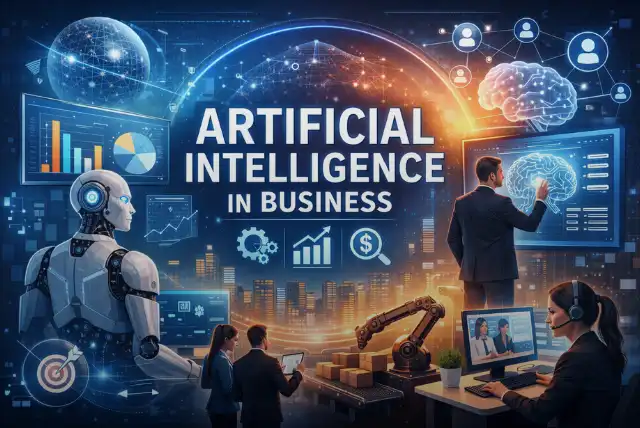
Artificial intelligence (AI) is no longer a concept confined to science fiction. It is now deeply integrated into businesses, driving automation, improving efficiency, and enabling data-driven decision-making. A 2024 report by PwC estimates that AI could contribute $15.7 trillion to the global economy by 2030, making it one of the most impactful technological advancements in history.
Companies adopting AI report up to a 40% increase in productivity. In marketing, 70% of professionals state that AI is the most valuable technology for customer engagement, while 67% use AI-driven strategies to personalize content and improve advertising effectiveness.
From customer service chatbots to predictive analytics in sales, AI is reshaping business operations. This article explores seven critical roles of AI in business, focusing on its impact on marketing, sales, product development, customer service, and security.
7 Role of Artificial Intelligence in Business
AI enhances business operations by automating tasks, reducing errors, and optimizing decision-making. Here are the primary ways AI is revolutionizing the corporate world.
1. AI in Marketing Strategies
AI is changing the way businesses interact with customers. It analyzes vast amounts of data to understand consumer behavior, personalize content, and optimize advertising campaigns.
Examples of AI in Marketing
- Netflix’s AI-driven recommendation engine accounts for 80% of viewed content, increasing customer retention.
- Coca-Cola uses AI to monitor social media trends and develop data-driven advertising strategies.
- AI-powered marketing tools like HubSpot and Jasper help businesses create targeted content and ad campaigns.
How AI Helps in Marketing
- Predictive analytics forecasts customer trends and recommends the best advertising strategies.
- Sentiment analysis monitors public opinion to adjust brand messaging.
- Automated ad targeting ensures that marketing budgets are spent efficiently, reducing costs by 30%.
2. AI in Sales Efficiency

AI enhances sales operations by identifying potential leads, personalizing outreach, and optimizing strategies.
Examples of AI in Sales
- Amazon’s AI-powered recommendation engine generates 35% of its total revenue by suggesting personalized products.
- Salesforce Einstein AI provides businesses with real-time sales insights, increasing conversion rates.
- AI-driven chatbots assist customers, reducing response times and improving user experience.
How AI Improves Sales
- Analyzes customer preferences to offer personalized product recommendations.
- Optimizes email marketing by determining the best times to reach out.
- Automates sales proposals, improving accuracy and speed.
3. AI in Product Development
AI accelerates innovation by streamlining product design, predicting failures, and optimizing manufacturing processes. Autonomous mobile robots are transforming industries by automating material handling, reducing human labor dependency, and improving overall production efficiency.
Examples of AI in Product Development
- Tesla’s self-driving AI processes real-time traffic data to improve autonomous driving.
- Apple uses AI for voice recognition and enhanced facial recognition in its devices.
- AI-powered automation helps automate complex manufacturing processes, increasing accuracy and efficiency.
- AI-driven 3D printing reduces development time by 50%.
4. AI in Human Resources
AI is transforming workforce management by automating hiring processes and enhancing employee engagement.
Examples of AI in HR
- Unilever uses AI-powered video analysis to assess job candidates, reducing hiring biases.
- AI tools like HireVue and Pymetrics analyze resumes and match candidates with job roles.
How AI Improves HR
- Automates resume screening, making hiring 75% faster.
- Enhances employee satisfaction analysis, using sentiment analysis from surveys.
- Predicts turnover trends, helping businesses improve retention.
5. AI in Customer Support
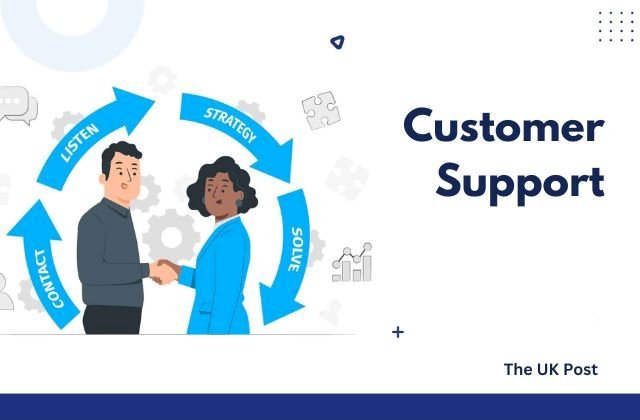
AI-powered virtual assistants and chatbots are improving customer interactions and service efficiency.
Examples of AI in Customer Support
- Bank of America’s Erica chatbot has handled over one billion customer interactions.
- Amazon’s Alexa and Google Assistant provide real-time customer assistance through AI-driven voice recognition.
How AI Enhances Customer Support
- Provides 24/7 instant responses to inquiries.
- Reduces service costs by 30%, freeing up human agents for complex cases.
- Uses AI sentiment analysis to improve responses and personalize interactions.
6. AI in Business Operations
AI enhances business efficiency by automating logistics, optimizing supply chains, and improving inventory management.
Examples of AI in Business Operations
- Walmart’s AI-powered robots manage inventory, reducing stock-related errors by 30%.
- UPS’s Orion AI system optimizes delivery routes, saving millions in fuel costs annually.
How AI Improves Operations
- Predicts supply chain disruptions, ensuring timely adjustments.
- Automates warehouse processes, improving inventory accuracy.
- Optimizes workflow automation, reducing operational costs.
7. AI in Fraud Detection and Security

AI helps businesses prevent fraud and improve cybersecurity by identifying threats before they cause damage.
Examples of AI in Fraud Detection
- Mastercard’s AI-powered fraud detection prevents unauthorized transactions in real time.
- Darktrace AI security systems detect cyber threats and prevent attacks before they escalate.
How AI Enhances Security
- Identifies fraudulent activity within seconds.
- Uses AI-driven risk assessment for fraud prevention in banking and e-commerce.
- Strengthens cybersecurity protocols, reducing hacking risks.
Read Also: How to Use AI for Business Optimization and Increased Productivity
The Benefits of AI in Business
AI provides numerous advantages, making businesses more efficient, secure, and customer-focused.
- Faster Processes – AI automates repetitive tasks, boosting efficiency.
- Cost Reduction – AI-driven automation saves $2.9 trillion annually across industries.
- Error Reduction – AI minimizes mistakes in data processing and decision-making.
- Better Insights – AI helps businesses make data-driven decisions faster.
- Enhanced Security – AI prevents cyber threats before they occur.
The Future of AI in Business

AI will continue to evolve, shaping industries with new innovations. Some key trends include:
- AI-Driven Personalization – Businesses will offer real-time customized experiences.
- AI in the Metaverse – AI-powered virtual assistants will support customers in immersive digital environments.
- AI & Blockchain – AI will enhance digital security and fraud detection.
- AI in Healthcare – AI will predict diseases and assist in drug discovery
How AI Is Regulated In The UK

Image source: pexels.com
The UK has taken a principles-based approach to AI, asking existing regulators such as the Information Commissioner’s Office, the Financial Conduct Authority and the Competition and Markets Authority to apply rules in their own sectors. Under UK GDPR, people have rights around solely automated decisions that have legal or similarly significant effects on them, such as hiring or credit decisions, so businesses need human review and clear explanations.
Selling Into The EU

Image source: pexels.com
The EU AI Act entered into force in August 2024, with obligations phasing in over several years. It can apply to UK companies that place AI systems on the EU market or whose AI outputs are used in the EU, so exporters should check whether their tools fall into its higher-risk categories.
Train Your People

Image source: pexels.com
AI projects succeed when staff understand the tools. Offer training on what AI can and cannot do, set clear rules on entering confidential or personal data into AI chatbots, and keep people accountable for final decisions. For more business technology ideas, see our guide to blockchain in supply chains.
How We Keep This Guide Up To Date
Rules, prices and services change, so we review guides like this regularly and update them when official sources change. Where the law or official guidance is involved, the relevant government or regulator’s website is always the final word, and it is worth checking there before making an important decision. If something here has changed, the official source will reflect it first.
A Quick Checklist Before You Decide

Image source: pexels.com
Before acting on anything in this guide, run through three quick checks. First, is the information current, and does it apply where you live in the UK, since rules often differ between England, Scotland, Wales and Northern Ireland? Second, have you compared more than one option or provider? Third, do you need professional advice for your specific situation? Taking ten minutes over these questions avoids most expensive mistakes.
Conclusion
In the workplace, using AI is tricky. Companies need to follow steps like finding where AI can help most, building good data systems, and fitting AI into their work. They also need people with the right skills. AI is everywhere now, from games to cars to medicine. It’s a big deal, with good and bad effects on society. So, we need to learn about AI and decide its future together.
FAQs
1. How does AI help businesses?
AI saves time, reduces mistakes, and improves customer service.
2. Which industries use AI the most?
AI is used in marketing, healthcare, banking, and retail.
3. How does AI stop fraud?
AI detects unusual activities and prevents fraud in real-time.
4. Will AI take away jobs?
AI will change jobs but also create new opportunities.
5. What is the future of AI in business?
AI will improve shopping, healthcare, security, and more.