
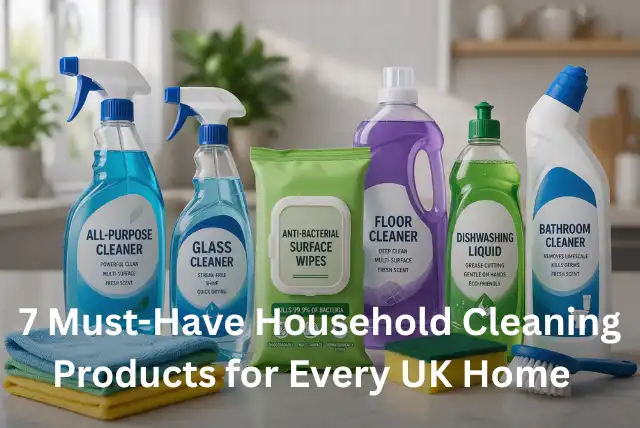
Most British homes own about three times as many cleaning products as they need, and the ones doing the real work are usually the cheapest on the shelf. This guide covers the seven that actually earn their place, what to skip, and the safety information that matters far more than any product recommendation.
That last part first, because it is the part people search for after something has gone wrong rather than before.
Last updated: 20 October 2026. Safety guidance checked against HSE and NHS sources on this date.
If someone swallows a cleaning product
Call 999 if they are unconscious, struggling to breathe or having a fit. Otherwise call NHS 111 straight away. Do not make them sick. Vomiting brings a corrosive product back up through the throat and does more damage. Keep the bottle and take it with you.
The short version
- Products you actually need: four do almost everything
- Never mix: bleach + ammonia, and bleach + any acid
- The symbol to respect: the corrosive pictogram — a red diamond
- Storage: high, locked, and always in the original bottle
- Hard water: changes what you need — descaler is essential in some areas, pointless in others
- Own brand: often the same actives. Compare ingredients, not price
- If swallowed: NHS 111. Do not induce vomiting. Keep the bottle.
What this article covers
- The two combinations you must never mix
- How to read the warning labels
- What to do if something goes wrong
- Storing them safely with children or pets
- The seven that earn their place
- What you can safely skip
- Hard water changes what you need
- Own brand, refills and what actually saves money
- Frequently asked questions
The Two Combinations You Must Never Mix
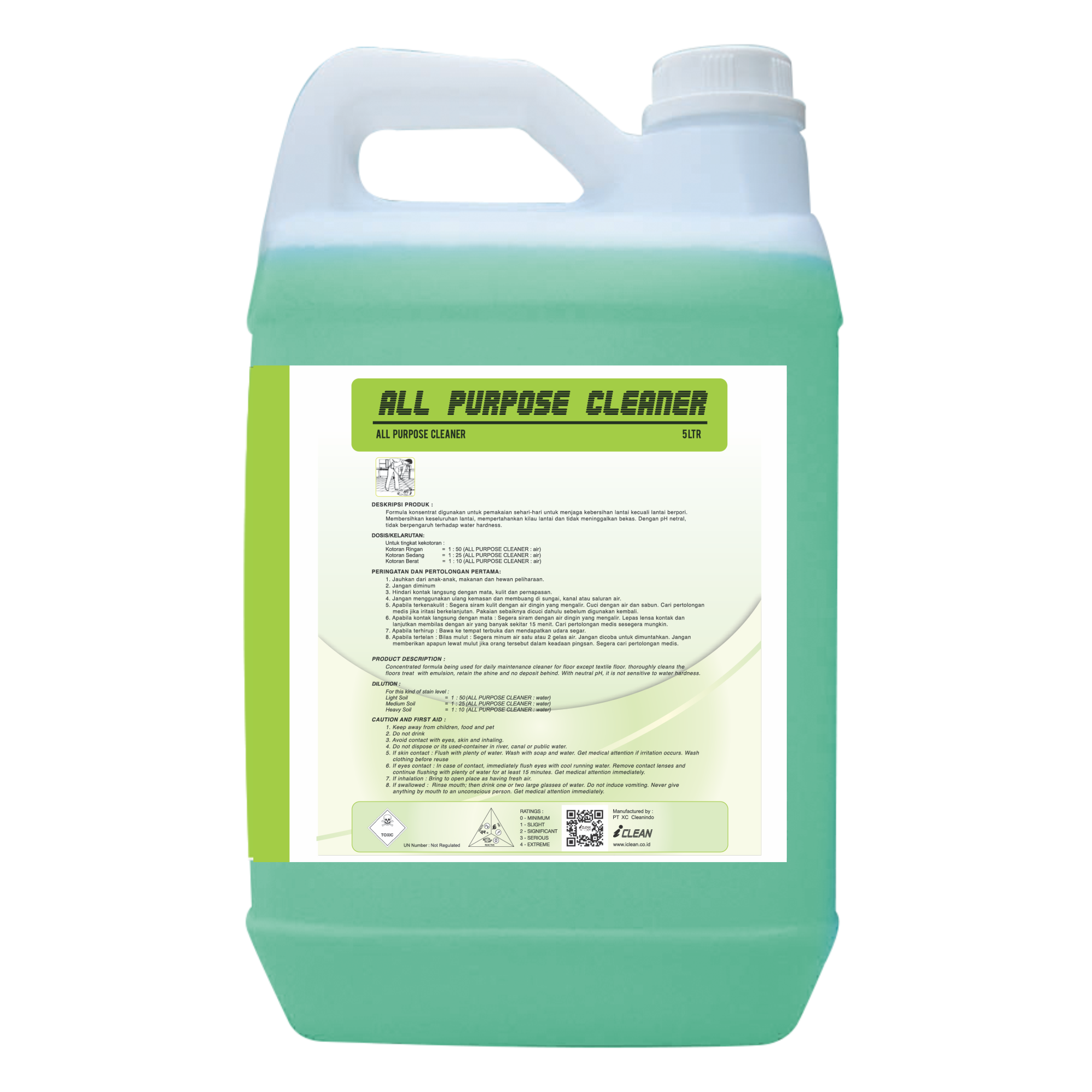
If you take one thing from this page, take this. Both of these happen in ordinary homes, usually in a small bathroom with the door shut.
| Combination | What it produces | Where it happens |
|---|---|---|
| Bleach + ammonia | Chloramine gas | Ammonia is in some glass cleaners and heavy-duty degreasers. Read the label — it is not always obvious |
| Bleach + any acid | Chlorine gas | Limescale remover, descaler, vinegar and many toilet cleaners are acidic |
| Bleach + vinegar | Chlorine gas | The “natural” option is still an acid. Being a food does not make it inert |
| Different toilet cleaners | Varies, potentially either of the above | One acidic, one bleach-based, poured into the same bowl minutes apart |
Both reactions are well documented. Background on hazardous chemical classes is at this overview.
The practical rule is simple: use one product, rinse, ventilate, then use the next. Never pour two things into the same bowl or bucket, and open a window before you start. If you do get a sharp smell and your eyes or throat sting, leave the room, open everything, and do not go back in to finish the job.
How To Read The Warning Labels

Those red diamonds on the bottle are a standard system, not decoration. The Health and Safety Executive publishes the full set, and four of them turn up constantly on household cleaners.
| Pictogram | What it means | On cleaning products |
|---|---|---|
| Corrosive — liquid burning a hand and a surface | Causes severe skin burns and eye damage | The one to respect most. Oven cleaner, strong descaler, drain unblocker |
| Exclamation mark | Irritant, or harmful if swallowed | Very common. Means take care, not that it is harmless |
| Health hazard — a figure with a starburst on the chest | Longer-term health effects, such as respiratory sensitisation | Some specialist and trade products |
| Environment — a dead fish and tree | Harmful to aquatic life | Means do not tip the remainder down the drain |
Source: HSE hazard symbols and pictograms, read 20 October 2026.
Two words worth knowing precisely. “Danger” is more serious than “Warning” — they are defined signal words, not marketing. And “irritant” does not mean mild; it means it will damage skin and eyes on contact rather than over time.
What To Do If Something Goes Wrong

This is the section the page previously lacked entirely, and it is the one that matters at the moment you need it.
| Situation | What to do |
|---|---|
| Swallowed | 999 if unconscious, struggling to breathe or fitting. Otherwise NHS 111 immediately. Do not make them sick. Keep the container |
| In the eyes | Rinse with cool running water for at least 15 minutes, holding the eye open. Then call 111. Do not rub |
| On the skin | Remove contaminated clothing, rinse thoroughly under running water, then seek advice if the skin is red, blistered or painful |
| Fumes inhaled | Get into fresh air at once. Call 999 if breathing is difficult. Do not re-enter to open windows |
| A pet has been exposed | Ring your vet straight away and tell them exactly which product it was |
General first-aid guidance. See NHS advice on poisoning for the full position, and always follow the instructions on the product label.
Why not induce vomiting? Because a corrosive product burns on the way down and burns again on the way back up, and because vomit can be inhaled. It is the single most common instinct and it is the wrong one.
Clinicians treating a poisoning in the UK consult the National Poisons Information Service. You reach that expertise through NHS 111 rather than directly, which is why 111 is the right call even when it does not feel like an emergency. RoSPA publishes further home safety guidance.
Storing Them Safely With Children Or Pets

- Keep everything in its original container. Most serious incidents involve a product decanted into something else. A cleaning fluid in a drinks bottle is the single worst thing in any kitchen.
- High, and locked if you can. Under the sink is the traditional place and the worst one — it is exactly child height.
- Keep the caps on properly. Child-resistant closures only work when fully closed.
- Separate bleach from acids physically, so they cannot be grabbed together in a hurry.
- Pets lick floors. Let floor cleaner dry fully before letting an animal back in, and rinse if the label says to.
- Dispose of the remainder properly. The environment pictogram means it should not go down the drain.
The Seven That Earn Their Place

| Product | What it is genuinely for | Honest verdict |
|---|---|---|
| All-purpose cleaner | Kitchen worktops, sealed surfaces, general wiping | The one you cannot do without. Does 70% of the work in most homes |
| Bathroom cleaner | Soap scum, basins, tiles | Worth having separately because the job is different |
| Washing-up liquid | Dishes, and a surprising amount else | Diluted, it cleans more than people realise |
| Floor cleaner | Hard floors, matched to the flooring type | Check it suits your floor — laminate and stone want different things |
| Glass cleaner | Windows, mirrors, glass | Useful, though a microfibre cloth and water does most of it |
| Antibacterial wipes | Quick jobs, raw-meat areas | Convenient, costly per use, and not recyclable. Keep for where they matter |
| Oven cleaner | Baked-on grease | The most hazardous thing in the cupboard. Strongly corrosive — gloves, ventilation, and read the label properly |
A realistic assessment of what each does. Always check a product suits the surface before using it.
What You Can Safely Skip
- Separate kitchen and “multi-surface” sprays that list the same actives. Read both labels and you will often find one product in two bottles.
- Antibacterial everything. On most household surfaces the mechanical action of wiping does the work. Reserve antibacterial for raw-meat preparation areas.
- Scented specialist sprays for single rooms. Fragrance is not cleaning.
- Drain unblockers as a first resort. Hot water, a plunger and removing the trap solve most blockages without the most corrosive product in the house.
- Anything you already own three of. The commonest household cleaning problem is duplication, not gaps.
If you would rather hand the whole job over, our guide to cleaning services in London covers what to look for in a professional.
Hard Water Changes What You Need
A genuinely British variable that most guides ignore. Much of the south and east of England has hard water; much of Scotland, Wales, Northern Ireland and the north-west does not.
| Your area | The main problem | What to buy |
|---|---|---|
| Hard water | Limescale on taps, kettles, shower screens and inside appliances | A descaler. It is acidic — never use it near bleach |
| Soft water | Soap scum rather than scale; products lather more | Skip the descaler. Use less detergent than the pack says |
Your water company publishes the hardness for your postcode, usually free on its site.
In a hard-water area, descaling the kettle and the washing machine also cuts energy use, because scale insulates the heating element. With bills where they are after the October 2026 price cap, that is a small saving that repeats every time you boil.
Own Brand, Refills and What Actually Saves Money
- Compare the ingredients, not the bottle. Own-brand and branded cleaners frequently share the same actives at similar concentrations.
- Work out cost per use, not cost per bottle. A concentrate that costs three times as much may make six times as much product.
- Refills cut plastic and usually cost less, provided you keep and reuse the trigger bottle.
- Dilute properly. Most people use far more than the label says, which wastes product and leaves residue that attracts dirt faster.
- Buy the small bottle of anything you rarely use. Cleaning products do degrade, and a cheap large bottle you throw away in two years is not a saving.
Frequently Asked Questions
What should I do if someone swallows a cleaning product?
Call 999 if they are unconscious, having difficulty breathing or fitting. Otherwise call NHS 111 immediately. Do not try to make them sick and do not give them anything to drink unless told to. Keep the container so the label can be read.
Which cleaning products must never be mixed?
Two combinations above all. Bleach and ammonia produce chloramine gas. Bleach and any acid — including limescale remover, vinegar and some toilet cleaners — produce chlorine gas. Both can be serious in an enclosed bathroom.
Is it safe to mix bleach and vinegar?
No. Vinegar is an acid, so it reacts with bleach to release chlorine gas. The fact that one of them is a kitchen cupboard staple does not make the reaction any safer.
What do the warning symbols on the bottle mean?
They are standard hazard pictograms — a red diamond with a black symbol inside. The corrosive one, showing liquid burning a hand and a surface, is the one to respect most on cleaning products. The HSE publishes the full set.
How many cleaning products do I actually need?
Far fewer than most homes own. A good all-purpose cleaner, a bathroom cleaner, washing-up liquid and a floor cleaner cover almost everything. Most specialist products duplicate something you already have.
Are own-brand cleaners as good as branded ones?
Frequently, yes. The active ingredients are often similar and are listed on the label. Compare the ingredients and concentration rather than the price or the packaging.
Do refills and concentrates save money?
Usually, and they cut plastic. Compare on cost per use rather than cost per bottle, because a concentrate that looks expensive may be several bottles’ worth.
Does hard water change which products I need?
Yes. In hard-water areas limescale is the main problem and you will need a descaler, which is acidic — and therefore must never meet bleach. In soft-water areas you can skip it.
How should I store cleaning products with children or pets in the house?
High, locked if possible, in their original containers, and never decanted into drinks bottles. Most serious incidents involve a product that was not in its own bottle.
Where can I get expert advice on a poisoning?
NHS 111 is the route for the public. Clinicians themselves consult the National Poisons Information Service, whose public pages explain what it does.
Conclusion
Four products do almost everything: an all-purpose cleaner, a bathroom cleaner, washing-up liquid and a floor cleaner matched to your floor. Add a descaler if you live in a hard-water area. Most of the rest duplicates something you already own.
The safety side matters more than the shopping. Never mix bleach with ammonia or with any acid. Read the red diamonds. Store everything high, locked and in its own bottle. And if something is swallowed, call NHS 111, keep the container, and do not try to make anyone sick. If you are interested in older domestic technology, our piece on boneshaker bicycles is a gentler read.
Sources
- HSE — hazard symbols and pictograms
- NHS — poisoning advice
- National Poisons Information Service
- RoSPA — home safety
- Background on hazardous chemical classes
Disclaimer
Safety guidance was checked against HSE and NHS sources on 20 October 2026. This article is general information and does not replace the instructions on a product label, which always take precedence. In an emergency call 999, or NHS 111 for urgent advice. Product suitability varies by surface — test first. More from The UK Post.



Image source: pexels.com
Image source: pexels.com

Image source: pexels.com

Image source: pexels.com