

The boneshaker was the first bicycle you could pedal, and the first anyone could buy. Built in France from the 1860s and sold as a velocipede, it had a wrought-iron frame, wooden wheels with iron tyres about a metre across, and pedals bolted straight onto the front axle. On cobbles it was punishing, which is how it got its nickname.
It mattered enormously. Within two years it had crossed to Britain and America, started the first cycling boom, and — in Coventry in 1868 — set off an industry that would dominate the city for a century. Then it vanished almost as fast, replaced by the penny-farthing from about 1870.
Last updated: 20 October 2026. Patent, dates and institutions verified on this date.
You cannot buy a “boneshaker bike” off the shelf
No mainstream manufacturer makes one. There are exactly three routes: an original from a specialist auction, a replica from a small builder, or a modern retro cruiser that borrows the look. Any page listing branded “boneshaker” models with prices is describing products that do not exist.
The boneshaker in brief
- What it was: the first commercially successful pedal bicycle
- Built: France, from the 1860s; Michaux produced them 1867–1869
- Patent: US 59,915 to Pierre Lallement, 20 November 1866
- Construction: wrought-iron frame, wooden wheels, iron tyres, ~14kg
- Reached Britain: 1868, via Coventry
- Why the name: iron tyres plus cobbles plus a rigid frame
- Superseded: from about 1870, by the penny-farthing
What this article covers
What a Boneshaker Actually Was

Image source: t3.ftcdn.net
Strip away the romance and it is a startlingly simple machine. Everything about it was a first attempt, and it shows.
| Part | How it was built | Why it mattered |
|---|---|---|
| Frame | Wrought iron, rigid, no suspension | Strong and cheap, but it transmitted every shock |
| Wheels | Wooden, iron tyres, roughly 1 metre across | Durable on dirt roads; brutal on cobbles |
| Drive | Pedals fixed directly to the front axle | No chain, no gears, no freewheel. One turn of the pedals is one turn of the wheel |
| Bearings | Lubricated bronze; some had oil reservoirs wicking from lamb’s wool | A genuinely sophisticated touch on an otherwise crude machine |
| Saddle | Mounted on a long flat spring | The only shock absorption on the entire bicycle |
| Brake | A lever pressing a wooden pad against the rear wheel | One brake, on the unweighted wheel. Expect long stopping distances |
| Weight | About 14kg (30lb) for a light model | Heavy by any modern standard |
Construction details as recorded in the published history of the velocipede. Read 20 October 2026.
The detail that explains everything else is the front-wheel drive. Because the pedals turn with the steering wheel, pedalling and steering interfere with each other, and top speed is limited by how fast your legs will spin. Solving that problem is what produced the penny-farthing’s enormous front wheel a few years later.
Who Invented It — An Honest Answer

Image source: fermanaghastoryin100objects.wordpress.com
Most articles state this confidently. They should not.
| Claimant | The case for | The problem |
|---|---|---|
| Pierre Michaux and his son Ernest | The Michaux company manufactured and sold them commercially from 1867 | The date the family first fitted pedals is claimed as 1861 but rests on a much later newspaper account |
| Pierre Lallement | Filed the only American patent for a pedal bicycle, granted November 1866 | His claim to have built one in France in 1864 is contested |
| The Olivier brothers | Financed and scaled the Michaux business | Investors rather than inventors |
Attribution as set out in the published histories of the velocipede and Pierre Lallement.
The reasonable conclusion is that the pedal bicycle was not invented once. Several people in France were circling the same idea in the early 1860s, one of them patented it in America, and another built a business on it. Anyone telling you flatly who invented the bicycle is simplifying a genuine historical dispute.
The Patent You Can Read
Here is something no other page about boneshakers offers: the actual document.
US Patent 59,915, “Improvement in Velocipedes”, was granted to Pierre Lallement on 20 November 1866, with James Carroll of New Haven, Connecticut as assignee. It was filed in April 1866. The text describes two wheels, one directly in front of the other, combined with a mechanism for driving them and an arrangement for guiding.
It is free to read in full, drawings included. For a machine whose origins are otherwise argued over in secondhand accounts, a dated patent document is the firmest evidence available — and it takes a minute to look at.
How It Started the British Cycle Industry

Image source: www.worksmancycles.com
This is the part of the story that belongs to Britain, and it is almost always left out.
In 1868, Rowley Turner, a sales agent for the Coventry Sewing Machine Company, brought a Michaux velocipede back to Coventry and placed an order with the firm for several hundred machines to be sold in France. Accounts differ on the exact number — some say 300, some 400 — and we are not picking one, because the sources genuinely disagree.
What is not disputed is the consequence. The company became the Coventry Machinists Company, and Coventry became the centre of British bicycle manufacturing. The firms that grew out of that trade went on to build motorcycles and then cars, which is why Coventry became a motor city at all. A sewing machine factory taking a speculative order for a French novelty is a reasonable claim for the start of the entire British cycle and motor industry.
From Boneshaker to Modern Bicycle
| Boneshaker | Penny-farthing | Safety bicycle | |
|---|---|---|---|
| Drive | Pedals on the front axle | Pedals on a huge front wheel | Chain to the rear wheel |
| Speed limit set by | How fast your legs spin | Wheel size, limited by leg length | Gearing — effectively unlimited |
| Getting on | Awkward | Genuinely dangerous | Easy |
| Falling off | Unpleasant | Potentially fatal — the “header” | Usually survivable |
| Still ridden? | By collectors | By enthusiasts | By everyone |
A compressed comparison of the three generations. Each solved the previous generation’s worst problem.
Buying an Original or a Replica

Image source: coimages.sciencemuseumgroup.org.uk
Be clear about what you are actually buying, because the word gets used for three very different things.
| What you are buying | What to expect | What to check |
|---|---|---|
| An original 1860s machine | Rare. Most were scrapped for metal in the First World War | Provenance and documentation. Whether the wheels, frame and saddle spring are original or later replacements. Expect specialist auction houses, not marketplaces |
| A faithful replica | Built to order by small specialist makers, in period style | Who built it and when, what it is made of, and whether it is intended to be ridden or displayed |
| A modern retro cruiser | A current bicycle with 19th-century styling, modern brakes and bearings | That it is sold honestly as retro styling, not as a historic machine |
We are not publishing prices here because we could not verify current figures. Check recent specialist auction results rather than any number on a blog.
A warning about listings. “Boneshaker” is a nickname, not a brand, so anyone can apply it to anything. If a listing uses it alongside an invented model name and a precise price, treat the whole thing with suspicion. Ask for the maker, the date and photographs of the hubs and the frame joints.
Where to See One in the UK
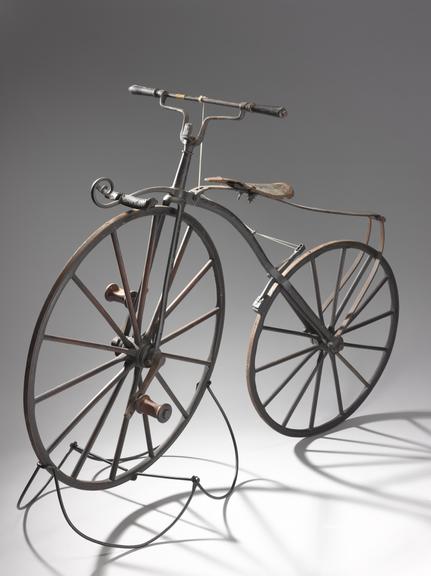
Image source: coimages.sciencemuseumgroup.org.uk
Far more satisfying than buying, and free or inexpensive. These are real institutions, checked on 20 October 2026 — but confirm opening times and what is currently on display before you travel, because collections rotate.
- The National Cycle Museum, Llandrindod Wells, Wales — home to over 260 cycles, covering the full span from the earliest machines onwards.
- Coventry Transport Museum — in the city where British cycle manufacturing began, which gives the Coventry story above its proper context.
- The Science Museum Group — its collection includes early cycles; search the online catalogue before visiting to see what is accessible.
- Local and club events — veteran cycle clubs run rides where originals and replicas are ridden in public, which is the only way to see one actually moving.
Riding One Safely
If you do get the chance, the machine will not behave like anything you have ridden.
- One brake, on the back wheel, operated by a lever pressing a wooden pad. Stopping distances are long. Plan well ahead.
- Pedalling steers the bike. The pedals are on the front axle, so pushing harder with one leg turns you. This takes practice.
- No freewheel. The pedals keep turning as long as the wheel does. You cannot coast.
- Smooth ground only. Iron tyres on a rigid frame are unforgiving, and the name is not a joke.
- Not in traffic. Private land or a closed event. A modern helmet looks wrong and is worth it anyway.
- Check the wheels first on any old machine. Dried-out wooden felloes and loose iron tyres are the common failure, and they fail suddenly.
If you are transporting one, it is heavy and awkwardly shaped — our comparison of roof rails and roof racks covers the load-carrying side, and if you are storing something valuable at home, our guide to door locks and home security is worth a look.
Why the Look Keeps Coming Back

Image source: pinterest.com
Every few years the styling returns — swept handlebars, a sprung leather saddle, cream tyres, a deep single colour. It persists because the shape is honest: you can see exactly how the machine works, which is the opposite of a modern bicycle with its cables routed inside the frame.
Just keep the distinction clear. A retro cruiser is a modern bicycle wearing 19th-century clothes, and there is nothing wrong with that. It is not a boneshaker, and it should not be sold as one.
Frequently Asked Questions
What is a boneshaker bike?
The first commercially successful pedal bicycle, built in France in the 1860s. It had a wrought-iron frame, wooden wheels with iron tyres about a metre across, and pedals fixed directly to the front axle. Makers called it a velocipede; riders called it a boneshaker.
Why was it called a boneshaker?
Because of the ride. A rigid iron frame and iron-tyred wooden wheels on cobbled streets transmitted every bump straight to the rider. The nickname dates from the 1860s and was never a brand name.
Who invented the boneshaker?
It is genuinely disputed. Pierre Michaux and his son Ernest are credited in France, and Pierre Lallement filed the only American patent for a pedal bicycle, granted in November 1866. The Olivier brothers financed the Michaux company. The honest answer is that several people were working on the same idea at once.
Can you still buy a boneshaker?
Not as a current production model. Originals appear occasionally at specialist auctions, small builders make accurate replicas to order, and some modern cruisers copy the styling without the 1860s engineering. There is no shop model called a boneshaker.
How much does an original boneshaker cost?
It varies enormously with condition, maker and provenance, and we are not quoting a figure because we could not verify current prices. Check recent results from specialist auction houses rather than any number you read on a blog.
Are boneshakers safe to ride?
They are rideable but demanding. There is one weak brake, no freewheel, no gears, and the pedals turn with the front wheel, so steering and pedalling fight each other. Ride one on smooth private ground, not in traffic, and wear a helmet.
How fast could a boneshaker go?
Not fast. With pedals fixed directly to the front wheel, speed is limited by how quickly you can turn your legs, which is why the next generation made the front wheel enormous.
What replaced the boneshaker?
The high-wheel bicycle, the penny-farthing, from about 1870. A bigger front wheel meant more distance per pedal revolution. That in turn gave way to the chain-driven safety bicycle, which is the design we still ride.
Where can I see a boneshaker in the UK?
The National Cycle Museum at Llandrindod Wells holds over 260 cycles, Coventry Transport Museum covers the city where British cycle manufacturing began, and the Science Museum Group collection includes early machines. Check opening times before travelling.
Why are so few originals left?
Most were scrapped. Large numbers of iron-framed machines were melted down for their metal during the First World War, which is why surviving examples are scarce and valuable.
Conclusion
The boneshaker was uncomfortable, slow, hard to steer and brilliant. It was the first bicycle an ordinary person could buy and pedal, it created the first cycling craze, and in 1868 it turned a Coventry sewing machine works into the beginning of the British cycle industry.
You cannot walk into a shop and buy one, whatever a product list tells you. What you can do is read the 1866 patent, go and stand next to a real one in Llandrindod Wells or Coventry, and understand why the next sixty years of engineering happened.
Sources
- US Patent 59,915 — Improvement in Velocipedes, 20 November 1866
- Velocipede — construction, production dates and decline
- Pierre Lallement — the patent and the disputed claim
- History of the bicycle
- Grace’s Guide — Coventry Machinists Company
- The National Cycle Museum, Llandrindod Wells
- Coventry Transport Museum
- Science Museum Group collection
Disclaimer
Historical details, dates and the patent reference were verified on 20 October 2026. Where sources disagree — notably the size of the 1868 Coventry order and the exact date pedals were first fitted — this is stated rather than resolved. No prices are quoted because current figures could not be verified; check specialist auction results. Museum displays rotate, so confirm before travelling. More from The UK Post.

Image source: www.sterba-bike.cz