
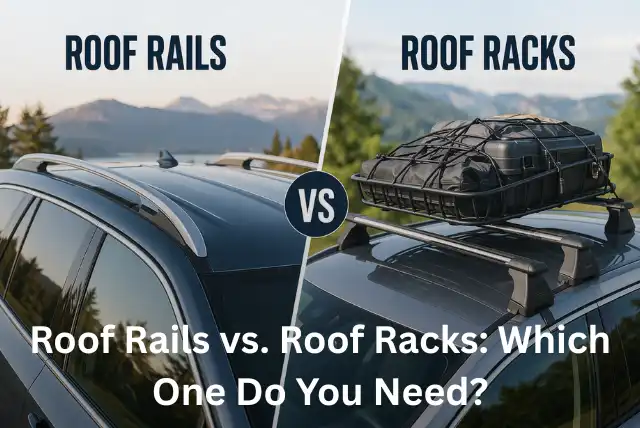
You might have heard individuals say to keep the extra gear on “roof rails” and “roof racks”. The terms do sound similar, but in reality, they carry the potential to startle you in different ways.
Are you considering getting one for your heavy-duty gear, but not sure which one will benefit you more? Then this blog is here to offer you some clarity as we will discuss and help you decide which one will remain ideal for your adventures.
What Are Roof Rails?

Roof rails are long aluminum or steel structures that run parallel to the edges of a vehicle’s roof. They are often pre-installed by manufacturers, especially on SUVs, wagons, and crossovers. Roof rails serve as a base for attaching crossbars and other accessories like bike racks, ski mounts, or cargo boxes.
Key Benefits of Roof Rails:
-
Versatility: Roof rails allow you to attach various accessories for carrying different types of gear, including bikes, kayaks, or luggage.
-
Aesthetics: They add a sleek, functional look to your car.
-
Weight Distribution: Roof rails allow for even weight distribution when paired with crossbars.
However, roof rails alone are not sufficient for securely holding cargo. You’ll need crossbars or additional attachments to keep items in place.
What Are Roof Racks?

Roof racks, on the other hand, are complete systems that typically consist of horizontal crossbars mounted across the roof. These crossbars can attach to roof rails or directly to the roof using clamps or mounting points.
Key Benefits of Roof Racks:
-
Heavy-Duty Capacity: Roof racks can hold heavier loads compared to roof rails alone, making them ideal for bulkier items like cargo baskets and kayaks.
-
Customizable Options: Roof racks come in various designs, such as platform racks or specialized mounts for snowboards or surfboards.
-
Utility: Roof racks provide a ready-to-use system without requiring additional components like crossbars.
However, roof racks may slightly impact your vehicle’s aerodynamics, increasing wind resistance and potentially reducing fuel efficiency. Proper installation and consideration of driving conditions can minimize these effects.
Roof Rails vs. Roof Racks: Which One Do You Need?

Choosing between roof rails and roof racks depends on your vehicle’s design and your lifestyle. Here’s a breakdown:
-
Vehicles with Pre-Installed Roof Rails:
-
If your car already has roof rails, you’ll only need to add crossbars or specific attachments to carry gear. Roof rails are perfect for those who need flexible options to switch between different types of equipment.
-
-
Vehicles Without Roof Rails:
-
If your vehicle lacks roof rails, you’ll need to install a roof rack system. Modern roof racks can clamp onto the roof or attach to manufacturer-supplied mounting points. These are ideal for individuals who frequently transport heavy or bulky items.
-
How to Choose the Right Option

Consider these factors before deciding:
-
Usage Frequency: If you frequently carry large or heavy items, roof racks may be the better choice.
-
Vehicle Compatibility: Check your vehicle’s manufacturer guidelines for roof load limits and compatibility with roof accessories.
-
Cost: Roof racks are generally more expensive due to their higher capacity and complete system design. Roof rails, if already installed, can save money on additional components.
Safety and Maintenance Tips

-
Weight Limits: Always adhere to your vehicle’s weight capacity to avoid damage or accidents.
-
Secure Attachments: Double-check that all items are securely fastened before driving.
-
Aerodynamics: Use wind deflectors to reduce drag and improve fuel efficiency.
-
Regular Inspections: Check for wear and tear on mounting points, bolts, and accessories to ensure longevity and safety.
Where to Buy Roof Rails and Roof Racks in 2025
For high-quality options, trusted brands like Front Runner, Thule, and Yakima offer a wide range of roof rails and roof racks suitable for various vehicles. Compare features and customer reviews before purchasing. Look for stores or websites with installation services and warranty coverage for added convenience.
Conclusion
choosing between roof rails and roof racks depends on what you need and your vehicle. Roof rails are great for flexibility and style, while roof racks are stronger and can carry heavier things. Think about how often you’ll use them, what your car can handle, and your budget before making a choice.
Always stay safe by following weight limits, checking that everything is secure, and inspecting your setup often. Whether it’s a big road trip or just extra space for everyday travel, picking the right roof system can make your journey much better and easier.
Frequently Asked Questions
1. Can roof rails be used as roof racks?
No, roof rails alone are not designed to hold cargo. You’ll need crossbars or additional attachments to securely carry items.
2. Do roof racks affect fuel efficiency?
Yes, roof racks can slightly reduce fuel efficiency due to increased wind resistance. However, using aerodynamic designs can mitigate this impact.
3. Which is better for off-road adventures?
Roof racks are generally better for off-road adventures as they can securely hold heavier gear and offer more stability.
4. Are roof racks removable?
Yes, most roof racks can be removed or swapped out for different configurations based on your needs.
5. How much weight can roof racks carry?
The weight limit varies by vehicle and rack system. Check your vehicle’s manual and the manufacturer’s specifications for exact details.
Find Your Car’s Roof Load Limit First
Before choosing between rails and racks, find the number that governs both. Every car has a maximum roof load specified by the manufacturer, and it is printed in the owner’s handbook rather than on the roof. Two figures matter and people confuse them. The dynamic load is what the roof may carry while the car is moving, and it is the lower number, commonly somewhere around 75 kilograms on an ordinary family car. The static load, relevant to roof tents when parked, is much higher because the stresses are different. The dynamic figure includes the bars and the box themselves, not just what you put inside.
An Insecure Load Is An Offence
This is the part guides leave out and it has real consequences. Driving with a load that is not properly secured is a motoring offence in the UK, and it can bring a fine and penalty points, or considerably worse if something comes off on a motorway. The Highway Code is explicit that a vehicle must not be overloaded and that loads must be secure. Beyond the law, an insurer will take a close interest in whether the roof load was within the manufacturer’s limit and correctly fitted, which is a conversation nobody wants to have after an accident.
Which Roof Do You Actually Have
Cars come with one of five roof types and the fitting kit depends entirely on which you have. Raised rails run front to back with a visible gap beneath them, so a bar clamps straight around them. Flush or integrated rails sit tight to the roof with no gap and need a specific clamp that grips the rail profile. Fixed points are threaded mounting holes hidden under plastic covers. A naked roof with no fittings takes a clamp that grips the door frame with the doors open. And older vehicles with rain gutters take a simple gutter clamp. Buy the fitting kit for your exact model and year.
What A Roof Box Costs You In Fuel
Aerodynamics punish anything on a roof, and the effect is larger than most drivers expect. Independent testing has repeatedly put the fuel penalty of a loaded roof box at roughly ten to twenty-five per cent at motorway speeds, with the higher end applying to large boxes on small cars. Empty bars alone still cost a few per cent. The conclusion is simple and is the single best piece of advice in this article: take the box and the bars off when you are not using them. A set left on all year costs more in fuel than the box did.
Noise, And How To Reduce It
Roof bars whistle, and how much depends on the bar. Square steel bars are the cheapest and the loudest, because the flat face and the sharp edges shed air turbulently. Aerofoil or wing-profile bars cut the noise substantially and improve the fuel figure at the same time, which is where the price difference goes. A wind fairing clipped to the front bar helps on square bars. Beyond hardware, position matters: loading tall items at the front of the rack creates more noise and drag than loading them behind the leading bar.
Fitting It Properly
Most roof-load failures are fitting errors rather than equipment failures. Fit the bars at the spacing the manufacturer specifies, because bars set too close together concentrate the load and reduce stability. Tighten to the stated torque, using the torque indicator many kits now include rather than guessing with brute force. Load the heaviest items low and centred over the bars. Then stop after the first few miles of the first journey and recheck everything, because clamps bed in and settle. Repeat that check at every fuel stop on a long trip.
Remember How Tall You Now Are
The most common damage caused by roof equipment happens at walking pace. Multi-storey car parks, supermarket entrances, height barriers, drive-through lanes and some petrol station canopies are set at heights that a car clears easily and a car with a roof box on top does not. Measure the total height once with the box fitted and write it somewhere you will see it, on the dashboard or in your phone. Car park barriers in Britain are frequently set around two metres, which is below the height of many SUVs with a box on the roof.
Bikes, Kayaks And Everything Else
Different loads want different hardware and the roof is not always the answer. Bike carriers come as roof-mounted, tow-bar-mounted or boot-mounted, and tow-bar carriers are easier to load, cost less in fuel and keep the weight low, which matters if you are carrying more than two bikes. Kayaks and boards want J-cradles or saddles rather than being strapped flat to bare bars. Ski and snowboard carriers clamp to the same bars. Whatever the load, the roof load limit from the first section still applies to all of it together, including the carrier.
Working on the car at home? See our essential garage safety tips.