That or Which? The Rule, the Commas and British Usage
The that vs which rule explained: that for defining clauses, which with commas for extra information, and how British usage differs.
 8 min read
Comments: 0Views: 4
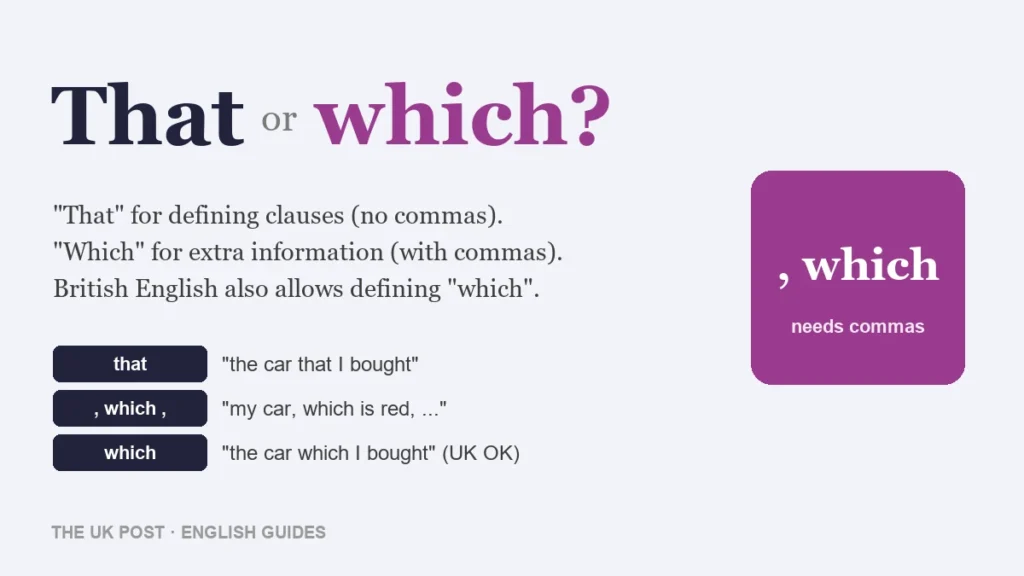
Short answer: use “which” with commas when the clause adds extra information that could be removed: “My car, which is red, needs a service.” When the clause identifies which thing you mean, use “that” with no commas: “The car that I bought last year needs a service.” That is the rule in American English. In British English, “which” is also accepted in identifying clauses (“the car which I bought”), but our analysis shows British writers have moved firmly towards “that”: in six common phrases, “that” rose from about 60% of uses in British books of the 1950s to about 90% in the 2010s. The one rule that applies everywhere: never use “that” after a comma or a preposition.
That vs Which at a Glance
| Type of clause | What it does | Word | Commas? | Example |
|---|---|---|---|---|
| Defining (restrictive) | Identifies which one you mean; essential | that (UK: which also OK) | No | “The book that I lent you is overdue.” |
| Non-defining (non-restrictive) | Adds extra information; could be removed | which only | Yes | “The book, which I lent you, is overdue.” |
| After a preposition | – | which only | – | “The house in which I grew up.” |
| Referring to a whole idea | Comments on the previous clause | which only | Yes | “He was late, which annoyed everyone.” |
| People | – | who (that is informal) | Depends | “The nurse who helped me.” |
The Rule in Plain English
Ask yourself: if I take this clause out, do I still know exactly which thing I mean?
- Yes, the clause is just extra detail: use which, with commas. “London, which is the UK’s capital, has almost nine million people.” Remove the clause and you still know which city.
- No, the clause tells me which one: use that, without commas. “The train that leaves at 8.15 is always late.” Remove the clause and you no longer know which train.
The commas do most of the work. A clause between commas is extra; a clause without commas defines. That is why “My brother, who lives in Leeds, is a teacher” (I have one brother) means something different from “My brother who lives in Leeds is a teacher” (I have more than one brother, and I mean the one in Leeds).
British grammar books usually call these defining and non-defining relative clauses; American ones say restrictive and non-restrictive. They mean the same thing.
Is “Which” Wrong in Defining Clauses?
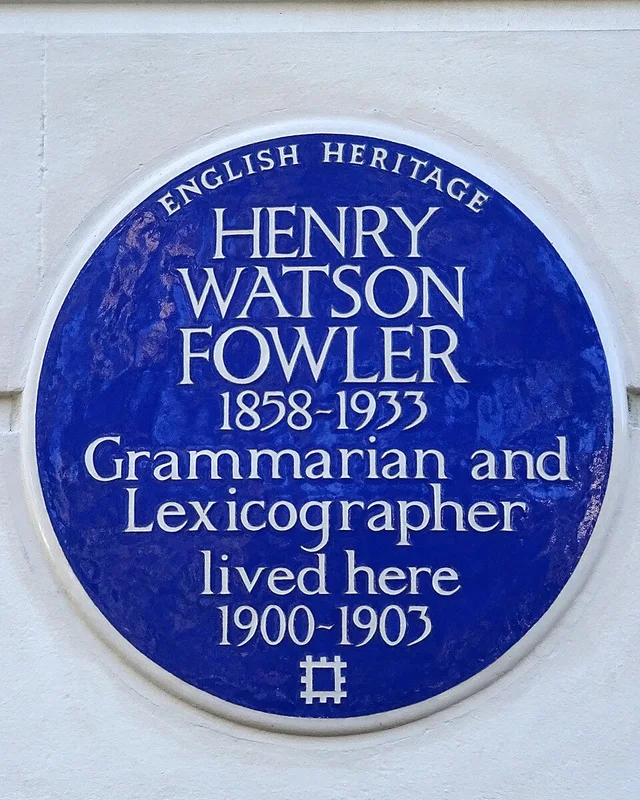
Not in British English. “The car which I bought last year” is grammatically correct and has been used by good writers for centuries. The strict “that for defining, which for non-defining” rule was popularised by the English lexicographer H. W. Fowler in A Dictionary of Modern English Usage (1926), who suggested it would make English clearer, and it was taken up most firmly by American style guides and editors.
Today many British editors also prefer “that” in defining clauses because it makes the meaning obvious at a glance. If you are writing for an American publication, an exam marked to US rules or a style guide that requires it, follow the rule strictly. Otherwise, “which” in a defining clause is a choice, not an error, as long as you don’t add commas.
What Our Data Shows
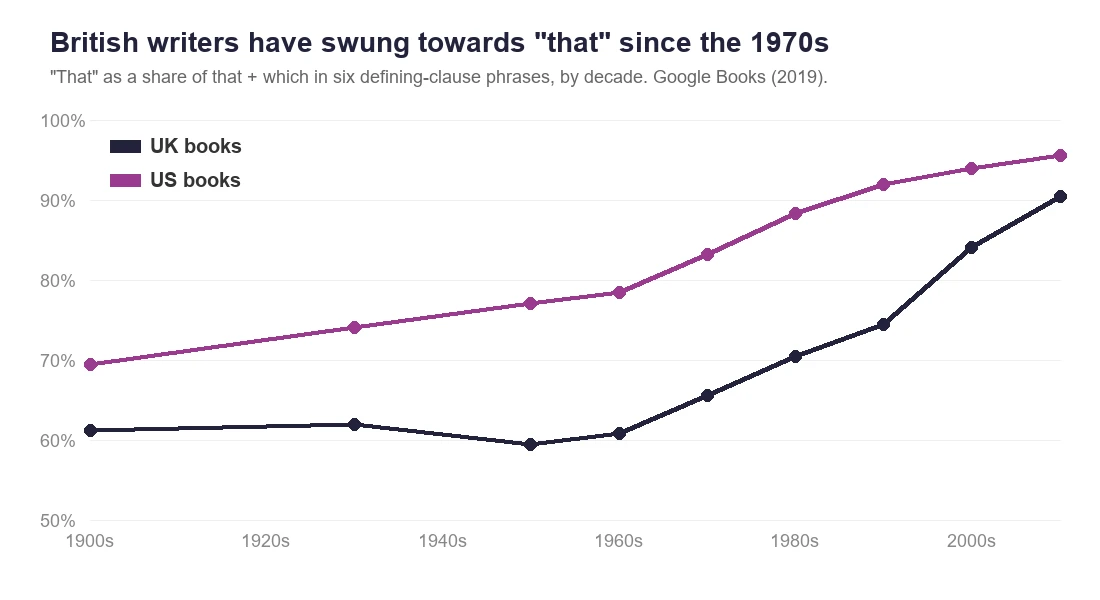
Google Books records commas separately, so a phrase like “something which” without a comma counts only defining uses. We compared six such pairs, including “something that/which”, “the one that/which” and “everything that/which”, in the British and American English collections, which run to 2019:
- In British books, “that” held steady at about 60% of these uses from the 1900s to the 1960s, so “which” was very common in defining clauses.
- From the 1970s British writers moved steadily towards “that”, reaching about 90% by the 2010s.
- In the 1950s, “something which” was actually more common than “something that” in British books (58% to 42%). By the 2010s, “something that” led 87% to 13%.
- American writers had already favoured “that” for longer: about 77% in the 1950s, rising to about 96% by the 2010s.
- 1900s-1960s“That” holds at about 60% of defining uses in British books; “which” is common.
- 1926H. W. Fowler suggests “that” for defining and “which” for non-defining clauses.
- 1950s“Something which” is more common than “something that” in British books.
- 1970sBritish writers start moving steadily towards “that”.
- 2010s“That” reaches about 90% in British books and 96% in American books.
Rules That Apply in All English
- Never “that” after a comma. “My phone, that is new, broke” is wrong; write “My phone, which is new, broke.”
- Never “that” straight after a preposition. Write “the house in which I grew up” or “the house that I grew up in”, but never “the house in that I grew up”.
- “Which” for a whole idea. “She passed her test, which surprised everyone.” Here “which” refers to the whole event, not one noun.
- “Who” for people. “The doctor who treated me” is the safest choice; “the doctor that treated me” is common in speech but less formal.
- You can often drop “that”. “The book (that) I read” works without it, but you cannot drop “which” in a non-defining clause.
Test Yourself
Choose the right word for each sentence. Your score appears at the bottom.
1. "My laptop, ___ is five years old, still works."
2. "The laptop ___ I bought yesterday is faster." (American style)
3. "This is the town in ___ I was born."
4. "He forgot her birthday, ___ upset her."
5. "The woman ___ called you is my aunt." Which is most formal?
My Advice
Use “that” without commas when the clause tells the reader which one you mean, and “which” with commas when you are adding extra detail. It is the clearest system, it satisfies American editors, and it is now what most British writers do anyway. But don’t let anyone tell you “the car which I bought” is wrong in British English; it isn’t. For more grammar and spelling traps, see our guide to commonly confused words, and our pages on especially or specially and smelled or smelt.
Frequently Asked Questions
What is the that vs which rule?
Use “that” (no commas) for clauses that identify which thing you mean, and “which” (with commas) for clauses that add extra information.
Can you use which instead of that in British English?
Yes. In British English “which” is accepted in defining clauses, as in “the car which I bought”. Just don’t add commas.
Do you need a comma before which?
Yes, when it introduces extra information: “Our office, which is in Leeds, is closed.” Not when it introduces a defining clause in British English.
Can that be used after a comma?
No. After a comma, use “which” (or “who” for people).
Who made up the that/which rule?
H. W. Fowler popularised it in A Dictionary of Modern English Usage (1926), and American style guides adopted it most strictly.
Should I use that or who for people?
“Who” is preferred in formal writing: “the person who called”. “That” is common in casual speech.
What is a defining relative clause?
A clause that identifies which person or thing you mean, without commas: “The man who lives next door is a pilot.”
What is a non-defining relative clause?
A clause that adds extra information between commas: “My neighbour, who is a pilot, is away.”
Can I leave out “that”?
Often, in defining clauses where it is the object: “The film (that) we watched was great.”
Is that or which more common in British English today?
“That” is now far more common in defining clauses: about 90% in our sample of British books from the 2010s.
Final Thoughts
Commas are the key: “which” with commas adds extra detail, and “that” without commas tells the reader which one you mean. American English treats this as a firm rule; British English allows “which” in both kinds of clause, though British writers increasingly choose “that”. Follow the system and your sentences will always be clear.
Sources: Our own analysis of Google Books Ngram data (British and American English 2019 collections, six phrase pairs; notes on file); H. W. Fowler, A Dictionary of Modern English Usage (1926); English Heritage blue plaque for H. W. Fowler; standard British grammar guidance on defining and non-defining relative clauses.