Process Server: What They Do, Your Rights and What to Do If Served
What a process server does in the UK, how personal service and form N215 work, what they can't do, how to spot a fake, what it costs and what to do if you're served.
 9 min read
Comments: 0Views: 3
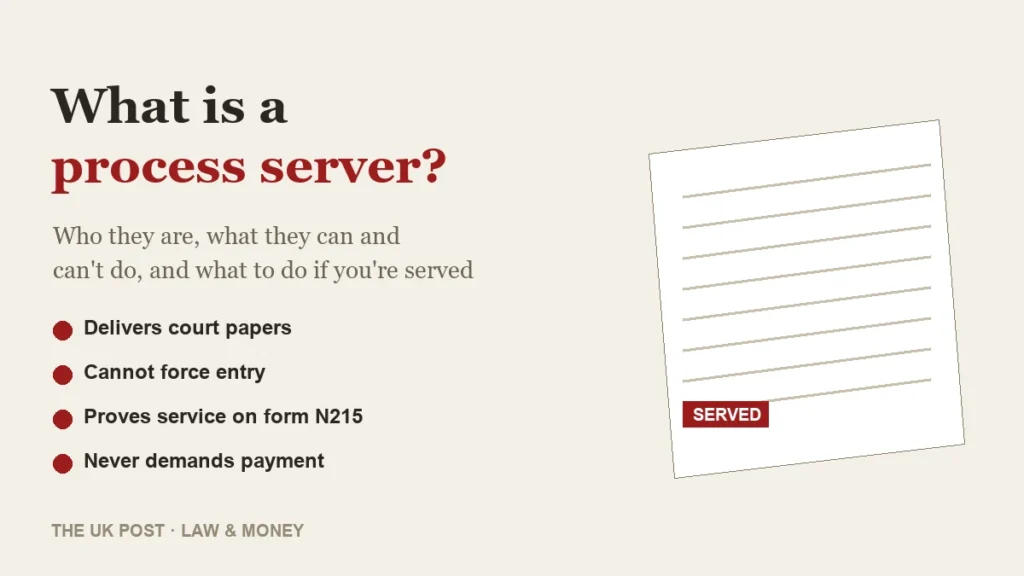
Short answer: a process server is a person paid to deliver legal documents, such as court claims, divorce papers, injunctions or insolvency demands, to the person named in them, and then prove to the court that they did. In England and Wales the rules on serving documents are in Part 6 of the Civil Procedure Rules, and the server usually signs a statement or a certificate of service (form N215) setting out when, where and how the papers were handed over. Process servers are not bailiffs: they cannot enter your home, take your belongings or demand money. Being served simply means a legal process has started, so read the papers straight away and note any deadline, because ignoring them can lead to a judgment against you. In Scotland, court documents are usually served by sheriff officers instead.
What Does a Process Server Do?
Courts need proof that people know about legal proceedings against them, so that nobody loses a case without the chance to respond. Many documents can be served by post, email or through a solicitor, but some must, or should, be handed to the person directly. That is called personal service, and it is what process servers do.
Common documents served by process servers include:
- civil court claim forms and particulars of claim;
- divorce and family proceedings papers, where postal or email service has not worked;
- injunctions and non-molestation orders, which often must be served personally;
- statutory demands and bankruptcy or winding-up petitions;
- witness summonses;
- notices and orders in property and possession cases.
Process servers are often private investigators or specialist firms instructed by solicitors, businesses or individuals. In England and Wales there is no licence or official register, so standards vary. Many reputable servers belong to professional bodies such as the Association of British Investigators.

How Service Works, Step by Step
How personal service works
- Instruction: a solicitor or claimant gives the server the documents, the person’s name, address and, ideally, a photo or description.
- Attempts: the server visits the address, often at different times of day, including early mornings, evenings or weekends.
- Identification: they confirm they have the right person, usually by asking their name.
- Handing over: they hand over or leave the documents with the person and tell them what they are. Refusing to take them does not usually stop service: documents left with or near someone who has been told what they are can still count.
- Proof: the server signs a statement or a certificate of service (form N215), sometimes with photos, setting out the details. This is filed at court.
Companies are served differently: personal service on a company can be made by leaving papers with someone holding a senior position, or at its registered office.
What a Process Server Can and Cannot Do
| A process server can | A process server cannot |
|---|---|
| Knock on your door and ask for you by name | Force their way into your home or a locked building |
| Hand you documents in a public place, such as outside your work | Take your belongings or remove goods |
| Make several visits at different times | Demand or collect payment of a debt |
| Leave papers with you even if you refuse to take them, once they have told you what they are | Threaten, harass or lie about who they are |
| Take photos to prove service | Stay on private property after being asked to leave |
Enforcement agents (bailiffs) are different. They are certificated, act on court orders to recover money or goods, and follow strict rules. If someone claims to be both, ask for identification and check with the court or the creditor’s solicitor.
Beware of Fake Process Servers
Scammers sometimes pretend to be process servers or “legal officers”, calling, texting or emailing to say papers will be served unless you pay immediately. A genuine process server delivers documents; they do not ask for payment, bank details or gift cards, and they do not threaten arrest. If you are unsure, do not use the phone number or link in the message: look up the court or the solicitor yourself and check. Our guide on how to stay safe online covers common scam tactics.
What to Do If You Are Served
- Do not ignore it. Read everything, and note the court, the case number and any deadline. For a county court money claim, you usually have 14 days after service to respond, or 28 days if you acknowledge the claim and say you intend to defend it.
- Check what it is. A claim form, an order, a statutory demand and a bankruptcy petition each have different timescales and consequences.
- Get advice quickly: a solicitor, Citizens Advice, or a law centre. For debt claims, free debt charities can help.
- Keep everything, including the envelope and a note of when and how you received it.
- If you dispute service (for example, it went to an old address), raise it promptly with the court.
Some demands for money are not court papers at all. Our guide to the RLP letter explains civil recovery letters, which only a court can make you pay.
How to Hire a Process Server
- Check the rules first: some documents can simply be posted or emailed under the court rules, and the court itself serves many claims.
- Choose a reputable firm with insurance, clear fees and membership of a professional body.
- Costs: fees depend on urgency, location and the number of attempts. Standard service is commonly quoted from roughly £60 to £150, with extra for same-day, out-of-hours or tracing services. Get a written quote.
- Give good information: a photo, description, work address and times the person is usually in make success more likely.
- Get proper proof: make sure you receive a signed statement or certificate of service that meets the court’s requirements.
If the person cannot be found or is avoiding service, the court can allow alternative service, for example by email or social media, if you can show good reason. Ask a solicitor before applying.
Property disputes are a common reason for serving papers; our explainer on squatters’ legal rights covers the possession process in England and Wales.
My advice: if you are being served, take the papers calmly, then get advice the same week. Most problems with court papers come from people putting them in a drawer and missing the deadline.
Scotland and Northern Ireland
Scotland has its own legal system. Court documents are usually served by sheriff officers (or messengers-at-arms for the Court of Session), who are court officers, and some documents can be posted by recorded delivery. Northern Ireland has its own court rules, and documents may be served personally by process servers or by post. Check the rules for the court involved.
Frequently Asked Questions
What is a process server?
A person who delivers legal documents to the person named in them and provides proof of delivery to the court.
Can a process server come into my house?
No. They cannot force entry or stay on your property after being asked to leave.
What happens if I refuse to accept the papers?
Refusing usually does not stop service. If the server tells you what the documents are and leaves them with you, the court will normally treat you as served.
Can a process server serve papers at my work?
Yes. They can hand papers to you personally anywhere, including outside your workplace.
Do process servers need a licence in the UK?
Not in England and Wales. Many belong to professional bodies. In Scotland, sheriff officers are regulated court officers.
Is a process server the same as a bailiff?
No. A process server only delivers documents. Bailiffs (enforcement agents) enforce court orders and can take goods.
What is form N215?
The certificate of service used in the civil courts of England and Wales to record which documents were served, on whom, and when, where and how.
How long do I have to respond to court papers?
It depends on the document. For a county court claim, usually 14 days from service, or 28 days if you acknowledge it and intend to defend. Check the papers and get advice.
How much does a process server cost?
Typically from around £60 to £150 for standard service, more for urgent or difficult cases.
How can I tell if a process server is fake?
A real process server does not demand payment, bank details or threaten arrest. Check directly with the court or solicitor using contact details you find yourself.
Final Thoughts
A process server is simply the messenger of the legal system: their job is to make sure you know about a case, not to punish you. If papers arrive at your door, stay calm, read them carefully, check the deadline and get advice quickly. And if someone claiming to be a process server asks you for money, it is almost certainly a scam.
Sources: Civil Procedure Rules Part 6 and Practice Direction 6A; GOV.UK, form N215 certificate of service; Insolvency Service technical manual on service of documents; GOV.UK guidance on responding to a court claim; Scottish Courts and Tribunals Service; Citizens Advice.