Commonly Confused Words: 50+ Pairs Explained, With UK Spelling Tips
Commonly confused words explained in plain British English, with examples, memory tricks, UK and US spelling differences and a 10-question quiz.
 15 min read
Comments: 0Views: 5
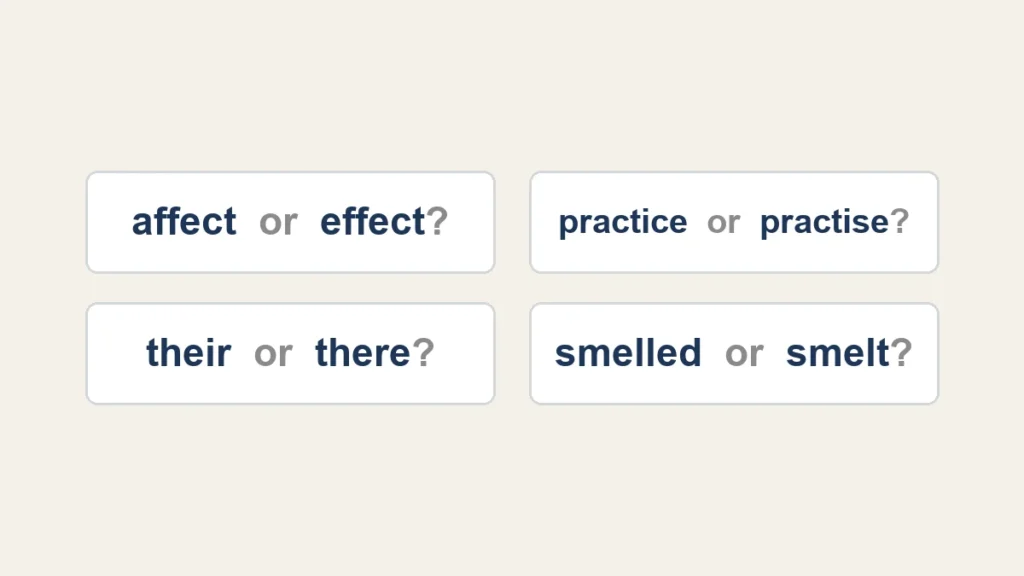
Commonly confused words are pairs that look or sound alike but mean different things, such as affect and effect, practice and practise, or recurring and reoccurring. Below you will find the pairs people search for most, each with a plain answer, an example and a memory trick. There are also the British and American spelling differences that catch out UK writers, and a few “words” that are not words at all. A short quiz at the end lets you test yourself.
The guide follows British English, as used in UK schools, offices and newspapers. Where American usage differs, it says so, because the spellcheck on most devices defaults to American English.
Quick Answers: The Most Searched Pairs
| Confused pair | The short answer |
|---|---|
| Recurring or reoccurring | Both are words. Use recurring for things that keep happening, such as a recurring payment. |
| Verbiage or verbage | Verbiage. “Verbage” is a misspelling. |
| Woken or woeken | Woken. “Woeken” is not a word. |
| Yeah, yea or yay | Yeah means yes, yay is a cheer, and yea is an old word for yes used in votes. |
| Pricey or pricy | Both are allowed, but pricey is far more common. |
| Smelled or smelt | Both are correct in British English. Americans use smelled. |
| Envision or invision | Envision, or envisage in formal British English. “Invision” is not a word. |
| Cue or queue | A cue is a signal; a queue is a line of people. |
| Especially or specially | Especially means particularly; specially means for a particular purpose. |
| Flyer or flier | Flyer for a leaflet in British English. |
| Honey or hunny | Honey. “Hunny” is a playful spelling made famous by Winnie-the-Pooh. |
| That or which | Which with commas for extra information. In British English, either works when the clause identifies something. |
The Most Searched Confused Words, Explained
Recurring or reoccurring?
Both are real words, but they are not quite the same. Recurring means happening again and again, often at regular intervals: a recurring dream, a recurring monthly payment, a recurring character in a soap. Reoccurring simply means happening again, without suggesting a pattern: “The fault has not reoccurred since the repair.” Merriam-Webster draws the line the same way, while the Oxford English Dictionary treats reoccur as close to a synonym of recur.
In practice, recurring is used far more often, so if you are unsure, choose recurring. Watch the spelling, too: recurring has a double r, and reoccurring has a double c and a double r. “Reoccuring” and “reccuring” are both wrong.
Memory trick: recur for things that come round like a rota. For usage data, recurring vs recurrent and more examples, see our full guide to recurring or reoccurring.
Verbiage or verbage?
Verbiage is the correct word. It usually means too many words with too little meaning (“cut the verbiage from your CV”), and it can also simply mean wording (“the verbiage of the contract”). It is said in three syllables: VUR-bee-ij.
Verbage is a common misspelling. Bryan Garner’s usage guide suggests it comes from the pattern of words such as herbage, and most dictionaries do not accept it as a standard spelling. Stick with verbiage in anything you want taken seriously.
Memory trick: verbiage ends like foliage. Lots of leaves, lots of words.
Woken or woeken?
“Woeken” is not a word. The word you want is woken, the past participle of wake. Use it after have, had or was: “I was woken by the bin lorry”, “She has woken up.” The simple past tense is woke: “I woke at six.” Awoken and awoke work the same way and sound a little more formal.
The mistake probably comes from mixing woken with woe. In British English you will also hear “woken up” far more often than the American waked, which is rare in the UK.
Yeah, yea or yay?
These three are often swapped in texts and on social media, but each has its own job:
- Yeah is the informal way of saying yes: “Yeah, I’ll be there.”
- Yay is a cheer of happiness or approval: “Yay, it’s Friday!”
- Yea (said like “yay”) is an old-fashioned word for yes, used today mainly in formal votes. The US Congress records “yeas and nays”. The UK House of Commons uses “ayes” and “noes” instead, so yea is rare in British English outside older texts such as the King James Bible.
So if you mean a casual yes, write yeah. “Yea” for yes in a text message is a common slip.
Pricey or pricy?
Both spellings appear in dictionaries, but pricey is the usual one in Britain and America, and it is the safe choice. The comparative forms are pricier and priciest for both spellings. If you want a different word, British English also has dear (“petrol is dear at the moment”), steep and, more formally, expensive or costly.
Smelled or smelt?
In British English, both smelled and smelt are correct as the past tense of smell: “The kitchen smelt of toast” and “The kitchen smelled of toast” are both fine. American English almost always uses smelled, which is why American spellcheckers sometimes flag smelt.
The same pattern applies to several other verbs. British writers can choose either form, while Americans mostly use the -ed version: learnt or learned, spelt or spelled, burnt or burned, dreamt or dreamed, spilt or spilled. Pick one and stay consistent in a piece of writing.
Smelt is also a noun, a small silvery fish, and a verb meaning to extract metal from ore by heating it.
Envision or invision?
“Invision” is not an English word. (InVision is the name of a design software company, which is one reason it turns up in search.) The word you want is envision, meaning to imagine something as a future possibility: “I envision a bigger office within two years.”
In formal British English, envisage is often preferred: “The plan envisages 200 new homes.” Envision is more common in American English but is widely used in the UK too.
Cue or queue?
A cue is a signal for someone to do something (“that’s my cue to leave”) or the stick used in snooker and pool. A queue is a line of people or things waiting, and in British English it is also a verb: “We queued for an hour.” In computing, a queue is a list of tasks waiting to be processed, such as a print queue.
“Que” is not English. It is a word in Spanish and French. For the -ing forms, queuing and queueing are both accepted, as are cueing and cuing.
Memory trick: a queue is long, and so is the word: five letters waiting in line.
Especially or specially?
Especially means particularly or above all: “I love Italian food, especially pasta.” Specially means for a particular purpose: “The cake was made specially for her birthday.”
The two overlap in casual speech, but in writing keep them apart. A good test: if you can swap in particularly, use especially. If you can swap in for this purpose, use specially. When especially adds an extra point at the end of a sentence, it usually follows a comma: “Roads are dangerous in winter, especially at night.”
Flyer or flier?
For a printed leaflet, flyer is the standard spelling in British English, and it is what most UK printers and businesses use. Even the American AP Stylebook switched from flier to flyer in 2017. Flier survives mostly in American writing and in the US phrase “take a flier”, meaning to take a risk. For a person or thing that flies, flyer is again the usual British spelling, as in “frequent flyer”.
Honey or hunny?
Honey is the only standard spelling, both for the food and as a term of endearment (“Thanks, honey”). Hunny is a playful, informal spelling. It is best known from the honey jars in A. A. Milne’s Winnie-the-Pooh stories, where the bear’s spelling is deliberately childlike. It is fine in a jokey message, but use honey in anything formal.
That or which?
Both introduce a clause that tells you more about a noun. The rule that matters in every kind of English is this: when the clause adds extra information that could be removed, use which and put it between commas. “My car, which is red, needs a service.”
When the clause identifies which thing you mean, American style guides insist on that: “The car that I bought last year needs a service.” British English is more relaxed, and which is also accepted here: “The car which I bought last year needs a service.” Many British editors still prefer that for these clauses, because it makes the difference clear.
Quick test: if you can remove the clause and the sentence still means the same thing, use which with commas.
Words That Sound the Same (Homophones)
These pairs and trios sound identical or nearly so, which is why spellcheckers miss them: each one is a real word.
| Words | What each means | Example or memory trick |
|---|---|---|
| its / it’s | its = belonging to it; it’s = it is or it has | “It’s raining, and the dog has lost its ball.” If you can say “it is”, use it’s. |
| their / there / they’re | belonging to them / a place / they are | “They’re over there with their coats.” Here is hidden in there. |
| your / you’re | belonging to you / you are | “You’re late for your train.” |
| whose / who’s | belonging to whom / who is or who has | “Who’s coming, and whose car are we taking?” |
| to / too / two | direction / also or excessively / the number 2 | Too has too many o’s. |
| stationary / stationery | not moving / paper and pens | Stationery has e for envelopes. |
| complement / compliment | to complete or go well with / praise | A complement completes; a compliment is what I like to hear. |
| principal / principle | main, or head of a college / a rule or belief | The principal is your pal; a principle is a rule. |
| discreet / discrete | tactful / separate | In discrete, the t keeps the two e’s separate. |
| breath / breathe | the noun / the verb | “Take a deep breath and breathe out slowly.” |
| peak / peek / pique | top / a quick look / to arouse (interest) | “The trailer piqued my interest.” Not “peaked”. |
| pore / pour | to study closely / to tip liquid | You pore over a map, but pour a cup of tea. |
| bare / bear | naked or basic / the animal, or to carry or tolerate | “Bear with me”, not “bare with me”. |
| brake / break | to slow a vehicle / to damage, or a pause | “Brake gently on ice.” |
| council / counsel | a local authority or committee / advice, or a barrister | Your local council collects the bins. |
| site / sight / cite | a place or website / vision / to quote as a source | “Cite the website you used.” |
| weather / whether | rain and sun / if | “Whether or not the weather holds…” |
| desert / dessert | dry land, or to abandon / pudding | Dessert has two s’s because you want seconds. |
| lead / led | the metal, or present tense of “to lead” / past tense of “to lead” | “She led the team yesterday.” |
| elicit / illicit | to draw out (a response) / illegal | “The question elicited a laugh.” |
Words That Look Alike but Work Differently
| Words | The difference | Example |
|---|---|---|
| affect / effect | Usually affect is the verb and effect the noun | “The rain affected the match; the effect was a draw.” Remember RAVEN: Remember, Affect Verb, Effect Noun. |
| accept / except | to receive or agree / apart from | “I accept all the terms except the last one.” |
| lose / loose | to misplace or be beaten / not tight | “Don’t lose that loose screw.” |
| then / than | time or sequence / comparison | “It was colder then than it is now.” |
| ensure / insure / assure | make certain / take out insurance / reassure a person | “Ensure the door is locked, insure the house, and assure the neighbours.” |
| imply / infer | the speaker suggests / the listener concludes | “She implied I was late; I inferred she was annoyed.” |
| allude / elude | to refer indirectly / to escape | “The answer eluded me.” |
| loath / loathe | unwilling / to hate | “I’m loath to admit I loathe sprouts.” |
| emigrate / immigrate | to leave a country / to come into one | “They emigrated from Britain and immigrated to Canada.” |
| farther / further | physical distance / distance, or “more” in an abstract sense | “Any further questions?” British English often uses further for both. |
| fewer / less | things you can count / things you cannot | “Fewer cars, less traffic.” The supermarket sign should read “10 items or fewer”. |
| amount / number | uncountable / countable | “A large number of people; a large amount of water.” |
| lay / lie | to put something down / to recline | “Lay the book on the table, then lie down.” |
| who / whom | the subject / the object | “Who called?” but “To whom did you speak?” If “him” fits, use whom. |
| i.e. / e.g. | that is / for example | “Bring a hot drink, e.g. tea or coffee.” “Arrive early, i.e. by 9am.” |
| maybe / may be | perhaps / might be | “Maybe it’s late; the train may be delayed.” |
| everyday / every day | ordinary (adjective) / each day | “Everyday shoes that I wear every day.” |
British vs American Spellings That Cause Confusion
Many “confused words” are not mistakes at all, just differences between British and American English. In British English, several pairs use -ice for the noun and -ise for the verb. American English uses one spelling for both.
| British noun | British verb | American | Example (British) |
|---|---|---|---|
| practice | practise | practice (both) | “I practise piano every day at a music practice.” |
| licence | license | license (both) | “You need a driving licence; the shop is licensed to sell alcohol.” |
| advice | advise | same as British | “I advise you to take my advice.” (This one is the same in both.) |
| dependant | dependent (adjective) | dependent (both) | “Her dependants are dependent on her income.” |
Memory trick: advice and advise sound different, so use them as a guide. Where the noun has a c (advice), so do practice and licence. Where the verb has an s (advise), so do practise and license.
Other British and American differences that look like errors:
- -our and -or: colour, favour, humour and honour in Britain; color, favor, humor and honor in America.
- -re and -er: centre, metre, theatre and fibre in Britain; center, meter, theater and fiber in America. In British English, a meter is a measuring device, such as a gas meter.
- -ise and -ize: both organise and organize are correct in British English, and Oxford University Press famously prefers -ize. American English uses -ize. Whichever you choose, be consistent.
- Past tenses: learnt, spelt, burnt, dreamt and smelt are all standard in Britain (see smelled or smelt above).
- Single words: grey (UK) and gray (US); tyre and tire; kerb and curb; cheque and check; programme and program (but a computer program in both).
These differences turn up in word games too. Our list of past Wordle answers shows the puzzle has used American spellings such as HUMOR, FAVOR and FIBER. Our guide to the legislator crossword clue shows how British and American grids expect different answers to the same clue.
“Words” That Are Not Words
Some of the most searched spellings are not standard English at all. If you are writing anything formal, avoid these:
| Avoid | Use instead | Why |
|---|---|---|
| woeken | woken | A misspelling of the past participle of wake |
| verbage | verbiage | A common error for verbiage |
| invision | envision or envisage | Not a dictionary word (InVision is a brand) |
| alot | a lot | Always two words |
| should of / could of / would of | should have, could have, would have | “Should’ve” sounds like “should of” in speech |
| irregardless | regardless | Used informally, but widely seen as an error |
| definately | definitely | Remember “finite” sits inside definitely |
| seperate | separate | There is “a rat” in separate |
| I could care less | I couldn’t care less | The original phrase; “could care less” literally says the opposite |
How to Stop Mixing Words Up
- Do not trust spellcheck alone. It only flags words that do not exist. “Their going to the park” passes a basic spellcheck because every word is real.
- Set your spellcheck to English (UK). Many phones and computers default to American English, so they “correct” practise, licence and colour.
- Use a grammar checker as a second opinion. Tools that read whole sentences catch more homophone errors than spellcheck does. Our comparison of Grammarly and ChatGPT shows what each catches, and there are free Grammarly alternatives with British English settings.
- Read your writing aloud. You will hear when “it’s” should be “it is” or when “then” should be “than”.
- Learn the few tricks that cover most mistakes: it’s = it is, you’re = you are, they’re = they are, and RAVEN for affect and effect. Those four alone fix a large share of everyday errors.
Test Yourself
Choose the right word for each sentence. Your score appears at the bottom.
1. We need to fix the ___ fault in the boiler, it happens every winter.
2. Cut the ___ and get to the point.
3. I was ___ by the alarm at 5am.
4. ___, it's the weekend!
5. I ___ the piano every evening. (British English)
6. You need a full driving ___ to hire a car.
7. The cold weather ___ the match.
8. Supermarket express lane: 10 items or ___.
9. The lorry was ___ at the lights.
10. My laptop, ___ is five years old, still works.
Frequently Asked Questions
What are commonly confused words?
They are words that look or sound alike but mean different things, such as affect and effect, their and there, or practice and practise. Most are homophones, which is why spellcheckers do not catch them.
Is reoccurring a real word?
Yes. Reoccurring means happening again, while recurring means happening repeatedly or regularly. Recurring is much more common, so use it if you are unsure.
Is verbage a word?
No, not in standard English. The correct word is verbiage, meaning too many words or simply wording.
Is it smelled or smelt in British English?
Both are correct in British English. American English uses smelled. The same choice applies to learnt or learned, spelt or spelled, and burnt or burned.
What is the difference between practice and practise?
In British English, practice is the noun and practise is the verb: “I practise every day at football practice.” American English uses practice for both.
Should I use that or which?
Use which with commas for extra information that could be removed. When the clause identifies the thing you mean, British English accepts that or which, while American style prefers that.
Is it flyer or flier?
Flyer is the usual spelling for a leaflet in British English, and the AP Stylebook has also used flyer since 2017. Flier is mainly American.
How can I remember affect and effect?
Use RAVEN: Remember, Affect is a Verb, Effect is a Noun. “The weather affected the game; the effect was a cancellation.”