
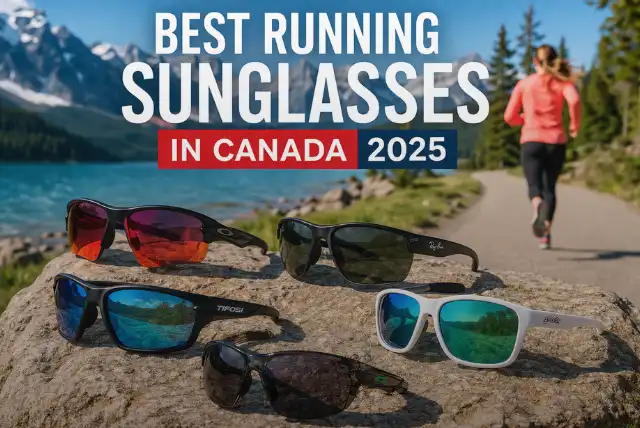
The most important thing on a pair of running sunglasses is four characters long, and most Canadians never look for it. It is “UV400”, or the words “100% UV”. Everything else — the tint, the brand, the price — tells you nothing about whether your eyes are protected.
That is not our opinion. The Canadian Association of Optometrists puts it in its position statement on UV and eye protection: “It is not possible to tell how much UV protection a pair of sunglasses will provide by looking at the price tag, colour, or darkness of the lenses.”
Canadian runners have a particular problem. Snow glare nearly doubles UV exposure in months when the index reads low, and only a third of Canadian adults wear sunglasses year-round at all. This guide covers what to check, what the lens categories actually mean, and which running models are worth a look.
Last updated: 20 October 2026. Every figure below is sourced, and this version removes several statistics and review scores that could not be traced to anyone.
The short version
- Look for: “UV400” or “100% UV” on the label
- Darkness: tells you nothing about UV protection
- Polarisation: cuts glare. Does not block UV
- Price: not necessarily related to UV protection
- Winter: fresh snow reflects over 80% of UV
- Cloud: up to 80% of UV still gets through
- Category: 2 or 3 for most running. Not 4 if you drive
- Fit: close-fitting wraparound, stable, full eye coverage
What this article covers
The Only Thing on the Label That Matters

Image source: pinterest.com
Both of Canada’s eye-care bodies give the same advice, and it is short. Look for “UV400” or “100% UV”. The Canadian Ophthalmological Society recommends “UV400 sunglasses (100% UVA/UVB protection)”. The optometrists say the same.
A dark lens with no UV filter is worse than no sunglasses. Shade makes your pupil open wider. If the lens is not filtering UV, that wider pupil simply admits more of it. This is why buying on tint alone is the one genuine mistake in this market — and a 2021 Leger survey for the Canadian Ophthalmological Society found about a third of Canadians believed darker lenses gave better UV protection, with a further 31% unsure.
The scale of the gap is the striking part. Canada is not a country short of sun or snow, yet the optometrists’ 2023 statement reports that only 33% of Canadian adults wear sunglasses always or regularly while outside, and only 16% of parents say their children do.
Canadian Association of Optometrists, Position Statement on UV and Eye Protection, 2023, citing Leger 2022.
UV exposure is cumulative, and the list of conditions it is linked to is longer than most people expect. The optometrists name photokeratitis, photoretinitis, cataract, age-related macular degeneration, dry eye disease, pterygium, climatic droplet keratopathy, and cancer of the eye and eyelid. The ophthalmologists noted in July 2026 that cataracts alone affect more than 2.5 million Canadians.
Why Canadian Winter Is the Hard Part

Image source: pinterest.com
Most people put their sunglasses away in October. In Canada that is exactly backwards.
The Government of Canada’s UV index guidance says fresh white snow reflects over 80% of the sun’s UV rays, so exposure can nearly double on a bright snowy day. A reading of 2 with snow underfoot is not a reading of 2 at eye level.
| UV index | Risk | What the Government of Canada advises |
|---|---|---|
| 0–2 | Low | Wear UV protection sunglasses. On bright snowy days outdoors for more than an hour, cover up and use sunscreen |
| 3–5 | Moderate | Hat covering face and ears, tightly woven clothing, sunscreen on exposed skin, shade near midday |
| 6–7 | High | As above — the same 3–7 band of advice |
| 8–10 | Very high | Limit sun 11am–3pm. Wear UV protection sunglasses and stay in shade. Reapply sunscreen every two hours |
| 11+ | Extreme | As above — the same 8+ band of advice |
Government of Canada, UV index and sun safety.
- Cloud is not cover. The Canadian Ophthalmological Society said in July 2026 that up to 80% of UV can penetrate cloud. The American Academy of Ophthalmology is blunter: clouds do not block UV.
- Snow blindness is real and it is sunburn. Photokeratitis is a corneal burn, and it follows UV reflected off snow, ice, sand or water.
- Spring is the dangerous window. A rising index plus snow still on the ground is the worst combination of the year. Canada’s own guidance suggests ski goggles on snowy terrain in spring.
- Low sun means low angle. Winter light arrives nearer the horizon and straight under the brim of a cap, which is where a wraparound frame earns its place.
Lens Categories, Properly Explained

Image source: pinterest.com
Lens category is the number most often misread. It describes how much visible light the lens lets through — nothing more.
Upper bound of luminous transmittance for each filter category under ISO 12312-1:2013. Category 0 is above 80%, category 1 is 43–80%, category 2 is 18–43%, category 3 is 8–18% and category 4 is 3–8%.
| Category | Light passed | Use for running |
|---|---|---|
| 0 | Over 80% | Clear or barely tinted. Night and very dull conditions. Not a sunglass |
| 1 | 43–80% | Overcast days, dawn and dusk running |
| 2 | 18–43% | Good general running category for variable Canadian light |
| 3 | 8–18% | Bright sun, open road, water and snow glare — the usual running choice |
| 4 | 3–8% | Extreme glare, high-altitude snow. Not suitable for driving |
ISO 12312-1 filter categories, as reproduced in peer-reviewed literature. Lenses unsuitable for driving must carry a crossed-out car symbol.
The category tells you nothing about UV. It is a visible-light measurement. UV filtering is specified separately, which is why “UV400” has to appear on the label in its own right. A category 3 lens with no UV rating is a dark lens, not a protective one.
Health Canada uses a different three-tier scheme on its own sunglasses page: cosmetic lenses block up to 60% of visible light and 87.5–95% of UVB and are usually not recommended for daytime driving; general purpose block 60–92% of visible light and 95–99% of UVB and are the everyday choice; special purpose block up to 97% of visible light and at least 99% of UVB, suit prolonged exposure and are not recommended for driving.
Two more points from Health Canada that runners get wrong. Photochromic lenses worn for driving need to darken enough to be useful. And mirror or “flash” lenses offer no performance advantage and scratch easily — so pay for a scratch-resistant coating instead of a finish. If you also wear prescription lenses, our guide to choosing glasses frames covers fit and lens options in more depth.
Models Worth Looking At

Image source: cdn.road.cc
These are real products and the lens technologies are as their makers describe them. We have not printed star ratings or exact prices — see the section below for why. Check UV400 on the specific model and the specific lens, because it can vary within a range.
| Model | Lens approach | Suits |
|---|---|---|
| Oakley Flak 2.0 XL | Prizm tinting to lift contrast; O Matter frame; wrap coverage | Road running in steady bright light |
| Julbo Aero | Reactiv photochromic — the tint shifts with the light; vented frame against fogging | Long runs, trails, and light that changes mid-run |
| Tifosi Jet Wrap | Shatterproof polycarbonate; wrap-around shield against wind and grit | Budget pick — protection without the brand premium |
| Nike Skylon Ace XV | Shatter-resistant lens, rubber nose pads, minimal frame | Mid-range all-rounder for sweaty sessions |
| Ray-Ban sports range | Polarised options and anti-slip pads; styling carries over to everyday wear | Runners who want one pair for both |
| Goodr, SunGod, Ombraz, Smith, Rudy Project | Goodr for low cost; SunGod for mono-lens coverage; Ombraz for a cordless, arm-free fit; Smith and Rudy Project for photochromic ranges | Worth comparing before you settle |
Lens technologies as described by each manufacturer. Availability in Canada varies by retailer. No review scores are published here.
On price. Running sunglasses sit in three broad tiers in Canada: a budget tier where Tifosi and Goodr live, a mid tier covering most Nike and entry Oakley models, and a premium tier for photochromic Julbo, Smith and Rudy Project lenses. Remember the optometrists’ point: paying more does not necessarily buy more UV protection. It buys optics, coatings, fit and adaptive tint.
If style matters as much as performance, the same UV400 rule applies to a designer sunglasses pair as to a wrap-around sports frame. A fashion frame is simply less likely to stay put at pace, and less likely to shield the sides.
Smart eyewear is now part of this market too — camera and audio glasses with polarised lenses. They are a different purchase with different trade-offs, and we look at the category in our piece on Ray-Ban display smart glasses.
Fit, Ventilation and Durability

Image source: i0.wp.com
Protection you take off halfway round is not protection. Fit is what decides whether you keep them on.
- Close-fitting and wraparound. Health Canada recommends it specifically, to block stray light from the sides — which on a winter run is most of the light.
- Stable, and large enough to cover the eye. The optometrists’ wording. A small lens leaves the eyelid and surrounding skin exposed.
- Grip where you sweat. Rubberised nose pads and temple tips are the difference between a pair that stays put and a pair that slides.
- Ventilation against fogging. Vented frames and lens cut-outs matter more in cold air than in warm — a cold lens plus a warm face is the classic fogging combination.
- Scratch-resistant coating on plastic lenses. Health Canada recommends it, and advises checking lenses for distortion before you buy.
- Plastic over glass. Tougher and far less likely to shatter — and for children, the optometrists recommend plastic or polycarbonate specifically.
If you are building out the rest of your kit, our guides to essential fitness kit and golf on a budget apply the same test to other gear, and travel essentials covers what to pack if you run while away. For inspiration on the running itself, see our profile of Keely Hodgkinson.
What We Removed From This Guide
Earlier versions of this page carried numbers we could not stand behind. Rather than quietly delete them, here is what went and why.
| Removed claim | Why |
|---|---|
| “43% of Canadians are at high risk for UV-related eye damage”, credited to the Canadian Ophthalmological Society | No such figure appears in COS material. Replaced with the society’s and the optometrists’ published numbers |
| “Prizm Road 2.0 lenses improve low-light performance by up to 20%” | No source. Removed |
| “Tifosi’s popularity in Canada has grown by 15% annually” | No source. Removed |
| “Reactiv lenses adjust light transmission by up to 80%” | No source for that figure. The lens range is real; the number was not verifiable |
| Five customer ratings — 4.8/5, 4.7/5, 4.6/5, 4.5/5, 4.3/5 | Attributed to nobody. All five removed |
| Exact CAD price bands for each model | Prices move weekly and differ by retailer and promotion. Replaced with honest tiers |
Audit carried out 20 October 2026.
The replacement figures all come from the Government of Canada, Health Canada, the Canadian Association of Optometrists and the Canadian Ophthalmological Society, and each is linked at the foot of this page.
Frequently Asked Questions
What should I actually look for on the label?
“UV400” or “100% UV”. That is the Canadian Association of Optometrists’ recommendation and the Canadian Ophthalmological Society’s. Nothing else on the box tells you about UV.
Do darker lenses give better UV protection?
No, and believing it is dangerous. The optometrists’ position statement is blunt: you cannot tell UV protection from the price tag, the colour or the darkness of the lenses. A dark lens with no UV filter opens your pupil wider and lets more UV in than no sunglasses at all.
Does polarisation block UV?
No. Polarisation cuts glare from reflected light — useful on wet roads, snow and water. It is a comfort and contrast feature, not a protection one. A lens can be polarised and still have poor UV filtering.
Do I need sunglasses for winter running in Canada?
Yes, arguably more than in summer. The Government of Canada says fresh white snow reflects over 80% of UV, so exposure can nearly double on a bright snowy day even when the UV index is low. Its advice at index 0–2 still includes UV protection sunglasses when there is snow on the ground.
Is it safe to skip them on a cloudy day?
No. The Canadian Ophthalmological Society said in July 2026 that up to 80% of UV rays can penetrate cloud cover. The American Academy of Ophthalmology puts it more simply: clouds do not block UV light.
What lens category suits running?
Category 2 or 3 for most conditions. Under ISO 12312-1, category 2 passes 18–43% of visible light and category 3 passes 8–18%. Category 4 is for extreme glare such as high-altitude snow and is not suitable for driving — which matters if you drive to your run.
Does the lens category tell me about UV?
No, and this is the most common misunderstanding. The category describes how much visible light the lens lets through. UV protection is a separate specification. A category 3 lens can have no meaningful UV filter at all.
Does spending more buy better UV protection?
Not necessarily. The optometrists’ position statement says plainly that the degree of UV protection is not necessarily related to price. A labelled UV400 budget pair protects as well as an expensive one.
What fit should I look for?
Health Canada recommends close-fitting wraparound eyewear to block stray light from the sides, plus a scratch-resistant coating on plastic lenses. The optometrists add that sunglasses should be stable when worn and large enough to cover the eye properly.
What about children who run?
Only 16% of Canadian parents say their children wear sunglasses always or regularly. Children’s eyes are more vulnerable, and the optometrists recommend plastic or polycarbonate lenses rather than glass for impact protection.
Can UV damage really build up?
Yes. The optometrists link UV exposure to photokeratitis, photoretinitis, cataract, age-related macular degeneration, dry eye disease, pterygium and cancer of the eye and eyelid. Cataracts alone affect more than 2.5 million Canadians.
Why does this guide not publish star ratings or exact prices?
Because the ones previously on this page could not be sourced to anybody. Prices move weekly and vary by retailer and promotion, and we would rather print nothing than print a number we cannot stand behind.
Conclusion
Buying running sunglasses in Canada comes down to one check and one habit. The check is UV400 or 100% UV on the label — not the tint, not the brand, not the price. The habit is wearing them year-round, because fresh snow reflects over 80% of UV and cloud blocks very little of it.
Beyond that, pick category 2 or 3, get a close wraparound fit that stays put when you sweat, and choose photochromic lenses if your light changes mid-run. A well-chosen budget pair protects your eyes as well as an expensive one. That is the optometrists’ position, not a money-saving tip.
For more on frames and lens choices, see our guides to choosing designer glasses and performance and luxury polo shirt brands.
Sources
- Canadian Association of Optometrists — Position Statement: UV and Eye Protection, 2023
- Government of Canada — UV index and sun safety
- Health Canada — Sunglasses
- Canadian Ophthalmological Society — UV eye-sunburn warning, 2 July 2026
- American Academy of Ophthalmology — The sun, UV light and your eyes
- ISO 12312-1 filter categories, as reproduced in peer-reviewed literature
Disclaimer
This is general information, not medical advice. If you have an eye condition or notice pain, glare sensitivity or vision changes after sun exposure, see an optometrist or ophthalmologist. Prices and model availability in Canada change frequently and are not stated here as exact figures. Always check UV400 or 100% UV on the specific lens you are buying. Information correct as at 20 October 2026. More from The UK Post.

Image source: www.eyetrusteyecare.ca

Image source: www.hindustantimes.com