Femoral Hernia: Symptoms, Causes, Surgery and Recovery (UK Guide)
What a femoral hernia is, the warning signs that need 999, how it differs from an inguinal hernia, NHS referral and surgery, and how long recovery takes.
 11 min read
Comments: 0Views: 3
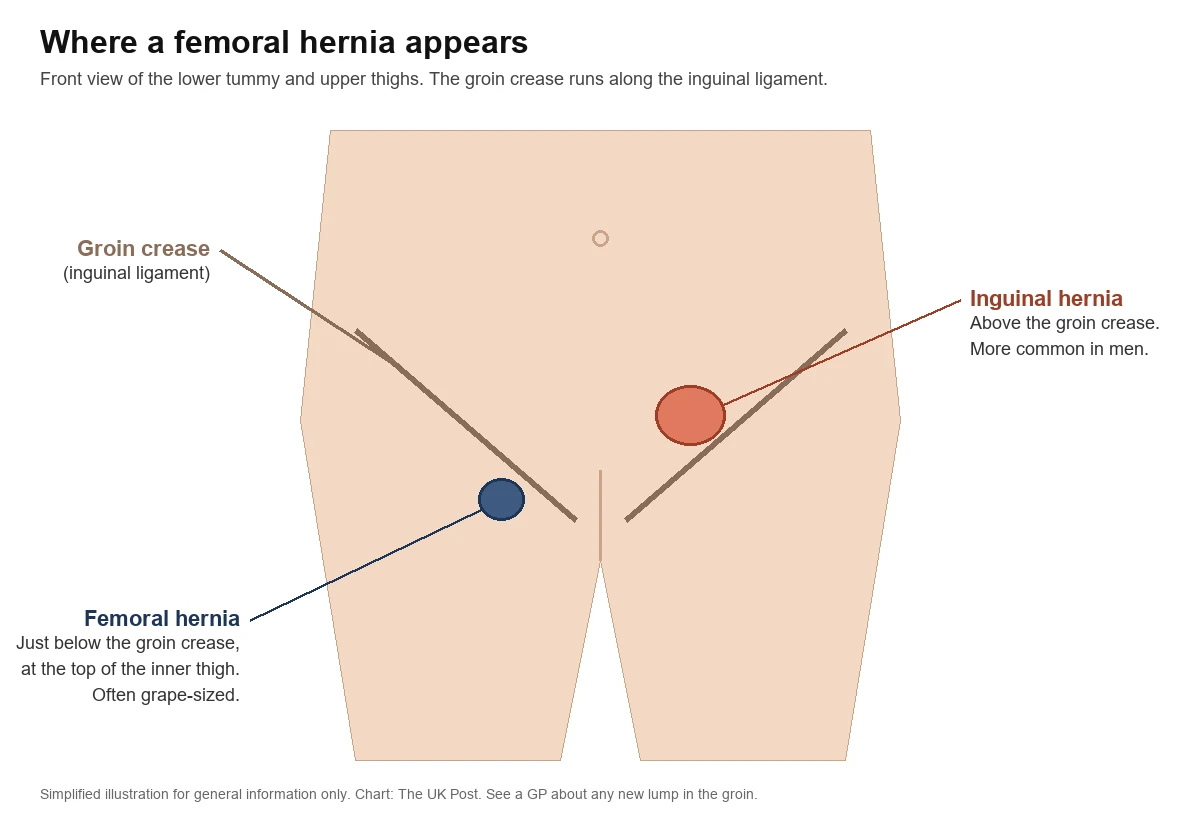
A femoral hernia is when part of the bowel or the fatty tissue around it pushes through a small gap called the femoral canal, at the very top of the inner thigh, just below the groin crease. It usually shows up as a small, grape-sized lump. It is far less common than other groin hernias, but more dangerous, because the gap is narrow and the hernia can easily become trapped and lose its blood supply (strangulated). That is why the NHS recommends surgery for almost every femoral hernia, and why a new lump at the top of the thigh should always be checked by a GP.
Call 999 or go to A&E now if you have a lump in your groin or upper thigh and any of these: very bad tummy pain, feeling or being sick, being unable to fart or poo, a high temperature or feeling hot, cold or shivery, or sudden confusion. These can be signs of strangulation, which is a medical emergency. Do not drive yourself to A&E. If you are unsure, call NHS 111.
Femoral Hernia at a Glance
| Details | |
|---|---|
| Where it appears | Top of the inner thigh, just below the groin crease |
| What it feels like | A small lump, often around the size of a grape; aching that comes and goes; discomfort when walking |
| Who gets it | Mainly women over 50, but anyone can |
| Main danger | Strangulation: the trapped bowel loses its blood supply |
| Treatment | Surgery, usually recommended even if there are no symptoms |
| Operation | Under general anaesthetic, often about 30 minutes; open or keyhole |
| Recovery | Around 4 to 6 weeks; back to work after about 1 to 3 weeks |
| On the NHS | Local NHS policies say all femoral hernias should be referred to a surgeon, urgently if they cause symptoms |
What Is a Femoral Hernia?
The femoral canal is a small passage at the top of the thigh. It sits next to the large blood vessels that run down into the leg, just below the inguinal ligament, the band of tissue under the groin crease. If the opening to this canal becomes stretched or weak, part of the bowel or the fatty apron inside the tummy (the omentum) can push through and form a lump.
The canal is narrow and stiff-edged. Once tissue has squeezed into it, it is easily pinched. That is the key difference from many other hernias, and the reason femoral hernias are treated with more urgency.
Femoral Hernia vs Inguinal Hernia
Both are groin hernias and they can look similar, which is why even doctors sometimes need a scan to tell them apart. The main differences:
| Femoral hernia | Inguinal hernia | |
|---|---|---|
| Position | Below the groin crease, at the top of the inner thigh | Above the groin crease; can extend into the scrotum in men |
| How common | Uncommon, around 3% of all hernias | The most common type of hernia |
| Who gets it most | Women, especially over 50 | Men |
| Risk of strangulation | High | Lower |
| Usual advice | Surgery, without delay | Surgery if it causes symptoms; sometimes watchful waiting |
Inguinal hernias are still more common in women overall, so a groin lump in a woman is not automatically femoral. Because the two are hard to tell apart by touch, some local NHS referral policies send all suspected groin hernias in women straight to a surgeon.
Who Gets Femoral Hernias and Why?
The NHS says femoral hernias mainly affect women over 50. Women have a wider pelvis, which makes the femoral canal wider too. The opening can be stretched or weakened by anything that raises the pressure inside the tummy or weakens the tissues, including:
- straining on the toilet, for example with long-term constipation;
- lifting heavy weights;
- being overweight;
- a persistent cough;
- pregnancy, and having several pregnancies;
- losing weight very quickly.
Men can get femoral hernias too. They are rarer in men, but they carry the same risks.
Symptoms of a Femoral Hernia
- A small lump in the groin or at the top of the thigh. It may be easier to see or feel when standing, coughing or straining, and it may disappear when you lie down.
- Aching around the lump that comes and goes.
- Discomfort when walking, or a heavy, dragging feeling in the leg.
Some femoral hernias cause no symptoms at all and are only found during a check-up, or only when they become stuck. A lump that becomes painful, tender, red or hard, or that you can no longer push back, needs urgent medical help.
Why Femoral Hernias Are More Dangerous
A femoral hernia can become incarcerated (stuck in place) and then strangulated, when the trapped bowel’s blood supply is cut off. Strangulated bowel can be damaged within hours, and the NHS calls strangulation and the bowel blockage it causes medical emergencies.
The research shows how often this happens:
- A widely cited study found the cumulative risk of strangulation was about 22% three months after diagnosis and 45% after 21 months, far higher than for inguinal hernias.
- Studies suggest around 4 in 10 femoral hernias are first found as emergencies, when they have already become stuck.
- A 15-year study of nine NHS trusts in the north of England found that 90% of people admitted as emergencies with a femoral hernia needed an operation, compared with 55% of those with an inguinal hernia.
- Emergency hernia surgery carries far higher risks than a planned operation. A UK-wide study of emergency abdominal wall hernia surgery found that almost 1 in 20 patients died within 90 days.
The message from these figures is simple: having a femoral hernia repaired as a planned operation is much safer than waiting until it becomes an emergency.
Getting Diagnosed on the NHS
If you notice a new lump in your groin or at the top of your thigh, book a GP appointment. The GP will examine the lump, usually while you stand and cough. If a femoral hernia is suspected, the GP should refer you to a surgeon. Local NHS commissioning policies, such as those in Derbyshire and in Buckinghamshire, Oxfordshire and Berkshire West, list femoral hernias for surgical referral, and symptomatic ones for urgent referral, because of the strangulation risk.
If imaging is needed, UK surgical guidance from the Royal College of Surgeons and the British Hernia Society recommends a dynamic ultrasound scan as the first test, done while you cough or strain. In an emergency, a CT scan may be used to check whether the bowel is trapped or blocked.
If you are waiting for surgery, learn the emergency warning signs above and act on them straight away.
Femoral Hernia Surgery
The NHS recommends surgery because a femoral hernia does not usually get better by itself and can have serious complications. The operation is done under general anaesthetic and often takes around 30 minutes. Many people having a planned repair go home the same day or the next day. There are two main approaches:
| Open repair | Keyhole (laparoscopic) repair | |
|---|---|---|
| How it is done | One cut in the groin, over the hernia | Several small cuts in the tummy, using a camera |
| Typical use | Common in emergencies, and when keyhole is not suitable | Often preferred for planned repairs where the surgeon has the expertise |
| Mesh | Usually used to close and strengthen the gap | Usually used, placed from the inside |
International guidelines for groin hernia management, published in 2018 by the HerniaSurge group, recommend prompt mesh repair of femoral hernias, by keyhole surgery where the surgeon has the expertise. In an emergency, if part of the bowel has died, the surgeon may need to remove that section, which makes the operation bigger and the recovery longer.
Recovery After Femoral Hernia Repair
The NHS says recovery usually takes around 4 to 6 weeks. Everyone recovers at a different pace, and your surgical team’s advice comes first. As a general guide:
| When | What to expect |
|---|---|
| First few days | Soreness, bruising and swelling around the wound; take painkillers as advised |
| About 2 weeks | Avoid baths and swimming until the wound has healed |
| 1 to 3 weeks | Most people return to work, depending on the operation and the job |
| 4 to 6 weeks | Avoid heavy lifting and strenuous activity during this time |
| Driving | Do not drive straight after surgery. Ask your doctor when it is safe, and check with your insurer |
- Medicines: because you should not drive straight after surgery, it can help to arrange prescriptions in advance. Our guide to pharmacy delivery services in the UK compares options for getting medicines brought to your door.
- Back to a desk job: sitting for long periods can pull on a groin wound. A supportive chair set at the right height helps, and our article on office chairs and posture explains what employers have to provide.
- Exercise: start with walking. Build up gradually and leave weights and heavy training until your surgeon says it is safe. If you train at home, our guide to home gym equipment brands in the UK covers kit you can use at a gentler pace as you recover.
Risks of Surgery
Femoral hernia repair is a common, generally safe operation, but like any surgery it has risks. The NHS lists infection, blood clots, pain, and difficulty peeing just after the operation. Less often, the hernia can come back. Call 999 if you have sudden severe breathlessness or chest pain after surgery, as this can be a sign of a blood clot in the lungs.
Can You Prevent a Femoral Hernia?
You cannot always prevent a hernia, but the NHS suggests you can lower the risk by:
- losing weight if you are overweight;
- staying active: aim for 150 minutes of moderate activity a week;
- stopping smoking;
- seeing a GP about a cough that will not go away;
- avoiding constipation and straining, with plenty of fibre and fluids;
- lifting heavy objects carefully, bending your knees rather than your back.
Frequently Asked Questions
What does a femoral hernia feel like?
Usually a small, soft lump at the top of the inner thigh, often around the size of a grape, with aching that comes and goes or discomfort when walking. Some cause no symptoms until they become stuck.
Is a femoral hernia an emergency?
Not always, but it can become one quickly. See a GP about any new groin or upper thigh lump. Call 999 or go to A&E if the lump becomes painful or hard, or you have severe tummy pain, vomiting, or cannot fart or poo.
Can a femoral hernia go away on its own?
No. The NHS says a femoral hernia does not usually get better by itself, which is why surgery is recommended.
How is a femoral hernia different from an inguinal hernia?
A femoral hernia appears below the groin crease at the top of the thigh and is most common in women over 50. An inguinal hernia appears above the crease and is most common in men. Femoral hernias are more likely to strangulate.
How long is recovery after femoral hernia surgery?
Around 4 to 6 weeks in total. Most people return to work after about 1 to 3 weeks and should avoid heavy lifting for 4 to 6 weeks.
Can men get femoral hernias?
Yes. They are much more common in women, but men can get them, and the risks and treatment are the same.
Will I have to wait for surgery on the NHS?
Local NHS policies prioritise femoral hernias for surgical referral, urgently if they cause symptoms, because of the strangulation risk. Waiting times vary by hospital. If your symptoms change while you wait, contact your GP or NHS 111, or call 999 for emergency signs.
Is keyhole surgery better for a femoral hernia?
For planned repairs, international guidelines recommend a keyhole approach where the surgeon has the expertise. Open surgery is often used in emergencies. Your surgeon will recommend the best option for you.
This article is for general information and does not replace advice from a doctor. If you are worried about a lump in your groin, see your GP or call NHS 111.
Sources
- NHS: Femoral hernia (reviewed 15 October 2026)
- NHS: Hernia (types, warning signs and prevention)
- NHS: Inguinal hernia repair (general recovery advice for groin hernia surgery)
- Patient.info: Femoral hernias (strangulation risk and emergency presentation figures)
- BJS Open: 15-year study of acute groin hernias in nine NHS trusts
- British Journal of Surgery: MASH study of emergency hernia surgery in the UK
- Royal College of Surgeons and British Hernia Society: Groin hernia commissioning guide
- HerniaSurge Group: International guidelines for groin hernia management (2018)