
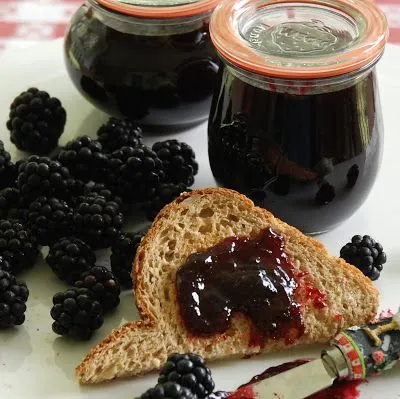
Smooth seedless blackberry jam from 1kg of fruit, with the one instruction most recipes leave out: weigh the pulp after you have strained it, and match the sugar to that. Not to the fruit you started with.
That matters because sugar in jam is the preservative, not a flavouring. Under UK regulations jam must reach 60% soluble solids to be jam at all — below that you have made something that belongs in the fridge.
Last updated: 26 October 2026.
At a glance
- Makes: about 3 × 340g jars from 1kg of fruit
- Hands-on: about 1 hour
- Sugar: equal to the weight of the strained pulp
- Pectin: none needed — but the lemon juice is essential
- Set test: wrinkle test, a full minute on a chilled saucer
- Keeps: 12 months sealed, a month in the fridge once open
- Mould: bin the jar — never scrape it off
What this article covers
Ingredients

Image source: Pinterest.com
| Ingredient | Amount | Notes |
|---|---|---|
| Fresh blackberries | 1kg | Ripe, not overripe. Frozen works — thaw completely first |
| Sugar | Equal to the weight of your strained pulp — expect about 700–800g | Weigh the pulp after straining, then match it. This is the step that decides whether the jam keeps — see below |
| Lemon juice | 2 tbsp | Do not skip it. Acid is needed for the pectin to set and it helps the jam keep |
| Butter | A knob, optional | Stirred in at the end to disperse foam and add gloss |
The sugar quantity is deliberately expressed against the strained pulp, not the raw fruit — straining removes weight, and sugar is what preserves the jam.
Equipment: a large deep pan, a wooden spoon, a masher, a fine sieve, clean jars with new lids or wax discs, and a sugar thermometer if you have one. Nothing specialised is required — the sieve does the work a commercial depulper would.
Method

Image source: Pinterest.com
- Wash the blackberries gently, discard leaves and any damaged fruit, and drain well.
- Cook the berries alone in a large pan over medium heat for 10–15 minutes, stirring now and then, until soft and releasing juice. Mash them, then take the pan off the heat.
- Strain out the seeds. Set a fine sieve over a bowl, pour the fruit in and press with the back of a spoon until only seeds remain. Discard the seeds.
- Now weigh the pulp — this is the step the old version skipped. From 1kg of berries expect roughly 700–800g. Weigh out the same amount of sugar.
- Return the pulp to a clean pan with the sugar and lemon juice and stir until the sugar has dissolved before the pan gets hot. Undissolved sugar is what makes jam grainy and what burns.
- Bring to a rolling boil and cook for 25–35 minutes, stirring regularly. Skim foam if you like, or stir in the butter at the end instead.
- Test for a set (below). Put your jars in a low oven now so they are hot when the jam is.
- Stir in the butter, let the jam settle for a minute or two, then pot it into hot jars and seal immediately. Label with the date.
Why the Sugar Weight Decides Everything

Image source: Pinterest.com
This is the fix that matters most on this page. The old version cooked 1kg of blackberries, strained out the seeds — which removes weight — and then set the sugar against the original 1kg, with “adjust to taste” after it. Sugar is not seasoning here. It is the thing that stops the jam going off. Weigh the pulp; match the sugar.
Jam and Similar Products (England) Regulations 2003 sets 60% for jam, with 25–50% permitted for products sold as “reduced sugar”. Codex Alimentarius gives 60–65% or greater, US federal standards 65%, and FAO guidance 68% total sugar.
Based on this recipe: roughly 750g of strained pulp from 1kg of berries, plus an equal weight of sugar. Water boils off during cooking, which is how the finished jam reaches 60%+ soluble solids. Figures in grams.
- Equal weights of pulp and sugar is the reliable starting point. After 25–35 minutes of boiling, enough water has gone to put you comfortably past 60%.
- “Adjust to taste” is the wrong instruction for a preserve. Adjust the fruit, the lemon, or what you put it on — not the preservative.
- Reduce the sugar and you change the product, not just the sweetness. It will set more softly and it must be kept in the fridge.
- UK law reserves “reduced sugar” for 25–50% soluble solids, which tells you how different a thing that is.
- Stir the sugar in before the pan heats up. Undissolved sugar is the cause of both grainy jam and burnt jam.
Testing for a Set

Image source: Pinterest.com
| Method | How | Note |
|---|---|---|
| The wrinkle test | Chill a saucer in the freezer. Spoon on a little jam, leave it a full minute, then push it with a fingertip. If the surface wrinkles, it is set. | The old page said “wait about 5 seconds” in one place and “wait a minute” in another. A minute is right — five seconds is not long enough for the sample to cool |
| Temperature | Around 104–105°C is the commonly cited target on a sugar thermometer | Treat it as a guide, not a rule. The FAO puts the endpoint at 106–108°C, and boiling point shifts with altitude and pan. The wrinkle test is more reliable at home |
| The flake test | Lift the spoon and let the jam fall. Set jam falls in sheets or flakes, not a thin stream | Useful as a second opinion |
| Remember | Jam thickens considerably as it cools. If it looks right in the pan it is probably overcooked | Err on the early side and test again |
Setting temperatures vary with altitude and equipment; the wrinkle test is the dependable domestic method.
Sterilising Jars Properly

Image source: Pinterest.com
- Wash jars and lids in hot soapy water and rinse well.
- Dry them in a low oven — about 140°C — for 15 minutes, and time it so they come out as the jam is ready.
- Fill while both the jars and the jam are hot. This is the whole point: hot jam into a hot jar, sealed at once.
- Do not air-dry jars and then fill them cold. The old version of this page said to boil jars and “let them air dry completely”, then in the next line to “always fill jars while the jam is still hot” — those two instructions do not work together, and cold glass plus boiling jam risks cracking.
- Use new lids, or wax discs under cellophane. A reused lid often will not seal.
- Fill to within a few millimetres of the top and seal immediately, so the cooling jam pulls a vacuum.
- Label with the date. You will not remember in March.
Storage, Settled

Image source: Pinterest.com
The old page gave two different shelf lives in two different sections. Here is the single answer.
| Situation | How long | Note |
|---|---|---|
| Sealed, properly made, 60%+ sugar | Up to 12 months in a cool, dark cupboard | This is the figure to use. The old page said both “6 months” and “up to a year” in different sections |
| Once opened | In the fridge, within about a month | The old page said “3 to 4 weeks” and “about a month” — the same thing, stated twice |
| Reduced-sugar jam | Fridge only, and eat it within a few weeks | Below roughly 60% sugar it is not a shelf-stable preserve. Treat it as a fresh product |
| Any sign of mould | Throw the whole jar away. Do not scrape it off | Mould in a low-moisture, high-sugar food can run deeper than the visible patch. See FSA home food advice |
| Freezing | Works well. Leave headspace and use within a year | Useful if you have made a low-sugar batch |
General preserving practice for jam at 60%+ soluble solids; food safety guidance from the Food Standards Agency.
Foraging Blackberries, and the Law

Image source: Pinterest.com
Picking brambles is a genuine British pleasure and the legal position is clearer than most people think — though not what this page used to say.
- Under section 4(3) of the Theft Act 1968, picking fungi, flowers, fruit or foliage growing wild is not theft — and on one reading, not even while trespassing — provided it is not for reward, sale or other commercial purpose.
- It does not cover cultivated plants. Garden fruit, a planted display or a commercial crop is a different matter entirely.
- Local bylaws can still restrict collection, particularly on nature reserves and SSSIs. The Theft Act exemption does not override them.
- Uprooting a plant is separate, under the Wildlife and Countryside Act 1981. Pick the fruit, leave the bramble.
- So the old wording — “generally permitted on public paths and common land” — was the wrong test. What matters is that the plant is wild and that you are not selling the crop.
- Avoid roadside bushes and anything that may have been sprayed, and pick above dog height at path edges.
- Late August into September is the season. Old Michaelmas Day is 11 October — the folklore says pick before then, and the practical reason is the same: later fruit is more often mouldy or fly-blown.
- Leave plenty. Blackberries are a serious autumn food source for birds and mammals.
What to Do With It

Image source: Pinterest.com
- On toast, scones or crumpets — the smooth texture is the point.
- As a cake or pastry filling, where seeds would be a nuisance. This is where seedless genuinely beats seeded.
- Thumbprint biscuits and jam tarts.
- Swirled through yoghurt or rippled into ice cream.
- Loosened with a splash of water as a sauce for cheesecake or pancakes — and the perfect use for a batch that refused to set.
- With cheese. Blackberry works far better than most jams against a sharp cheddar or a goat’s cheese.
- For more straightforward cooking, see our simple British recipes for beginners, one-pan weeknight dinners, quick British lunches and our chocolate chess pie.
- For the kit: essential kitchenware and food storage containers. If you are freezing a soft-set batch, our storage notes may help with the jars, and the avocado aioli recipe is another five-minute kitchen job worth having.
Corrections Made to This Page
| What it said | Why it changed |
|---|---|
| Shelf life given as “up to 6 months” AND “up to a year” | A food-safety contradiction in the same article, in two duplicated storage sections. Resolved: 12 months sealed at 60%+ sugar |
| Two different sterilising methods | One said boil and “air dry completely” then “fill while hot” — which cannot both be done. Resolved: low oven, fill hot into hot jars |
| Set test: “wait about 5 seconds” vs “wait a minute” | A full minute — five seconds is not long enough for the sample to cool |
| “700 to 800 grams sugar (adjust to taste)” against the original fruit weight | The recipe strains the pulp first, which removes weight. Sugar is the preservative. Now: weigh the strained pulp and match it |
| No mention of what sugar level jam actually needs | UK law requires 60% soluble solids; “reduced sugar” is permitted at 25–50%. That is what decides the storage advice |
| “Sugar can be reduced slightly… use it faster” | Too vague for a preserve. Now explicit: below about 60% it is a fridge jam, not a shelf-stable one |
| Foraging “generally permitted on public paths and common land” | The wrong test. Under Theft Act 1968 s.4(3) what matters is that the plant is wild and the picking is not commercial — bylaws and the Wildlife and Countryside Act still apply |
| Michaelmas “in early October” | Old Michaelmas Day is 11 October |
| “Water-bath canning is recommended”, undefined | Mentioned once with no explanation. Hot-filling sterilised jars is the normal UK domestic method and is now described properly |
| “color”, “flavor”, “Sterilizing”, “yogurt”, “medium flame” | US spellings and non-UK phrasing |
| No Recipe structured data | A recipe page with one Gutenberg block and no schema. Recipe and FAQ JSON-LD added |
All corrections made on 26 October 2026. All sixteen images and all original links were kept.
Frequently Asked Questions
How much sugar do I actually need?
Weigh the strained pulp and use the same weight of sugar. From 1kg of blackberries expect roughly 700–800g of pulp. The old version of this page set the sugar against the original fruit weight and added “adjust to taste” — but sugar in jam is the preservative, not a flavouring.
Why does the sugar level matter so much?
Because it is what makes the jam keep. Under the Jam and Similar Products (England) Regulations 2003, jam must reach 60% soluble solids; a product sold as “reduced sugar” is permitted at 25–50%. Codex sets 60–65% or more, the US 65%, and the FAO 68%. Below about 60% you have made a fridge jam, not a preserve.
Can I reduce the sugar?
Yes, but then change how you store it. A reduced-sugar batch belongs in the fridge, eaten within a few weeks, or in the freezer — not in a cupboard for a year. It will also set more softly, because sugar helps the pectin. This is a trade, not a free improvement.
How long does homemade jam keep?
Up to 12 months sealed in a cool, dark cupboard if properly made at 60%+ sugar, and about a month in the fridge once opened. The old version of this page said both “6 months” and “up to a year” in different sections, which is why it has been rewritten.
How should I sterilise the jars?
Wash in hot soapy water, rinse, then dry in a low oven (about 140°C) for 15 minutes — and fill them while both the jars and the jam are hot. Use new lids or wax discs. Do not air-dry jars and then fill them cold; the old page advised exactly that in one section while telling you to fill hot in the next line.
How do I know when it is set?
The wrinkle test, and give it a full minute. Chill a saucer, spoon on a little jam, wait a minute, push it with a fingertip — if the surface wrinkles, it is ready. Around 104–105°C on a thermometer is the usual target, though the FAO gives 106–108°C and it varies with altitude.
Do I need to add pectin?
No. Blackberries contain useful natural pectin, and with the lemon juice and a proper boil the jam will set. The lemon juice is not optional — pectin needs acid to work.
Is it legal to pick wild blackberries?
Yes, for your own use. Under section 4(3) of the Theft Act 1968, picking fungi, flowers, fruit or foliage growing wild is not theft — even if you are trespassing — provided it is not for reward, sale or other commercial purpose. It does not cover cultivated plants, local bylaws can still restrict collection, and uprooting plants is separate under the Wildlife and Countryside Act 1981.
When is the best time to pick blackberries?
Late August into September in most of Britain. Folklore says pick them before Old Michaelmas Day, 11 October — after which the Devil is said to have spat on them. The practical version is the same advice: late berries are more likely to be mouldy or fly-blown.
Where should I avoid picking?
Beside busy roads, on anything that may have been sprayed, and below roughly waist height at the edges of paths where dogs go. Leave plenty for wildlife — blackberries are a significant autumn food source.
Can I use frozen blackberries?
Yes, and they are often better value. Thaw completely and include any juice. Freezing ruptures the cells, which actually helps them break down and strain.
My jam did not set. Can I fix it?
Usually, yes. Return it to the pan and boil harder for another 5–10 minutes, then retest. If it still will not set, the likely causes are skipped lemon juice or too little sugar for the amount of pulp. A stubborn batch makes excellent ice cream sauce.
Final Thoughts
Cook the fruit, strain the seeds, weigh what is left, match the sugar. That sequence is the whole recipe, and the weighing step is the one that separates jam that keeps for a year from jam that has to live in the fridge.
Then trust the wrinkle test over the clock, pot it hot into hot jars, and label it. Seedless blackberry jam is one of the few preserves genuinely worth the extra ten minutes with a sieve — particularly if you are baking with it. More from The UK Post.
Sources
- The Jam and Similar Products (England) Regulations 2003 — the 60% soluble solids requirement
- Codex Alimentarius — standard for jams, jellies and marmalades
- FAO — jam processing guidance, including setting endpoint
- Theft Act 1968, section 4 — wild plants and the theft exemption
- Wildlife and Countryside Act 1981, section 13 — uprooting wild plants
- Eatweeds — foraging and the law explained
- Food Standards Agency — home food fact checker
- Pectin — how fruit sets
Disclaimer
Sugar is the preservative in jam. Shelf-life guidance here assumes a properly made jam at 60% or more soluble solids, hot-filled into sterilised jars and sealed immediately; a reduced-sugar batch is not shelf stable and belongs in the fridge or freezer. Discard any jar showing mould rather than scraping it off. Setting temperatures vary with altitude and equipment. Foraging law is summarised, not legal advice — check local bylaws, and note that the Theft Act exemption applies only to wild plants picked for non-commercial use. Information correct as at 26 October 2026.

Image source: Pinterest.com

Image source: Pinterest.com

Image source: Pinterest.com

Image source: Pinterest.com

Image source: Pinterest.com

Image source: Pinterest.com

Image source: Pinterest.com

Image source: Pinterest.com