Easy Decisions: Fun Ways to Choose Without Second-Guessing Yourself
Fun, research-backed ways to make easy everyday decisions: flip a coin, set a good-enough bar, shrink the options and use our random picker.
 9 min read
Comments: 0Views: 2
Short answer: the easiest way to make everyday decisions without second-guessing yourself is to decide how much the choice really matters, set a “good enough” standard instead of hunting for the perfect option, cut the choices down to two or three, and give yourself a time limit. For small or evenly balanced choices, fun tricks work surprisingly well: flipping a coin and noticing whether you feel relief or disappointment, letting a random picker choose, or asking “will this matter in ten days?” Research also suggests people are often too cautious: in a study of more than 20,000 coin tosses, people who made a change after a toss told them to were happier six months later.
Easy Decision Tricks at a Glance
| Trick | Best for | How long it takes |
|---|---|---|
| Coin flip “gut check” | Two options you cannot separate | 10 seconds |
| Random picker | Dinner, films, where to walk | 10 seconds |
| “Good enough” checklist | Shopping and buying online | 2 minutes |
| Rule of three | Menus, holidays, gifts | 2 minutes |
| 10-10-10 question | Choices you keep replaying | 1 minute |
| Two-way door test | Bigger choices you can undo | 1 minute |
| Default rules | Repeating choices (breakfast, clothes) | Set once |
Try It: Flip a Coin or Let the Picker Choose
Type in your options, one per line, and press a button. The trick is not to obey the result blindly but to notice your reaction. If you feel a flicker of disappointment, you have just learned what you really wanted.
Why We Second-Guess Everyday Choices
Overthinking small decisions usually comes from treating every choice as if it has one right answer. In the 1950s the economist and psychologist Herbert Simon coined the word "satisficing", a blend of "satisfy" and "suffice", for choosing the first option that meets your standards instead of searching for the best possible one. The psychologist Barry Schwartz later contrasted "satisficers" with "maximisers", who try to find the very best option. In his book The Paradox of Choice (2004) he argued that maximisers often end up with better options but feel less satisfied with them.
Too much choice can make this worse. In the well-known "jam study", published in 2000, Sheena Iyengar and Mark Lepper set up a tasting stand in a supermarket. A display of 24 jams attracted more shoppers than one of 6, but far fewer of them bought a jar.
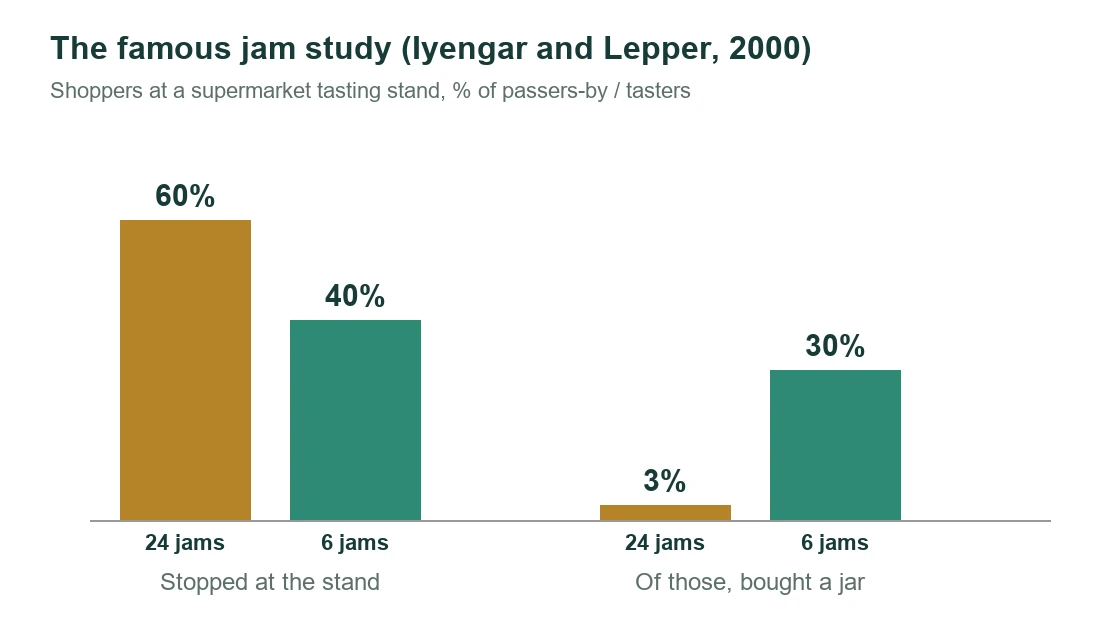
It is a memorable result, but the evidence is more mixed than the story suggests. A 2010 review of 50 experiments by Benjamin Scheibehenne and colleagues found that, on average, the "choice overload" effect was close to zero, although it did show up in some situations. The takeaway is not that choice is bad, but that cutting your options can help when you feel stuck.
Seven Fun Ways to Decide Faster
A quick decision routine in six steps
1. The coin flip gut check
Assign each option to heads or tails and flip. While the coin is in the air, most people find they are quietly hoping for one side. That hope is your answer. In the economist Steven Levitt's "Heads or Tails" experiment, published in the Review of Economic Studies in 2021, volunteers facing hard choices flipped a virtual coin. Those told by the coin to make a change, such as quitting a job, were more likely to do it, and were on average happier six months later, suggesting people may be overly cautious about change.
2. Set a "good enough" bar
Before you start browsing, write down two or three things the option must have, such as a price limit, a size, or a delivery date. Pick the first one that ticks every box, and stop looking.
3. The rule of three
If there are dozens of options, cut them to three straight away, using reviews or a friend's recommendation, then choose between those. It turns an endless scroll into a quick comparison.
4. Ask "10 minutes, 10 months, 10 years?"
The writer Suzy Welch popularised the "10-10-10" approach: how will you feel about this choice in 10 minutes, 10 months and 10 years? Most everyday decisions, such as which café to visit or which jumper to buy, will not matter in 10 months, which is a good sign to decide quickly.
5. Is it a one-way or two-way door?
Amazon founder Jeff Bezos described "Type 1" decisions as one-way doors that are hard to reverse, and "Type 2" decisions as two-way doors you can walk back through. Most daily choices are two-way doors: you can return the item, try the other restaurant next week or change your plans. Make those decisions quickly and save your careful thinking for the one-way doors.

6. Set defaults for repeating choices
Decide once and stop deciding: porridge on weekdays, a regular takeaway night, a "work uniform" of a few outfits, a set weekly shop. Defaults free up mental energy for choices that matter.
7. Use a timer
Give small decisions a deadline, such as two minutes for a menu or ten for a purchase under £50. When the timer ends, go with your current favourite.
Everyday Examples
- What's for dinner? Keep a list of five reliable meals and let the random picker choose; our easy winter recipes for British families make a good starting list.
- What to watch? Each person picks one option, then the picker chooses.
- Which of two products? Apply your good-enough list. If both pass, buy the cheaper one or flip a coin.
- Weekend plans? Treat it as a two-way door: choose, and if the weather turns, switch.
When Indecision Is a Sign of Something More
Everyone dithers sometimes. But if you find you cannot make even small decisions, constantly seek reassurance, or feel anxious most days, it may be linked to stress, anxiety or low mood. The NHS Every Mind Matters website has free advice on anxiety and overthinking, and your GP can help if it is affecting your daily life. You can also refer yourself to NHS talking therapies in England.
My Advice
I would start with the decisions you make most often and turn them into defaults; it is the quickest win. For anything else, ask whether it is a two-way door. If it is, give yourself a minute, pick a good-enough option and move on. And if you are torn between two great options, flip the coin. Either way, you win. For bigger life choices, it helps to know what matters most to you, and our core values list is a good place to start.
Frequently Asked Questions
How can I make easy decisions without overthinking?
Decide how much the choice matters, set a good-enough standard, cut the options to three and give yourself a time limit.
Does flipping a coin really help you decide?
It can. Your reaction to the result often shows what you wanted, and Steven Levitt's study found people who made changes after a coin toss were happier six months later.
What is a satisficer?
Someone who chooses the first option that meets their standards rather than searching for the best possible one. The term was coined by Herbert Simon.
What is the jam study?
A 2000 experiment by Sheena Iyengar and Mark Lepper. Shoppers offered 6 jams were more likely to buy than those offered 24.
Is choice overload real?
Sometimes. A 2010 review of 50 experiments found the average effect was close to zero, but it can appear in certain situations.
What is the 10-10-10 rule?
Ask how you will feel about a choice in 10 minutes, 10 months and 10 years. It was popularised by Suzy Welch.
What is a two-way door decision?
A decision you can easily reverse. Jeff Bezos used the term to argue such decisions should be made quickly.
Why do I second-guess every decision?
Often because you are trying to find the perfect option. Setting a good-enough standard and a time limit can help. If it causes constant anxiety, speak to your GP.
How do I stop regretting decisions?
Remind yourself that you made the best choice you could with what you knew at the time, and focus on what you can do next rather than replaying the choice.
What is an easy way to decide what to eat?
Keep a short list of meals you enjoy and use a random picker, or set default meals for certain nights.
Final Thoughts
Easy decisions are less about willpower and more about a few simple habits: know what matters, settle for good enough, shrink the options and give yourself a deadline. Add a coin flip or a random picker for fun, and save your careful thinking for the few choices that really can't be undone.
Sources: Levitt, "Heads or Tails: The Impact of a Coin Toss on Major Life Decisions and Subsequent Happiness", Review of Economic Studies (2021) and NBER working paper 22487; Iyengar and Lepper, Journal of Personality and Social Psychology (2000); Scheibehenne, Greifeneder and Todd, Journal of Consumer Research (2010); Schwartz, The Paradox of Choice (2004); Amazon 2015 shareholder letter; NHS Every Mind Matters.