
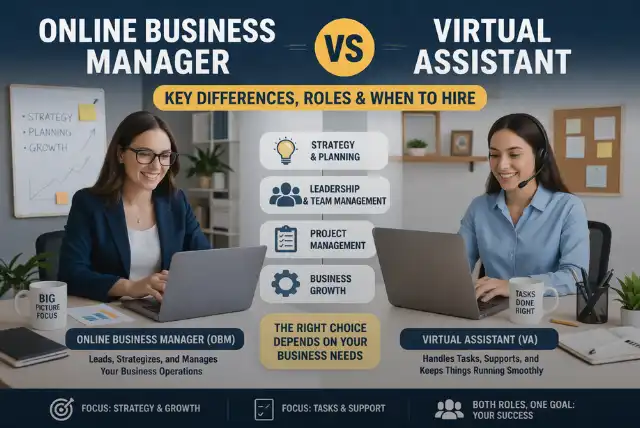
In today’s digital world, businesses rely more on remote professionals to manage various operations and tasks. Two popular roles that often come into consideration are the Online Business Manager (OBM) and the Virtual Assistant (VA). Though they might seem similar at first glance, they play different roles in business management. Understanding their unique responsibilities is essential to making the right choice for your business needs.
What is an Online Business Manager (OBM)?
An Online Business Manager (OBM) is a professional who manages the day-to-day operations of a business. They take on a leadership role, overseeing various aspects like project management, team coordination, strategy implementation, and ensuring that business goals are met. OBMs work closely with business owners to streamline processes, develop plans, and keep the business running smoothly. They often focus on big-picture tasks, delegating work to team members, and ensuring that projects stay on track.
Businesses hire OBMs when they need someone to manage higher-level tasks that require strategic thinking and leadership. An OBM’s role is more aligned with management, focusing on growth and development rather than just task execution.
What is a Virtual Assistant (VA)?
A Virtual Assistant (VA) is a remote professional who provides administrative, technical, or creative assistance to businesses. VAs handle tasks such as scheduling, email management, data entry, social media updates, and customer service. Unlike OBMs, VAs focus on specific tasks rather than overseeing the entire business.
VAs are hired to handle routine and repetitive tasks that free up time for business owners. They offer flexibility, working on either a part-time or full-time basis, depending on the business’s needs. The role of a VA can vary widely, depending on the skills they bring to the table, but they generally assist with task execution rather than management.
Key Differences Between OBMs and VAs
- Scope of Work: OBMs manage the overall business operations, while VAs handle specific tasks.
- Leadership Role: OBMs take on leadership and strategic planning, whereas VAs focus on following instructions and completing tasks.
- Project Management: OBMs are responsible for managing projects and ensuring timely completion, while VAs support those projects by handling delegated tasks.
- Skill Level: OBMs typically have more advanced skills in management and strategy, whereas VAs excel in administrative and task-oriented work.
When to Hire an OBM
An OBM is the right choice when your business has grown to the point where managing day-to-day operations is overwhelming. If you’re spending more time managing projects than growing your business, an OBM can step in to take over. They are ideal for businesses that need someone to create systems, manage teams, and implement strategies.
- Your business has multiple projects running simultaneously.
- You need help with strategic planning and growth.
- You require someone to manage and lead your team.
When to Hire a VA
A VA is perfect for businesses that need assistance with day-to-day tasks but do not require high-level management. If you’re a solo entrepreneur or a small business owner who needs help with administrative tasks, hiring a VA can save you time and allow you to focus on more important areas of your business.
- You need help with specific tasks like email management, scheduling, or social media updates.
- You’re looking for flexibility in terms of hours and workload.
- You want to focus on growing your business rather than handling routine tasks.
How to Choose Between an OBM and a VA
Choosing between an OBM and a VA depends on your business’s current needs and goals. If you’re looking for someone to manage your business’s overall operations and strategy, an OBM is the right choice. However, if you need assistance with specific tasks and want to reduce your workload, a VA might be a better fit.
Consider the following factors when making your decision:
- Business Size: Larger businesses with multiple projects and a growing team may need an OBM. Smaller businesses or solopreneurs may benefit more from hiring a VA.
- Budget: OBMs generally command higher rates due to their advanced skills and management responsibilities, while VAs are typically more affordable for businesses on a tight budget.
- Long-Term vs. Short-Term Needs: If you need ongoing management and strategy implementation, an OBM is ideal. For short-term or specific tasks, a VA can provide the flexibility you need.
The Cost of Hiring an OBM vs. a VA
Hiring an OBM typically comes at a higher cost than hiring a VA. OBMs usually charge on an hourly basis or a monthly retainer, depending on the scope of work. Their rates can range from $65 to $150 per hour, depending on their experience and expertise. On the other hand, VAs tend to have more flexible pricing, often charging between $15 and $50 per hour. The cost also varies depending on the tasks they are assigned and the level of expertise required.
- OBM Costs: $65 to $150 per hour, depending on expertise.
- VA Costs: $15 to $50 per hour, depending on tasks and skills.
Real-Life Scenarios: OBM vs. VA
Consider these real-life scenarios to understand when to hire an OBM versus a VA:
-
Scenario 1: Growing E-commerce Business
A growing e-commerce business with multiple vendors, a small team, and several projects might require an OBM to manage operations, team coordination, and strategy implementation. -
Scenario 2: Solo Entrepreneur
A solo entrepreneur running a coaching business might only need a VA to handle administrative tasks like scheduling, email management, and social media updates, allowing them to focus on clients and business development.
The Sign You Have Outgrown A Virtual Assistant
Most business owners hire a VA first and an OBM later, and the transition point is recognisable. If your VA is doing good work but you are still the one deciding what gets done, chasing deadlines, and holding the whole plan in your head, the bottleneck is no longer tasks, it is management. That is the moment an OBM earns their fee. If instead the problem is simply too many tasks and not enough hands, another VA is the cheaper answer.
Writing The Brief
Whichever you hire, the quality of the brief decides the quality of the hire. For a VA, list the tasks, the tools, the hours and the standard expected. For an OBM, describe the outcomes you want in six months, the team they will manage, the budget they control, and the decisions you are and are not willing to delegate. Owners who cannot answer the last question are usually not ready for an OBM yet, because the role depends on genuine delegation.
Start With A Paid Trial
A short paid trial reduces the risk on both sides. For a VA, a week or two of real tasks shows speed, accuracy and communication. For an OBM, a defined project such as auditing your workflows or running one launch shows whether they can take ownership without constant direction. Pay for the trial properly, agree the success criteria in advance, and make the decision on evidence rather than on the interview.
Contractor Or Employee?
Most VAs and OBMs work as independent contractors, but the label on the contract does not decide employment status; the reality of the working relationship does. HMRC looks at factors such as control over how the work is done, the right to send a substitute and whether the person works for other clients. HMRC’s Check Employment Status for Tax tool helps you assess it, and if you are a medium or large business engaging someone through their own limited company, the off-payroll working rules place the assessment on you.
Giving Access Without Losing Control
Both roles need access to your systems, and handling that well protects your business. Use a password manager with shared vaults rather than sending passwords by email or message, give each person their own login where the tool allows it, and grant the lowest level of access that lets them do the job. Keep a list of what each person can access, and remove it promptly when an engagement ends. If they handle customer data, your data protection obligations under UK GDPR still apply.
Measuring Whether It Is Working
Decide in advance how you will judge the hire. For a VA, turnaround time, accuracy and how much of your week they give back are the practical measures. For an OBM, look at outcomes: projects shipped on time, fewer decisions landing on your desk, a team that runs its own weekly rhythm, and revenue or capacity growth that the extra structure enabled. Review after three months against the brief you wrote at the start.
When You Need Both
Growing businesses often end up with an OBM managing one or more VAs, and that is usually the most efficient structure: the OBM decides what should happen and in what order, and the VAs carry it out. The owner then deals mainly with the OBM, rather than directing everyone. Hiring in that order, VA first for capacity, OBM next for management, keeps costs in line with the stage of the business.
Read Next
If you are leaning towards an OBM, our guide to the skills of a successful online business manager explains what a strong candidate should be able to do, and our guide to becoming an online business manager shows the role from the other side of the table. For the wider question of what to keep in-house and what to buy in, see our guide to IT outsourcing.
Conclusion
Both Online Business Managers and Virtual Assistants are valuable assets to businesses, but their roles differ significantly. An OBM is ideal for managing the overall business operations and driving growth, while a VA is best suited for handling specific tasks that free up your time. Assess your business needs, budget, and goals to determine which role is right for you.
FAQ
1. Can a VA eventually become an OBM?
Yes, with the right experience and training, a VA can transition into an OBM role over time.
2. Do I need to hire both an OBM and a VA?
It depends on your business needs. Some businesses benefit from having both an OBM and a VA, where the OBM manages operations and the VA handles specific tasks.
3. What skills should I look for in an OBM?
Look for skills in project management, leadership, team coordination, strategic planning, and systems implementation.
4. What tasks can a VA handle?
VAs can handle various tasks, including email management, scheduling, social media updates, customer service, data entry, and more.
5. How do I decide between an OBM and a VA?
Evaluate your business size, needs, and budget. If you need high-level management and strategy, hire an OBM. If you need task-based assistance, hire a VA.