
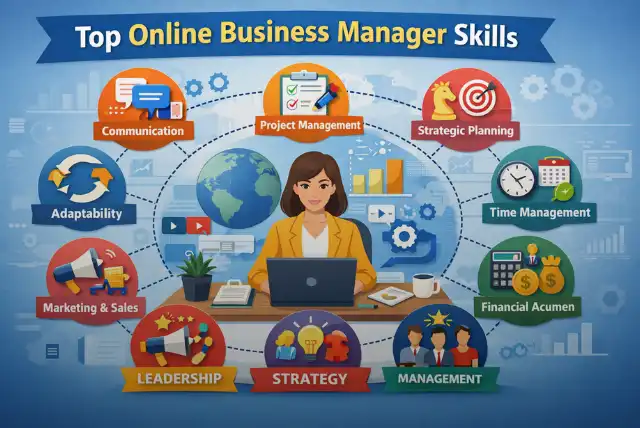
In today’s digital age, the role of an Online Business Manager (OBM) is more critical than ever. As companies increasingly move their operations online, the need for skilled managers to oversee digital projects, remote teams, and online strategies is paramount. To excel in this role, an OBM must possess a diverse set of skills. This article explores the ten essential skills that contribute to the success of an Online Business Manager.
1. Effective Communication
Effective communication is the cornerstone of any successful business operation. As an OBM, you must be able to convey ideas clearly and concisely to team members, stakeholders, and clients. This includes both written and verbal communication, as well as the ability to listen actively and provide constructive feedback.
2. Project Management
Project management skills are crucial for an OBM. This includes planning, executing, and overseeing projects to ensure they are completed on time and within budget. Familiarity with project management tools like Asana, Trello, and Monday.com can greatly enhance your ability to manage tasks and deadlines effectively.
3. Strategic Planning
Strategic planning involves setting long-term goals and determining the best strategies to achieve them. An OBM must be able to analyze market trends, identify opportunities for growth, and develop plans that align with the company’s overall vision. This skill is essential for ensuring the long-term success of the business.
4. Time Management
Time management is about prioritizing tasks and managing your time efficiently to maximize productivity. An effective OBM knows how to delegate tasks, set realistic deadlines, and avoid procrastination. Tools like Google Calendar and Todoist can help keep track of schedules and deadlines.
5. Financial Acumen
A successful OBM needs a solid understanding of financial principles. This includes budgeting, forecasting, and financial analysis. Knowing how to manage the company’s finances ensures that resources are allocated effectively and that the business remains profitable.
6. Leadership and Team Management
Leadership skills are essential for motivating and guiding teams. As an OBM, you must be able to inspire your team, resolve conflicts, and foster a positive work environment. Strong leadership leads to increased productivity and a more cohesive team.
7. Technical Savvy
In an online business environment, technical skills are a must. An OBM should be comfortable with various digital tools and platforms, including content management systems (CMS), customer relationship management (CRM) software, and e-commerce platforms. Staying updated with the latest technology trends can give you a competitive edge.
8. Problem-Solving
Problem-solving skills are crucial for navigating the challenges that arise in managing an online business. An effective OBM can identify problems quickly, develop creative solutions, and implement them efficiently. This skill helps in maintaining smooth operations and achieving business goals.
9. Marketing and Sales Knowledge
Understanding the basics of marketing and sales is important for an OBM. This includes knowledge of digital marketing strategies, social media management, and sales funnel optimization. These skills help in driving traffic, increasing conversions, and boosting revenue.
10. Adaptability and Flexibility
The digital landscape is constantly changing, and an OBM must be adaptable and flexible. Being open to new ideas, willing to learn new skills, and able to pivot strategies when necessary is crucial for staying relevant and competitive in the online business world.
An Online Business Manager Is Not A Virtual Assistant
This is the distinction the whole role rests on, and getting it wrong is why some people undercharge for years. A virtual assistant is given tasks and completes them. An online business manager is given outcomes and decides what the tasks should be, then makes sure other people do them. The VA is asked to schedule the emails; the OBM decides the campaign exists, who writes it, when it ships and what happens if it underperforms. One is executing a plan, the other owns it. If you are still waiting to be told what to do next, you are doing the first job.
What The Job Looks Like In A Normal Week
Stripped of the job-description language, most of the week goes on four things. Running the operating rhythm: the weekly planning session, the stand-up, the review of what shipped. Keeping projects moving, which mostly means unblocking other people rather than doing the work. Watching the numbers that matter, usually revenue, pipeline, delivery dates and capacity. And handling the awkward conversations the founder has been avoiding. It is less glamorous than the title suggests and considerably more useful, because a business with no one doing this quietly runs on the founder’s memory.
How Online Business Managers Actually Charge
There are three common models and they suit different stages. Hourly is the easiest to start with and the worst to stay on, because your income is capped by your calendar and you get punished for being efficient. A monthly retainer for an agreed scope and an agreed number of days is where most established OBMs settle, because it gives the client predictability and gives you a stable income. Project or launch fees work for one-off pieces of work with a clear finish line. Whatever the model, define the scope in writing, because scope creep is the single biggest cause of an unprofitable retainer.
The Tool Stack You Are Expected To Run
Clients rarely ask which specific tools you know, then expect you to be fluent in whatever they already use from day one. In practice that means a project tool such as Asana, ClickUp, Trello, Monday or Notion, a communication layer of Slack or Teams, some form of CRM, an email platform such as Mailchimp, Kit or Klaviyo, a payments and invoicing system, and increasingly an automation layer like Zapier or Make. You do not need to master all of them. You do need to be the person who can learn a new one over a weekend and then document how the team should use it.
Getting The First Client Without A Track Record
The chicken-and-egg problem is real, and there are only a few honest ways through it. Most OBMs come up from an adjacent role, a VA who started making decisions, a project manager who went freelance, an operations person from a corporate job, and their first client is someone who already knows their work. Failing that, the routes that work are a small piece of paid project work that proves you can run something end to end, a referral from another freelancer who serves the same clients, or a documented case study from a business you helped even unpaid. Cold outreach without one of those three is very slow going.
The Admin Side Of Working For Yourself
Most people arrive at this role through the work and are caught out by the paperwork. In the UK you will be trading either as a sole trader or through a limited company, and GOV.UK sets out the difference in its guide to setting up a business. Beyond the structure itself, the things that matter early are a written contract for every client, professional indemnity insurance, a sensible approach to handling client data, and setting money aside for tax from the first invoice rather than the first tax bill.
Managing A Team You Have Never Met
Nearly all of this work is remote, often across time zones, and that changes how management works. You lose the corridor conversation, so anything that matters has to be written down and findable. You lose body language, so you ask direct questions instead of reading the room. And you lose the visible signal of someone looking busy, which is a good thing, because it forces you to measure delivered work rather than hours online. Teams that run well remotely tend to have one document everyone trusts, a small number of fixed meetings, and a written rule about how quickly people are expected to reply.
Telling A Good Client From A Bad One
Experienced OBMs turn work down, and the warning signs show up in the first conversation. A founder who cannot say what success would look like in three months. A business with no numbers to hand. A request for the responsibility of the role at assistant rates. And the hardest one to spot, the client who wants a manager but will not actually delegate, so every decision comes back to them anyway. The best clients tend to be the ones who are already stretched, know exactly why, and are visibly relieved to hand something over. For the wider context of which functions a business should buy in rather than build, see our guide to IT outsourcing models and risks, and for the product-business version of the same problem, our guide to starting a kidswear business.
Just starting out? See our strategies for a new business in the UK.
Want to do this work yourself? Our guide to becoming an online business manager covers setting up, contracts and your first clients.
Hiring rather than applying? See our comparison of an online business manager vs a virtual assistant.
Conclusion
The role of an Online Business Manager is multifaceted and demanding. By developing these ten essential skills, you can effectively manage online operations, lead your team to success, and contribute to the overall growth and profitability of your business. As the digital world continues to evolve, staying updated and continuously improving these skills will ensure your ongoing success as an OBM.
FAQ
Q1: What is an Online Business Manager (OBM)?
A1: An Online Business Manager is a professional who oversees the daily operations, projects, and team management of an online business.
Q2: Why is effective communication important for an OBM?
A2: Effective communication ensures that ideas are conveyed clearly, team members are aligned, and projects run smoothly.
Q3: What tools can help with project management?
A3: Tools like Asana, Trello, and Monday.com are popular for managing tasks and deadlines efficiently.
Q4: How does strategic planning benefit an OBM? A4: Strategic planning helps in setting long-term goals, identifying growth opportunities, and aligning efforts with the company’s vision.
Q5: What financial skills are important for an OBM?
A5: Budgeting, forecasting, and financial analysis are crucial for managing a company’s resources effectively.
Q6: What makes a good leader in an online business environment?
A6: A good leader motivates the team, resolves conflicts, and fosters a positive work environment, leading to higher productivity.
Q7: Why is technical savvy important for an OBM?
A7: Being comfortable with digital tools and platforms helps an OBM manage online operations efficiently.
Q8: How can problem-solving skills benefit an OBM?
A8: Problem-solving skills help in quickly identifying and addressing issues, ensuring smooth business operations.
Q9: What marketing knowledge should an OBM have?
A9: An OBM should understand digital marketing strategies, social media management, and sales funnel optimization.
Q10: Why is adaptability important for an OBM?
A10: Adaptability is crucial for staying relevant and competitive in the constantly changing digital landscape.