
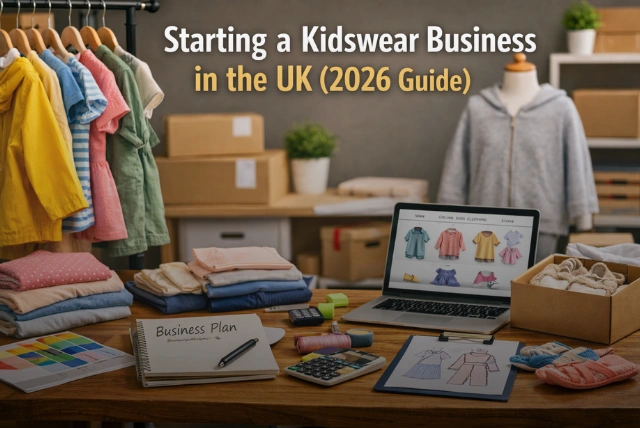
Starting a kidswear business can be both creative and profitable. Children grow quickly, which means parents need to buy clothes regularly. Even when adult fashion sales slow down, children’s clothing remains essential. This is why kidswear is considered one of the most stable parts of the fashion industry.
In 2026, the UK kidswear market is valued at around £7.5–£8 billion. Growth is steady rather than rapid, but demand remains consistent. School uniforms, everyday clothing, and online shopping continue to drive sales, making this a realistic market for new businesses.
This guide explains how to start a kidswear business in the UK using current and realistic information.
Understanding the UK Kidswear Market
The kidswear market is more resilient than adult fashion because parents continue to buy clothing even during economic pressure. On average, UK parents spend between £700 and £800 per child each year on clothing. Demand increases during back-to-school periods and around Christmas, while everyday wear sells steadily throughout the year.
Online shopping now plays a major role in how parents buy children’s clothing. Parents prefer online shopping because it offers:
-
Convenience and time savings
-
Easy size comparisons
-
Home delivery and simple returns
In recent years, buying behaviour has shifted. Parents increasingly look for:
-
Durable everyday clothing
-
Comfortable and child-safe fabrics
-
Simple, practical designs
-
Ethical and sustainable options
Although competition is strong, especially from large retailers, smaller brands continue to succeed by offering clear value and focused product ranges.
Choosing the Right Kidswear Niche
Trying to sell everything often makes it harder to grow. Successful kidswear brands usually focus on one clear category and build trust within that space.
Common and proven kidswear niches include:
-
Organic or eco-friendly clothing
-
Gender-neutral kidswear
-
Personalised outfits
-
Ethnic or cultural children’s wear
-
Adaptive clothing for children with special needs
A clear niche helps customers quickly understand what your brand stands for.
Planning and Registering Your Kidswear Business
Before selling, it is important to create a simple business plan. This does not need to be complex, but it should clearly explain:
-
What type of clothing you will sell
-
Who your target customers are
-
How you will price your products
-
Where and how you will sell them
In the UK, children’s clothing must follow strict safety rules. These regulations focus mainly on:
-
Fabric safety and chemical use
-
Buttons, cords, zips, and small parts
-
Labelling and care instructions
You must also register your business with HMRC before trading.
Sourcing and Producing Kidswear
You can manufacture clothing locally or work with overseas suppliers. Many new brands start with small production batches to reduce risk and test demand.
When producing kidswear, quality matters more than trends. Clothing should be:
-
Soft and comfortable
-
Durable enough for frequent washing
-
Safe for children to wear
-
Practical for everyday use
Testing samples before full production is essential.
Selling Kidswear Online
Online selling is now essential for kidswear businesses. Most parents prefer shopping online because it saves time and offers more choice.
A good kidswear website should include:
-
A mobile-friendly layout
-
Clear size guides
-
High-quality product images
-
Honest and simple descriptions
-
Easy return and exchange policies
Trust and clarity strongly influence buying decisions.
Marketing Your Kidswear Brand
Marketing should focus on trust, not pressure. Parents respond better to helpful and relatable content.
Effective marketing methods include:
-
Social media content aimed at parents
-
Blog posts and guides related to children’s clothing
-
Collaborations with parenting influencers
-
Email newsletters with updates and offers
Real customer reviews and photos often perform better than polished advertisements.
Managing Inventory and Pricing
Inventory control helps protect profit and avoid waste. New businesses often struggle with stock planning.
Good inventory management includes:
-
Starting with limited quantities
-
Tracking best-selling sizes and items
-
Preparing for seasonal demand
Pricing should reflect your costs while staying affordable for parents. Many customers are willing to pay slightly more for better quality and safety.
Growing Your Kidswear Business
Once your business is stable, growth can come from several directions:
-
Adding accessories such as socks or hats
-
Expanding into new age groups
-
Selling to international customers
-
Applying for UK startup or sustainability support schemes
Growing slowly helps maintain quality and control costs.
The VAT Rule That Decides Your Pricing
This is the single most important thing a new kidswear seller in Britain needs to know, and most guides never mention it. Young children’s clothing and footwear is zero-rated for VAT in the UK, which means you charge no VAT on it while still reclaiming VAT on your costs. HMRC sets out the conditions in VAT Notice 714. Four tests all have to be met: it must be an article of clothing or footwear, it must not be made of fur, it must be designed for young children, and it must be suitable only for young children.
Where The Under-14 Line Actually Sits
The threshold is not a vague idea of childhood, it is a measurement table. HMRC treats young children as those up to the eve of their fourteenth birthday, on the basis that body dimensions start merging with adult sizes at that point. The maximum reference measurements it publishes are a height of 163cm for boys and 161cm for girls, a chest of 84cm and 85cm, and a waist of 70cm and 69cm respectively. Cross those, or label a garment to fit a larger size, and it fails the suitability test and becomes standard-rated. Teen ranges are exactly where new brands get this wrong.
Safety Law Is Specific, And It Is Enforced
Children’s clothing carries obligations that adult clothing does not, and the two that catch small brands are cords and flammability. Drawstrings and decorative cords around the neck and hood are a recognised strangulation risk and are the subject of a British and European standard that most retailers write into their supplier contracts. Nightwear has separate flammability requirements. If you want to see how seriously this is taken, the Office for Product Safety and Standards publishes every case in its product safety alerts and recalls database, and children’s pyjamas and cord-trimmed tops appear in it regularly, including products from very large retailers.
Sizing Is Where New Brands Lose Their Margin
Returns quietly destroy more small clothing businesses than poor sales do, and in kidswear the usual cause is sizing. British shops label by age, which is convenient for parents and close to meaningless as a measurement, because two five-year-olds can differ by ten centimetres. The brands that keep returns low publish height-based sizing alongside the age label, put a proper measurement table on every product page, and say plainly whether a garment runs small. Doing that costs nothing at the design stage and saves you the postage, the restocking and the refund on every avoidable return.
Sole Trader Or Limited Company

Image source: pexels.com
Most kidswear businesses start as a sole trader because it is quick, cheap and involves the least paperwork, and that is a perfectly reasonable place to begin. The trade-off is that a sole trader is personally liable for the business’s debts, while a limited company is a separate legal entity with its own liability, its own accounts and public filings at Companies House. GOV.UK sets out the comparison in its guide to setting up a business. The practical advice most accountants give is to start simple and incorporate when turnover, stock commitments or supplier contracts make personal liability uncomfortable.
Minimum Order Quantities Are The Real Barrier
The gap between designing a range and owning a range is a minimum order quantity. Manufacturers in Portugal, Turkey, India, Bangladesh and China typically want a few hundred units per style and colourway, which means a four-style launch can tie up most of your starting capital in stock before a single sale. The usual routes around it are print-on-demand for basics, white-label stock you brand yourself, small studios in the UK that accept low runs at a higher unit cost, or launching with a single hero product and reinvesting. None is free; all of them beat a stockroom full of one size.
Marketplaces Or Your Own Shop
You do not have to choose one, and most successful small brands do not. Marketplaces such as Etsy, Amazon, eBay and Not On The High Street bring existing traffic and cost you a commission on every sale. Your own site on Shopify, WooCommerce or Squarespace costs less per order but you have to supply the visitors yourself, which is slow at the start. The pattern that works is to use a marketplace to prove that people will actually buy the product, then move repeat customers onto your own site where the margin and the customer relationship both belong to you.
Your Real Competitor Is The Second-Hand Market
Any honest guide has to name this. Children outgrow clothes long before they wear them out, which has made resale platforms and local selling groups an enormous part of how British families now buy kidswear, alongside charity shops and hand-me-downs. You cannot beat that on price, so competing on price is a losing plan. What holds up against it is the thing second-hand cannot offer reliably: consistent sizing, durability that survives repeated washing, and a design nobody else in the class is wearing. For more on positioning a small brand, see our guide to building a marketing operation and our breakdown of the skills behind running an online business in our online business manager guide.
Conclusion
Starting a kidswear business in the UK in 2026 is a practical opportunity for entrepreneurs who plan carefully and focus on quality. While the wider fashion industry faces challenges, children’s clothing remains essential and continues to sell consistently. With a clear niche, strong online presence, and attention to safety and comfort, it is possible to build a trusted and sustainable kidswear brand.
For general start-up foundations beyond this sector, see our strategies for success in a new business.
Frequently Asked Questions
What is needed to start a kidswear business?
Market research, a clear plan, legal compliance, safe products, and strong branding.
Is online selling important for kidswear?
Yes. Most parents now prefer buying children’s clothes online.
What matters most in kidswear design?
Comfort, safety, durability, and easy care.
Is sustainable kidswear worth offering?
Yes. Many parents actively look for eco-friendly clothing options.
What challenges do kidswear businesses face?
Common challenges include stock management, sizing accuracy, safety compliance, and competition.