
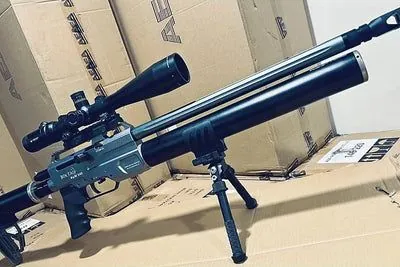
Two things about UK airgun law that this page previously got wrong, and both could land you in trouble. An air pistol over 6 ft-lb is a prohibited weapon — you cannot get a certificate for one at all. And a trigger lock does not satisfy the legal storage requirement.
The engineering is genuinely interesting — regulators, choked barrels, digital valve timing — but the law is the part that bites, so it goes first.
Last updated: 3 November 2026.
Correction, and it matters. The previous version said that anything above the power limits “is classed as a firearm and needs” a certificate. That is true for rifles and false for pistols. Firearms licensing guidance states that air pistols above 6 ft-lb are prohibited and cannot be licensed. There is no application to make. It also offered a trigger lock as a way to meet the storage law — BASC says trigger guard locks do not satisfy the requirement.
The legal position, short
- Air rifle: over 12 ft-lb needs a firearm certificate
- Air pistol: over 6 ft-lb is PROHIBITED — not licensable
- Scotland: certificate for all air weapons since 31 Dec 2016
- N. Ireland: separate regime — check PSNI
- Buying age: 18. Supervisor age: 21
- Storage: secure, out of sight, ammo separate
- Never: fire beyond your boundary
What this article covers
UK Airgun Law, Properly Set Out

Image source: Pinterest.com
| Category | The position | Source |
|---|---|---|
| Air rifle, up to 12 ft-lb | No certificate needed in England and Wales. Must be 18 to buy | 1969 Rules |
| Air rifle, over 12 ft-lb | Section 1 firearm — firearm certificate required | Firearms licensing guidance |
| Air pistol, up to 6 ft-lb | No certificate needed in England and Wales. Must be 18 to buy | 1969 Rules |
| Air pistol, over 6 ft-lb | PROHIBITED WEAPON. It cannot be licensed at all — police guidance states such pistols “are prohibited and cannot be licensed”. This page previously said it merely needed a certificate | Firearms licensing guidance |
| Energy varies between individual guns | Do not assume every example of a model produces the same muzzle energy, especially near the limits. A rifle sold as sub-12 can test over — and that becomes your problem, not the shop’s | Firearms licensing guidance |
| Scotland | An air weapon certificate is required for air weapons, under the Air Weapons and Licensing (Scotland) Act 2015, in force 31 December 2016 | 2015 Act |
| Northern Ireland | A separate firearms regime applies. Check with the PSNI before buying or moving an air weapon there — this page previously ignored NI entirely | — |
Power thresholds under the Firearms (Dangerous Air Weapons) Rules 1969 and Home Office firearms licensing guidance. This is a summary, not legal advice.
Above 12 ft-lb an air rifle is a Section 1 firearm and needs a certificate. Above 6 ft-lb an air pistol is prohibited — a certificate is not available. Firearms licensing guidance.
- The limits apply to your actual gun, not the model. Licensing guidance warns that examples of the same model can produce different muzzle energies, especially near the limits.
- A tune, a heavier pellet or worn seals can push a rifle over 12 ft-lb — at which point you are in possession of an unlicensed Section 1 firearm.
- Have it chronographed if you are unsure. Most clubs and dealers will do it.
- It is an offence to fire a pellet beyond the boundary of the land where you have permission to shoot.
- Carrying in public needs a reasonable excuse — unloaded, in a case, going to or from somewhere you may shoot.
The Four Nations Are Not the Same
Scotland requires an air weapon certificate under the Air Weapons and Licensing (Scotland) Act 2015, in force 31 December 2016. Northern Ireland operates a separate firearms regime and readers should check with the PSNI — we are not publishing a figure for NI that we could not verify.
This caught the old version out: it covered England, Wales and Scotland and did not mention Northern Ireland at all. If you are moving an air weapon between nations, the rules change at the border — a rifle you may own freely in Carlisle needs a certificate in Gretna.
The Age Rules

Image source: Pinterest.com
| Age | What is allowed | Source |
|---|---|---|
| Under 14 | May use an air weapon only on private premises with the occupier’s permission and under the supervision of someone aged 21 or over. A parent or guardian who buys one for an under-14 must exercise control over it at all times, even in the home or garden | BASC |
| 14 to 17 | Cannot buy or hire an air weapon or its ammunition, but may borrow one and use it on private land with the occupier’s consent | BASC |
| 18 | Minimum age to buy or hire an air weapon or ammunition. Selling to an under-18 is an offence | GOV.UK |
| 21 | Minimum age of a supervisor, and an under-18 carrying an air weapon in a public place must be accompanied by someone 21 or over and have a good reason, such as travelling to a range | BASC |
BASC — young people and air weapons and Home Office guidance, England and Wales. Scotland and Northern Ireland differ.
The detail people miss: a parent or guardian who buys an air rifle for a child under 14 must exercise control over it at all times — including in the home and garden. Handing it over and going inside is not supervision.
Storage, and Why a Trigger Lock Is Not Enough

Image source: Pinterest.com
- Section 46 of the Crime and Security Act 2010, in force since February 2011, makes it an offence to fail to take reasonable precautions to prevent an under-18 gaining unauthorised access to an air weapon.
- Guidance is: stored securely, out of sight, and separately from ammunition.
- BASC states that trigger guard locks do not satisfy the requirement. The old version of this page listed one as an acceptable option.
- A locked cabinet is the sensible answer, with pellets kept somewhere else.
- “Reasonable” is judged against your household. A house with teenagers in it needs more than a house without.
- The offence is committed by failing to take precautions — nobody has to actually get hold of the gun.
Power Systems: Springer, Gas Ram, PCP, CO2

Image source: Pinterest.com
| Type | How it works | In practice |
|---|---|---|
| Spring piston (“springer”) | A coiled spring drives a piston that compresses air behind the pellet | Cheap, self-contained, needs no air supply. Recoils in two directions, which is why they are harder to shoot well |
| Gas ram | A sealed gas strut replaces the coiled spring | Smoother and quieter than a springer, and can be left cocked without taking a set |
| PCP (pre-charged pneumatic) | Air stored in an onboard cylinder at high pressure, released shot by shot | Almost no recoil, the most accurate type, but needs a pump, bottle or compressor |
| CO2 | Powered by a disposable or refillable CO2 cartridge | Convenient, but power drops noticeably as the temperature falls |
| Regulator | Meters a constant pressure to the valve on a PCP | The single biggest gain in shot-to-shot consistency. An unregulated rifle has a narrower usable fill range |
| Barrel | Rifled to spin and stabilise the pellet | Choked barrels squeeze slightly at the muzzle to settle the pellet before it exits |
General engineering description. Performance claims for specific models should be checked with the manufacturer.
Regulators, Valves and Barrels

Image source: Pinterest.com
- The regulator is the biggest single upgrade on a PCP. It meters a constant pressure to the valve, so velocity stays flat across the fill instead of rising and falling.
- Valve timing decides how much air each shot uses. Too long and you waste air for no extra velocity — the point of diminishing returns is real and measurable.
- A choked barrel narrows very slightly at the muzzle, settling the pellet before it exits. It is one of the quiet reasons some barrels simply group better.
- Electronics have arrived. The Daystate Delta Wolf uses a digital trigger and onboard computer to adjust valve timing, and the FX Impact M3 is modular with dual regulators and interchangeable barrels. Air Arms S510 remains the conventional benchmark.
- Consistency beats power. At UK legal limits, a rifle that puts every pellet within a few feet per second of the last is worth far more than one that is nominally faster.
- For optics and low-light shooting, see our guide to night vision technology.
Pellets and Ballistics

Image source: Pinterest.com
- Domed pellets are the default for general shooting — the best ballistic coefficient of the common shapes, so they hold velocity and buck wind better.
- Wadcutters cut clean round holes in paper, which is why they suit close-range target work and little else.
- Pointed pellets are usually the least consistent. They look fast and rarely group well.
- Weight matters more than shape at UK limits. A heavier pellet leaves slower but keeps its energy further.
- Barrels are individuals. Buy three or four tins and shoot groups — the pellet your barrel likes is not predictable from a review.
- Weigh and sort pellets if you shoot competition. For everything else it is effort better spent on practice.
Safety and Maintenance

Image source: Pinterest.com
- Treat every airgun as loaded. They are not toys, and the law treats them as weapons.
- Use a solid backstop and wear eye protection. Pellets ricochet off stone, metal and water in ways that surprise people.
- PCP systems hold air at very high pressure. Inspect seals and fittings before filling, and never let oil near a high-pressure air fitting.
- Clean the barrel every few hundred shots, lubricate sparingly, and replace worn O-rings before they fail rather than after.
- Keep fill equipment dry. Moisture in a cylinder causes internal corrosion you cannot see.
- Know what is behind your target, every single time. This is the rule that actually prevents accidents.
- The Home Office air weapons safety leaflet is short, free and worth reading before your first shot.
Corrections Made to This Page

Image source: Pinterest.com
| What it said | Why it changed |
|---|---|
| “Anything more powerful is classed as a firearm and needs [a certificate]” | True for rifles, false for pistols. An air pistol over 6 ft-lb is a prohibited weapon and cannot be licensed at all. There is no application to make |
| Store it securely “such as in a locked cabinet or using a trigger lock” | BASC states trigger guard locks do not satisfy the requirement of section 46 of the Crime and Security Act 2010 |
| “Legal note (India, 2025)” | An India-specific legal note on a UK site. Removed and replaced with the UK position |
| “According to Data Insights Market (2025), the global air-rifle sector is valued at roughly USD 1.2 billion” | A market-research aggregator with no published methodology. Removed rather than repeated |
| “Strict rules on use by under-18s”, with no detail | The age rules are now set out in full — under 14, 14–17, 18 and the 21-year-old supervisor requirement |
| Northern Ireland not mentioned at all | NI has a separate firearms regime. Readers are told to check with the PSNI rather than given a figure we could not verify |
| No warning that muzzle energy varies between guns | Licensing guidance warns not to assume every example of a model produces the same energy — and it is the owner who commits the offence |
| Two links in the whole article, no sources | On a page about firearms law. GOV.UK guidance, the Home Office safety leaflet, the 1969 Rules, the Crime and Security Act 2010, the Scottish Act and BASC now linked |
| No Gutenberg blocks, no tables, no structured data | The article had a wp: block count of zero. Rebuilt, with FAQ JSON-LD |
All corrections made on 3 November 2026. All nine images and both original links were kept.
Frequently Asked Questions
Do I need a licence for an air rifle in the UK?
It depends which nation you are in. In England and Wales, an air rifle up to 12 ft-lb needs no certificate; above that it is a Section 1 firearm and requires a firearm certificate. In Scotland an air weapon certificate is required under the Air Weapons and Licensing (Scotland) Act 2015, in force since 31 December 2016. Northern Ireland has a separate regime — check with the PSNI.
Can I get a certificate for a powerful air pistol?
No, and this is the most important correction on this page. An air pistol producing more than 6 ft-lb is a prohibited weapon — firearms licensing guidance states such pistols “are prohibited and cannot be licensed”. There is no certificate available for one. The previous version of this page implied you could simply apply for one.
Is a trigger lock enough to store an airgun legally?
No. BASC states that trigger guard locks do not satisfy the requirement. Under section 46 of the Crime and Security Act 2010, in force since February 2011, it is an offence to fail to take reasonable precautions to stop an under-18 gaining unauthorised access. Guidance is to store it securely, out of sight, and separately from ammunition. This page previously offered a trigger lock as a compliant option.
What age can someone use an air rifle?
Under 14: only on private premises with the occupier’s permission and supervised by someone 21 or over. 14–17: cannot buy or hire, but may borrow one and use it on private land with consent. 18: minimum age to buy or hire. 21: minimum age of a supervisor. See BASC.
Can I shoot in my garden?
Only if the pellet stays on your land. It is an offence to fire a pellet beyond the boundary of the land where you have permission to shoot. A garden with a neighbour behind it is rarely a safe backstop, and “I did not mean to” is not a defence.
My rifle is sold as sub-12 ft-lb. Is that enough?
Not necessarily, and the law looks at your gun, not the model. Firearms licensing guidance warns that it should not be assumed that every example of a model produces the same muzzle energy, particularly near the limits. Tuning, a different pellet or worn seals can push a rifle over — and it becomes your offence, not the retailer’s. Have it chronographed if you have any doubt.
What is the difference between a springer and a PCP?
A springer makes its own air; a PCP stores it. A spring piston rifle is self-contained and cheap but recoils in two directions, which makes it genuinely harder to shoot accurately. A pre-charged pneumatic has almost no recoil and is far more accurate, but needs a pump, dive bottle or compressor.
What does a regulator actually do?
It delivers the same pressure to the valve on every shot. On an unregulated PCP the pressure falls as you shoot, so velocity rises then drops across the fill. A regulator flattens that out, which is why regulated rifles have a much wider usable shot count.
Which pellet should I use?
Whichever your barrel likes — and the only way to know is to test. Domed pellets are the default for general shooting because of their ballistic coefficient; wadcutters cut clean paper holes at close range; pointed pellets are usually the least consistent. Buy three or four tins and shoot groups rather than trusting a review.
Are airguns dangerous?
Yes. They are not toys, and the law treats them as weapons. Always treat one as loaded, use a solid backstop, wear eye protection, and never point it at anything you are not prepared to destroy. PCP systems hold air at very high pressure — check seals and fittings, and never oil a high-pressure air fitting.
Can I carry an airgun in public?
Not without a reasonable excuse. Transport it unloaded, in a case, going to and from a specific place you have permission to shoot. An under-18 doing so must be accompanied by someone 21 or over.
Where can I learn to shoot properly?
A club. You get supervision, a safe range, and people who will tell you what the law actually requires — which, as this page shows, is not always what the internet says. BASC publishes an air rifle code of practice.
Final Thoughts
Modern airguns are genuinely impressive machines — regulated air, choked barrels, digital valve timing — and at UK legal limits the whole game is consistency rather than power.
But know the law for your nation before you buy. 12 ft-lb for a rifle, 6 ft-lb for a pistol — and above 6, a pistol is prohibited outright, not licensable. Store it in a cabinet, not with a trigger lock, and keep the pellets somewhere else. More from The UK Post.
Sources
- GOV.UK — Guide on firearms licensing law
- Home Office — Air weapons: a brief guide to safety (PDF)
- The Firearms (Dangerous Air Weapons) Rules 1969
- Crime and Security Act 2010, section 46 — safe storage of air weapons
- Air Weapons and Licensing (Scotland) Act 2015
- BASC — young people and air weapons
- BASC — air rifle code of practice
- Ballistic coefficient — why pellet shape matters
Disclaimer
This is a general summary of UK airgun law, not legal advice. Firearms law is complex, differs between England and Wales, Scotland and Northern Ireland, and changes. Check the current position with your police force’s firearms licensing department before buying, modifying, storing or transporting an air weapon. An air pistol over 6 ft-lb is a prohibited weapon and cannot be licensed. Muzzle energy varies between individual guns — if in doubt, have yours chronographed. Airguns are weapons, not toys: always use a safe backstop, eye protection and secure storage. Information correct as at 3 November 2026.

Image source: Pinterest.com