
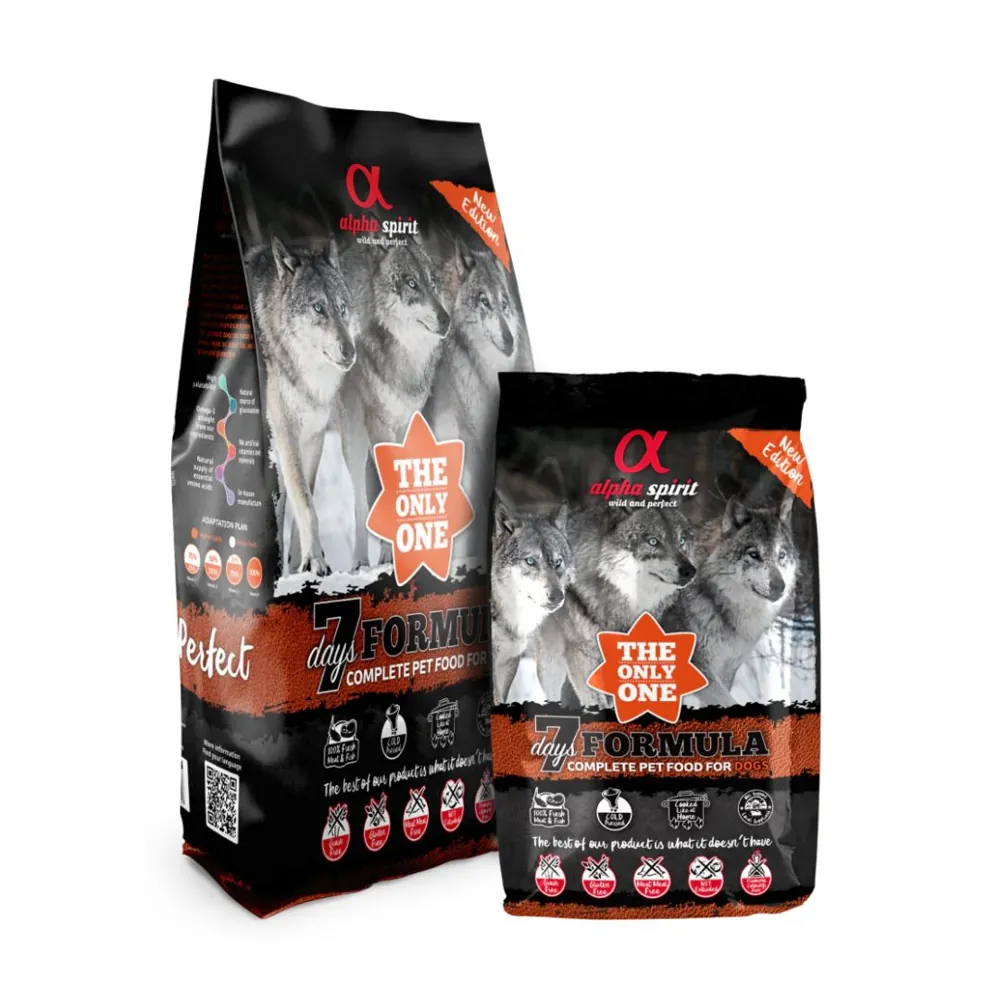
Alpha Spirit is a Spanish dog food sold in the UK and Ireland, built around a cold-pressed, grain-free recipe with a high declared meat content. This page sets out what can actually be checked about it: the manufacturer’s own declared figures, what an independent rating site scores it, what it costs per day, and one open scientific question about grain-free food that is worth raising with your vet.
It is not a hands-on test. No dog was fed this food for this article, no laboratory analysis was commissioned, and no vet was consulted for it. An earlier version of this page claimed otherwise – it described a review process involving veterinary nutritionists and verified retailer feedback that did not happen – and it carried owner quotes and a star rating that were not real. All of that has been removed, and the corrections table below says exactly what went.
What is left is smaller but true, and for choosing a dog food it is the part that matters: the numbers on the pack, what they mean, and what they cost.
Key takeaways
- Who makes it: Amigüitos Pets & Life S.A of Lorca, Spain, founded 2013, around 16 employees. The same company owns the Orygo and Primal Spirit brands.
- The declared figures: for The Only One Adult Complete Poultry, 30% protein, 15.5% fat, 2% fibre, 16% moisture and 8% ash. The earlier version of this page omitted the ash.
- Independent score: All About Dog Food rates the brand 76% on average, not the “4.4 out of 5” this page used to claim.
- The cost: around £5.63 a day on average across the range. That is the number the old version left out, giving prices in Indian rupees instead.
- The “85% fresh meat” claim: is a weight measured before cooking. Fresh meat is mostly water, so it shrinks a long way before it reaches the bag.
- Worth asking your vet: this is a grain-free food containing pulses. The US FDA has an unresolved investigation into that combination and canine heart disease.
What this article covers
Last updated: 14 November 2026.
What this page got wrong

Image source: pinterest.com
This was a review with invented evidence. That is worth being blunt about, because the invented parts were exactly the parts a reader would have leaned on.
| The earlier version | What checking found | Action |
|---|---|---|
| A “How We Reviewed” section citing verified feedback from Zooplus, Miscota and Amazon, nutritional data from All About Dog Food, and “professional insights from veterinary nutritionists” | None of this happened. No testing was carried out and no veterinary nutritionist was involved. A fabricated methodology is the most misleading thing a review can contain | Removed and replaced with a plain statement of what this page is |
| Six quoted owner reviews, in quote marks, such as “my Labrador has allergies… Alpha Spirit was a game-changer” | No source, no date, no platform, not traceable to any real reviewer. They were invented testimonials | All removed |
| A rating table: ingredient quality 4.5, palatability 4.5, digestibility 4.5, value 4.0, overall 4.4 out of 5 | Derived from nothing. For comparison, All About Dog Food – the independent site the page claimed to have used – rates the brand at 76% | Removed; the real independent rating is given instead |
| Prices only in Indian rupees, “as of October 2025”, citing distributors in India | This is a UK site. UK readers got no usable price at all, and the figures were over a year old | Replaced with UK cost-per-day figures |
| “Grain-free, hypoallergenic formulas are ideal for dogs with sensitive stomachs or food allergies” | “Hypoallergenic” is a marketing word, not a regulated one, and removing grain does not treat an allergy. A genuine food allergy needs a vet-supervised elimination diet | Rewritten |
| “Promotes healthy skin, coat and joints”, “visible health results”, “real health benefits” | Unevidenced health claims for a specific product | Removed |
| Nutrition given as ranges: protein 30–36%, fat 15–18% | Analytical constituents are declared per product, not as a range across a brand. The real declared figures for one UK-sold product are in the table below, and they include ash, calcium and phosphorus, which the page left out entirely | Replaced with one product’s actual declared figures |
| A comparison table giving Orijen 85–90% meat, Acana 70%, Farmina 60–70% | Unsourced figures about other companies’ products | Removed |
| No mention of the FDA’s investigation into grain-free diets and canine heart disease | This is a grain-free food containing chickpeas. The investigation is directly relevant and was missing | Added, with the FDA’s own figures and caveats |
| Both internal links pointed at unpublished drafts | They returned 404 pages to readers | Links removed |
| Image captions read “Pinterest.cpm”; US spelling (“colorants”, “Fiber”, “emphasizes”) | — | Corrected |
Checks carried out 14 November 2026 against the sources listed at the foot of this page.
Who actually makes it

Image source: pinterest.com
Alpha Spirit is a brand of Amigüitos Pets & Life S.A, based in Lorca in southern Spain. The company was founded in 2013 and is small – around 16 employees. It serves the UK and Ireland among other markets, and it also owns two other pet food brands, Orygo and Primal Spirit.
Those details are worth having because they set expectations. This is not a multinational with its own research division; it is a small European manufacturer. That is neither good nor bad in itself, but it does mean you are relying on the declared figures on the pack and on independent assessment, rather than on published feeding trials.
The range covers cold-pressed dry food, semi-moist food, wet tins, pouches, sausages and meatballs. The food is not extruded – that is the brand’s main technical claim, and it is why the texture differs from standard kibble.
What is actually in it

Image source: pinterest.com
Below are the declared analytical constituents for Alpha Spirit The Only One Adult Complete Poultry, as published by a UK retailer selling it. These are the manufacturer’s declared figures for that specific product. Other products in the range will differ, so check the pack you are actually buying.
| Declared constituent | Figure | What it tells you |
|---|---|---|
| Crude protein | 30.0% | High for a dry food. Suits active adult dogs; not automatically better for every dog |
| Fat content | 15.5% | Moderate. Fat is the main energy source, so this drives how much you feed |
| Crude fibre | 2.0% | Low. Fibre affects stool consistency and satiety |
| Moisture | 16.0% | Higher than typical extruded kibble, which is why the texture is softer. It also means 16% of the bag weight is water |
| Crude ash | 8.0% | The mineral content left after burning off everything else. The earlier version of this page did not mention it at all |
| Calcium | 1.5% | Matters most for growing dogs, where the calcium-to-phosphorus balance affects bone development |
| Phosphorus | 1.2% | Gives a calcium:phosphorus ratio of about 1.25:1 for this product |
Declared analytical constituents for Alpha Spirit The Only One Adult Complete Poultry, as listed by My Pet Warehouse UK, read 14 November 2026.
One number there deserves a second look. Moisture is 16%, against roughly 8–10% for ordinary extruded kibble. That is the softer texture the brand sells on, and it is genuine – but it also means a kilogram of this food contains less dry matter than a kilogram of standard kibble. When you compare the price per kilogram against another brand, you are not comparing like with like.
The recipes are made without grains, gluten or meat meals, and the dry range is cold-pressed rather than extruded. Carbohydrate comes from sources such as sweet potato and chickpeas. Hold on to that last detail – it comes back below.
The “85% fresh meat” claim, explained

Image source: pinterest.com
Headline meat percentages are the most misread number in pet food, and Alpha Spirit gives you enough information to see why. The retailer listing states that in every 1kg of finished food, 2.42kg of fresh meat and 0.28kg of fresh fish have been used.
Read that again: 2.7kg of raw ingredients go in, 1kg of food comes out. Nothing dishonest is happening – it is simply that fresh meat is mostly water, typically around 70%, and that water is driven off during production. The percentage is measured before cooking, not after.
This is why “85% fresh meat” and “85% dried meat” on two different bags are not the same claim, and why a food listing dried or dehydrated meat can contain more actual meat protein than one listing a bigger fresh-meat number. The declared protein figure – 30% here – is measured in the finished food, which is why it is the more useful number of the two.
The practical rule: compare the analytical constituents, not the marketing percentage. The marketing percentage tells you about the recipe before it was cooked. The analytical constituents tell you about the food your dog will eat.
What an independent rating site says

Image source: pinterest.com
All About Dog Food scores UK dog foods on ingredients and composition. It is the site the earlier version of this page claimed to have drawn on, so it is worth stating what it actually says. As at its page update of 12 March 2026, it gives Alpha Spirit an average rating of 76%.
| Product | AADF rating | Cost per day |
|---|---|---|
| Alpha Spirit Imperial Wet Sausage Wild Fish | 77% | £9.12 |
| Alpha Spirit Imperial Wet Sausage Poultry | 76% | £8.25 |
| Alpha Spirit Soft Food Puppy Complete | 75% | £2.88 |
| Alpha Spirit Mediterranean Diet Wet Sausage Iberian Pork | 72% | £8.63 |
| Brand average | 76% | £5.63 |
All About Dog Food, Alpha Spirit brand page, updated 12 March 2026. Cost per day is AADF’s own calculation and varies with dog size.
76% is a respectable score, not an outstanding one. It places the brand in the upper part of the market without making it a class leader, which is a more useful thing to know than an invented 4.4 out of 5. The gap between the two numbers – 76% against the equivalent of 88% – is the difference between a real assessment and a flattering one.
Note also the spread within the range: the products listed run from 72% to 77%, so “Alpha Spirit is rated X” is less meaningful than checking the specific product. AADF’s own brand note describes the food as suitable for dogs with allergies, but that description originates with the manufacturer rather than from independent testing, so treat it as a brand claim.
The grain-free question to raise with your vet

Image source: pinterest.com
This is the section the earlier version of this page was missing, and it is the one most worth your attention. Alpha Spirit is grain-free, and its recipes use pulses such as chickpeas in place of grain. That combination – grain-free plus pulses – is the subject of an open question in veterinary medicine.
In 2018 the US Food and Drug Administration began investigating reports of dilated cardiomyopathy (DCM), a serious heart condition, in dogs eating certain diets. Its update of 27 June 2019, covering reports from 1 January 2014 to 30 April 2019, found:
US Food and Drug Administration, DCM investigation update of 27 June 2019, covering reports from 1 January 2014 to 30 April 2019. Percentage of reported products containing each. This is an association in reports, NOT evidence of cause.
The FDA recorded 524 reports of DCM in total over that period, of which 515 were canine and 9 feline. The canine reports covered 560 animals, and 119 of those dogs died.
US Food and Drug Administration, 560 dogs across 515 canine reports. Reports to a regulator are self-selecting and do not show how common a condition is.
Now the essential caveat, and it is a big one. The FDA has never established that these diets cause DCM. Its own December 2022 note states that the reports “by themselves… do not supply sufficient data to establish a causal relationship with reported product(s)”. An association in voluntary reports is not proof. Owners of dogs on grain-free diets were also, by 2019, more likely to report – which inflates the association on its own.
The status of the investigation is genuinely unclear, and this page is not going to pretend otherwise. The FDA’s page contradicts itself. A note dated 23 December 2022 says the agency “does not intend to release further public updates until there is meaningful new scientific information to share”, while a section further down the same page still says it “is continuing to investigate”. The page has not been updated since December 2022. It has not been closed, and grain-free diets have not been cleared.
What that means for you in practice:
- This is not a reason to panic, and it is not a reason to avoid this or any other grain-free food on its own. Millions of dogs eat grain-free food without heart problems.
- It is a reason to go grain-free deliberately rather than by default. If your dog has no diagnosed need to avoid grain, there is no established benefit to removing it.
- It is a question for your vet, especially for breeds already predisposed to DCM, such as Dobermanns, Great Danes, Boxers and Irish Wolfhounds.
- Know the signs. The FDA advises contacting your vet promptly if a dog shows possible signs of DCM or other heart conditions – tiredness, coughing, difficulty breathing, or fainting.
The FDA also urges owners to work with their vet, who may consult a board-certified veterinary nutritionist, before making diet changes. That is sound advice regardless of which food you are considering.
What it costs

Image source: pinterest.com
Bag prices vary a lot between UK retailers and change constantly, so the useful figure is cost per day. All About Dog Food puts the brand average at £5.63 a day, with individual products ranging from £2.88 for the puppy soft food to £9.12 for the Wild Fish wet sausage.
At the brand average, that is roughly £170 a month for one dog. This is firmly premium territory, and it is the single most important practical fact about the food – which is why it is striking that the earlier version of this page managed not to give a UK price at all.
Two things to weigh against that. The cost-per-day figures depend on dog size, so a small dog will cost far less than the headline suggests and a large one more. And the 16% moisture means you should compare cost per day, not cost per kilogram, against a drier food – otherwise the comparison flatters the drier bag.
Availability in the UK is patchy. Several independent retailers and Amazon stock it, but individual products go out of stock, which matters more for dog food than for most purchases: running out mid-bag forces exactly the abrupt food change you are told to avoid.
Switching food safely

Image source: pinterest.com
Whatever you switch to, change it gradually. An abrupt change is the most common cause of the upset stomach that then gets blamed on the new food. Seven to ten days is the usual guidance, and slower is fine.
| Days | Old food | New food |
|---|---|---|
| 1–2 | 75% | 25% |
| 3–4 | 50% | 50% |
| 5–6 | 25% | 75% |
| 7 onwards | 0% | 100% |
A standard transition schedule. Stretch it over ten days or longer for a dog with a sensitive stomach, and go back a step if stools loosen.
While you transition, watch stool consistency, energy and appetite, and keep fresh water available at all times. If stools loosen, go back to the previous ratio for a few days rather than pushing on.
One caution specific to this food: at 30% protein it is higher than many mainstream foods, so if you are coming from a standard supermarket brand the step up is larger than the schedule above implies. Taking it slower costs nothing.
Reading a UK pet food label

Image source: pinterest.com
Most of what you need to judge a dog food is on the back of the bag, and it is governed by law rather than by marketing. Four things to look at:
- Complete or complementary. This is a legal distinction and it must be stated. A complete food supplies everything the dog needs. A complementary food – treats, toppers, mixers – does not, and feeding it alone will leave gaps.
- The ingredients list. Ingredients appear in descending order by weight. If an ingredient is emphasised on the front of the pack, its percentage has to be declared.
- The analytical constituents. Crude protein, crude oils and fats, crude fibre, crude ash, and moisture where it is above 14%. These are the comparable numbers between brands.
- The feeding guide. A starting point, not a prescription. Adjust for your dog’s age, weight, neutering status and how active it actually is, and weigh the food rather than using a scoop.
The reason the analytical constituents matter more than the front of the pack is simple: the front of the pack is advertising and the back is a legal declaration. “Fresh”, “natural”, “ancestral” and “hypoallergenic” have no fixed legal meaning in pet food. “Complete” does.
When to talk to your vet
Speak to your vet before changing diet if your dog has a diagnosed condition – kidney disease, pancreatitis, a heart condition, diabetes – or is pregnant, growing, or a breed predisposed to DCM. Also speak to them before switching to a grain-free food if that is a deliberate choice rather than an incidental one.
One of the original links on this page pointed at our guide to whether dogs can eat bird food, which was an unpublished draft when this review was rebuilt and is now live. It covers the other half of the feeding question: what your dog gets hold of that you did not choose.
Go back to your vet if, after a food change, you see persistent vomiting or diarrhoea, itching, weight loss, or lethargy. And if you suspect a food allergy, the answer is a properly supervised elimination diet, not a bag labelled hypoallergenic. Food allergies in dogs are most often to a protein the dog has eaten before, and grain is not usually the culprit – which is why removing grain frequently changes nothing.
The short version

Image source: pinterest.com
- Alpha Spirit is made by Amigüitos Pets & Life S.A in Lorca, Spain, founded 2013, around 16 employees, serving the UK and Ireland.
- The Only One Adult Complete Poultry declares 30% protein, 15.5% fat, 2% fibre, 16% moisture and 8% ash.
- All About Dog Food rates the brand 76% on average, with products from 72% to 77%.
- It costs about £5.63 a day on average, roughly £170 a month.
- The “85% fresh meat” figure is measured before cooking – 2.7kg of raw ingredients per 1kg of finished food. Compare analytical constituents instead.
- It is grain-free and uses pulses. The FDA’s investigation into that combination and canine heart disease is unresolved and has not been updated since December 2022.
- This page is a desk review. It is not a feeding trial and no vet was consulted for it.
FAQs
Is Alpha Spirit a good dog food?
All About Dog Food, which scores UK dog foods on composition, rates the brand at 76% on average as at March 2026, with individual products between 72% and 77%. That is a respectable upper-mid score rather than a class-leading one. Whether it suits your dog depends on their age, size, activity and any health conditions.
How much does Alpha Spirit cost in the UK?
All About Dog Food calculates an average of about £5.63 a day across the range, or roughly £170 a month, with individual products from £2.88 a day for the puppy soft food to £9.12 for the Wild Fish wet sausage. Costs depend heavily on your dog’s size. Bag prices vary between retailers.
What is the protein content of Alpha Spirit?
For The Only One Adult Complete Poultry, the declared analytical constituents are 30% crude protein, 15.5% fat, 2% crude fibre, 16% moisture and 8% crude ash, with 1.5% calcium and 1.2% phosphorus. Other products in the range differ, so check the pack you are buying.
Does Alpha Spirit really contain 85% fresh meat?
The fresh-meat figure is measured before cooking. The manufacturer states that 2.42kg of fresh meat and 0.28kg of fresh fish go into every 1kg of finished food. Fresh meat is roughly 70% water, and that water is driven off in production, so the finished food contains far less meat by weight than the headline suggests. The declared 30% protein is the figure measured in the food your dog actually eats.
Is grain-free dog food safe?
The honest answer is that it is unresolved. The US FDA investigated reports linking grain-free, pulse-heavy diets to dilated cardiomyopathy. Of the products in its reports to April 2019, 91% were grain-free and 93% contained peas or lentils. But the FDA has never established that those diets cause the condition, and said in December 2022 that the reports do not supply sufficient data to establish a causal relationship. It has published no update since. Discuss it with your vet, particularly for breeds predisposed to DCM.
Is Alpha Spirit suitable for dogs with allergies?
The brand is marketed that way, and it is free from grain and gluten, which helps a dog with a confirmed intolerance to those. But “hypoallergenic” has no fixed legal meaning in pet food, and most food allergies in dogs are to a protein rather than to grain. If you suspect an allergy, ask your vet about a supervised elimination diet rather than choosing a bag by its label.
Who makes Alpha Spirit?
Amigüitos Pets & Life S.A, based in Lorca, Spain. The company was founded in 2013, has around 16 employees, and also owns the Orygo and Primal Spirit brands.
Is Alpha Spirit good for puppies?
There is a puppy soft food in the range, which All About Dog Food rates at 75% and costs about £2.88 a day. For a growing dog the calcium and phosphorus levels and their ratio matter more than the headline protein figure, so check those on the specific product and ask your vet if you are unsure, particularly for a large breed.
How do I switch my dog to Alpha Spirit?
Gradually, over seven to ten days: roughly 25% new food for two days, then 50%, then 75%, then all new food. Go slower if your dog has a sensitive stomach, and step back if stools loosen. At 30% protein this is higher than many mainstream foods, so a slower change is sensible.
Why does the food have a strong smell?
It has a higher moisture content than standard kibble – 16% against roughly 8–10% – and a high fresh fish and meat content, which makes the aroma stronger. Store it sealed. Once opened, keep it in an airtight container and use it within the period stated on the pack.
Was this review based on testing the food?
No. This is a desk review of declared figures, independent ratings and regulator publications. No dog was fed the food for this article and no vet was consulted for it. An earlier version of this page claimed a testing process that did not take place, which has been removed.
Sources
- All About Dog Food, Alpha Spirit – brand page, updated 12 March 2026: average rating 76%, average cost £5.63 per day, individual product ratings and per-day costs, and the company details (Amigüitos Pets & Life S.A, Lorca, founded 2013, around 16 employees, UK & Ireland, also owns Orygo and Primal Spirit).
- My Pet Warehouse UK – declared analytical constituents for The Only One Adult Complete Poultry (30% protein, 15.5% fat, 2% fibre, 16% moisture, 8% ash, 1.5% calcium, 1.2% phosphorus) and the manufacturer’s statement that 2.42kg of fresh meat and 0.28kg of fresh fish are used per 1kg of finished food. Read 14 November 2026.
- US Food and Drug Administration, DCM investigation – the investigation page, content current as of 23 December 2022. Source of the 27 June 2019 figures (524 reports in total, 515 canine covering 560 dogs with 119 deaths; more than 90% of products grain-free, 93% containing peas and/or lentils; peas 89%, lentils 62%, potatoes or sweet potatoes 42%), of the December 2022 statement that the reports “do not supply sufficient data to establish a causal relationship”, and of the advice to work with a vet before changing diet.
- UK pet food labelling requirements – the complete versus complementary declaration, ingredients in descending order by weight, percentage declaration for emphasised ingredients, and the mandatory analytical constituents (crude protein, crude oils and fats, crude fibre, crude ash, and moisture above 14%) – per UK Pet Food (formerly PFMA) labelling guidance.
Where the record is incomplete or a source contradicts itself, this page says so. The FDA’s own page is the clearest example: it simultaneously says it has stopped issuing updates and that it is continuing to investigate, and this page reports both rather than choosing the more convenient one.