Is Bruce Willis Still Alive? His Health in 2026, Explained
Yes. Bruce Willis is 71 and living with frontotemporal dementia, cared for by his family. His health timeline since 2022, the latest updates, what FTD is and where to get UK support.
 9 min read
Comments: 0Views: 6
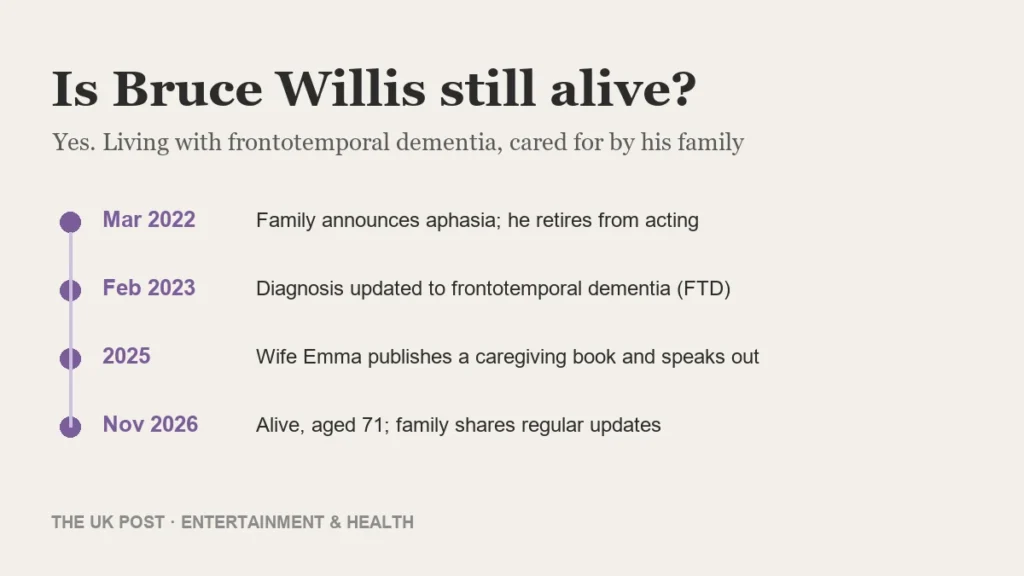
Short answer: yes, Bruce Willis is alive. As of November 2026 he is 71 and living with frontotemporal dementia (FTD), cared for by his wife Emma Heming Willis and his wider family. He retired from acting in March 2022, when his family said he had aphasia, a condition affecting language. In February 2023 they shared that doctors had diagnosed FTD. His family still posts regular updates and photos. Any story claiming he has died should be checked against his family’s own accounts and reputable news outlets: rumours and fake “tribute” videos circulate regularly online.
Bruce Willis at a Glance
| Full name | Walter Bruce Willis |
|---|---|
| Born | 19 March 1955, Idar-Oberstein, West Germany (his father was a US soldier); grew up in New Jersey |
| Age | 71 (November 2026) |
| Status | Alive; retired from acting in 2022 |
| Health | Frontotemporal dementia, diagnosed in early 2023 |
| Wife | Emma Heming Willis (married 2009) |
| Former wife | Demi Moore (married 1987–2000) |
| Children | Five daughters: Rumer, Scout and Tallulah with Demi Moore, and two younger daughters with Emma |
| Best known for | Die Hard, Moonlighting, Pulp Fiction, The Sixth Sense, Armageddon |
Why People Ask If Bruce Willis Is Still Alive
The question comes up for three reasons. He disappeared from the screen suddenly in 2022, after years of making several films a year. He is rarely photographed in public now. And fake news spreads fast: AI-generated videos and “RIP” posts about famous people with serious illnesses are common on social media and YouTube.
The best way to check is to look at the accounts of his wife Emma Heming Willis and his daughters, who post regularly, and at established news outlets. If a death were announced, it would come from the family and be reported everywhere within minutes, not first appear on an anonymous page.
Bruce Willis’s Health: A Timeline
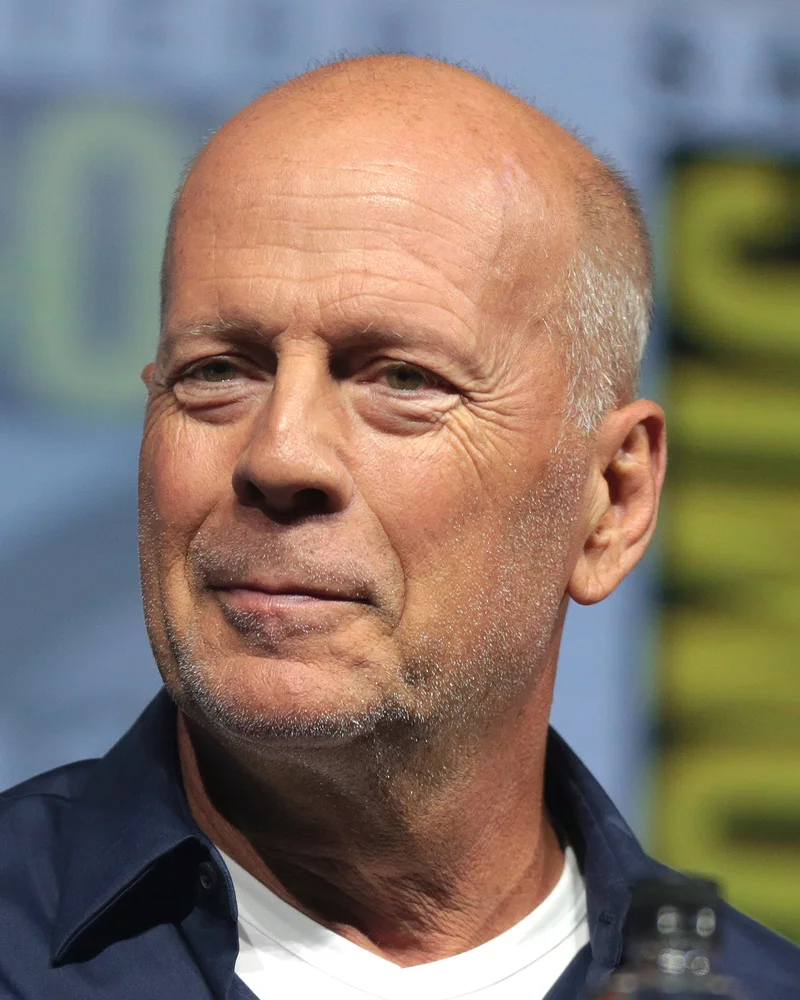
- 19 Mar 1955Born in Idar-Oberstein, West Germany.
- 1985Moonlighting makes him a TV star.
- 1988Die Hard makes him a film star.
- 2009Marries Emma Heming.
- 30 Mar 2022Family announces aphasia; he steps away from acting.
- 16 Feb 2023Family confirms frontotemporal dementia.
- 2025Emma publishes a caregiving book and speaks to ABC.
- 19 Mar 2026Turns 71; family marks his birthday.
- Nov 2026Alive; daughter Tallulah shares a new photo.
March 2022: aphasia. His family announced he was “stepping away” from acting because he had been diagnosed with aphasia, which was affecting his cognitive abilities. The statement was signed by Emma Heming Willis, Demi Moore and his five daughters.
February 2023: frontotemporal dementia. In a statement on the website of the Association for Frontotemporal Degeneration, the family said his condition had progressed and that doctors now had a “clear diagnosis” of FTD, which they called “a cruel disease”. They said communication problems were “just one symptom”.
2025: speaking out about caregiving. Emma Heming Willis published a book about caring for someone with dementia and appeared in an ABC special with Diane Sawyer. She explained that the family had set up a separate, single-storey home near the family house where Bruce lives with round-the-clock care, so that the household could meet his needs and their daughters’ at the same time. She has said he is still “very present” in his own way.
2026: regular updates. Through 2026 Emma has spoken about the family being in “a constant state of grief” while learning to adapt, launched a fund for dementia research, and continued sharing photos for birthdays and family occasions. In late November 2026 his daughter Tallulah shared a new photo of the two of them. None of these updates suggested any change beyond the slow progression of his illness.
Some tabloid stories have claimed, citing anonymous “insiders”, that he has moved into a care home or no longer recognises family members. The family has not confirmed these claims, and we have not repeated details we cannot verify.
What Is Frontotemporal Dementia?
Frontotemporal dementia is caused by damage to the frontal and temporal lobes of the brain, which control behaviour, personality and language. According to the UK Dementia Research Institute, it is more likely than other forms of dementia to start at a younger age: most cases are diagnosed in people in their 40s, 50s and 60s. Unlike Alzheimer’s disease, memory is often unaffected at first.
Common early signs of frontotemporal dementia
FTD is rare. A UK study in two English counties estimated that about 11 in every 100,000 people were living with FTD or a closely related condition, a lifetime risk of roughly 1 in 742. There is currently no cure and no treatment that slows it, although medicines and therapies can help with some symptoms, and research is under way.
If you are worried about yourself or someone close to you in the UK, start with your GP, who can refer you to a memory clinic or neurologist. Support is available from:
- Dementia UK Admiral Nurse Helpline: 0800 888 6678 (free), for families and carers.
- Alzheimer’s Society Dementia Support Line: 0333 150 3456, which covers all types of dementia, not just Alzheimer’s.
- Rare Dementia Support: a UK charity service with specialist groups for people affected by FTD.
His Family Today
Willis’s family has become known for how closely it pulls together (not every famous family manages it so smoothly; see Miley and Billy Ray Cyrus’s relationship). His ex-wife Demi Moore, whom he divorced in 2000, often spends time with Bruce, Emma and the children, and the blended family regularly shares holiday and birthday photos. His eldest daughter, Rumer, is an actor; Tallulah has written about her father’s illness and her own mental health; and Scout is a singer-songwriter. His two younger daughters with Emma are not named here.
Emma Heming Willis, a former model who was born in Malta and grew up in London, has become one of the best-known advocates for dementia carers, focusing on the toll caregiving takes on the people doing it.
A Career Built on Die Hard
Willis became famous in the 1980s TV comedy-drama Moonlighting opposite Cybill Shepherd, then became a film star as New York cop John McClane in Die Hard (1988). In Britain, Die Hard has become a fixture of Christmas TV schedules and of the annual argument about whether it counts as a Christmas film. His other hits include Pulp Fiction (1994), 12 Monkeys (1995) with Brad Pitt (see our look at a young Brad Pitt), The Fifth Element (1997), Armageddon (1998) and The Sixth Sense (1999).
Later in his career he worked with a new generation of action stars in The Expendables films alongside Jason Statham, whose own unusual route to stardom we cover in our Jason Statham Stole My Bike article. He also made an uncredited cameo in Charlie’s Angels: Full Throttle (2003) with Cameron Diaz.
In his final working years he made a large number of low-budget films, often shooting his scenes in a day or two. After the 2022 announcement, some of those involved said they had noticed he was struggling, which has led to a wider conversation about how the industry handled his decline.

Frequently Asked Questions
Is Bruce Willis still alive?
Yes. As of November 2026, Bruce Willis is alive and living with frontotemporal dementia, cared for by his family.
How old is Bruce Willis?
He is 71. He was born on 19 March 1955.
What illness does Bruce Willis have?
Frontotemporal dementia (FTD). His family first announced aphasia, a language disorder, in March 2022, and confirmed the FTD diagnosis in February 2023.
Is Bruce Willis in a care home?
His wife has said he lives in a separate single-storey home near the family house with full-time care. Tabloid claims beyond that are unconfirmed.
Does Bruce Willis still recognise his family?
His family has not given details. Emma Heming Willis has said he is still “very present” in his own way, while describing how the illness has changed him.
Did Bruce Willis retire?
Yes. He stepped away from acting in March 2022 because of his health.
Who is Bruce Willis married to?
Emma Heming Willis, a model and author, since 2009. He was previously married to Demi Moore.
How many children does Bruce Willis have?
Five daughters: three with Demi Moore and two with Emma Heming Willis.
Can frontotemporal dementia be cured?
Not at present. There is no treatment that stops or slows it, but support and some medicines can help with symptoms.
Where can I get help with dementia in the UK?
See your GP first. Dementia UK’s helpline (0800 888 6678), the Alzheimer’s Society (0333 150 3456) and Rare Dementia Support all offer advice.
Final Thoughts
Bruce Willis is alive, and his family has been unusually open about life with frontotemporal dementia. Their candour has helped thousands of families recognise the illness and look for support. If you see a post claiming otherwise, check it before you share it. And if any of the symptoms here sound familiar in someone you love, please do not wait: talk to a GP, and lean on the UK charities that exist to help.
Sources: Family statements via the Association for Frontotemporal Degeneration (March 2022 and February 2023), reported by PBS, NPR and CBS News; ABC News and Good Morning America (2025); Heart, Hello! and Hola (2026) on Emma Heming Willis’s updates; UK Dementia Research Institute; Coyle-Gilchrist et al., Neurology (2016), on FTD prevalence in the UK; Dementia UK; Alzheimer’s Society; Rare Dementia Support.