
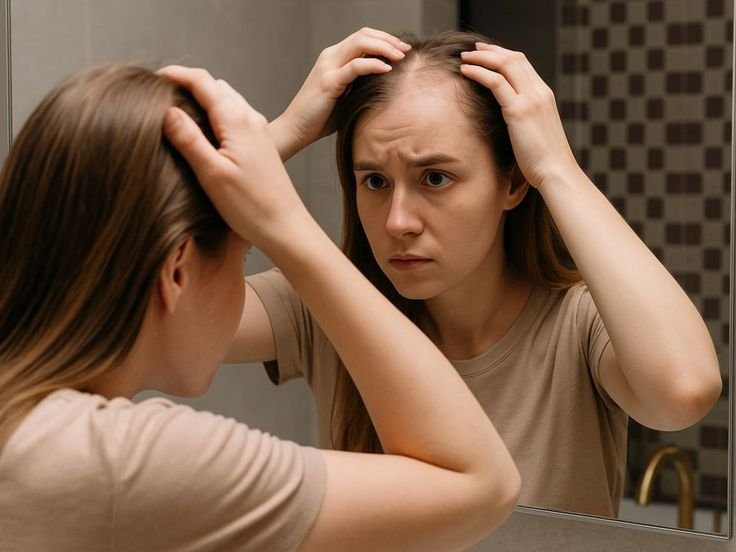
Hormonal hair loss in women is primarily caused by an excess of DHT (dihydrotestosterone), while declining estrogen, thyroid imbalances, and high cortisol levels also play key roles. By age 50, about 40% of women experience noticeable thinning. Fortunately, early diagnosis and modern treatments — from Minoxidil to Dutasteride — make recovery highly achievable.
Hair is more than just a cosmetic feature — it’s an indicator of internal health and hormonal balance. When hormones fluctuate, hair follicles can weaken, slow down their growth cycle, and eventually stop producing new strands. For millions of women, this leads to gradual thinning or shedding that cannot be explained by aging alone.
Recent studies suggest that hormonal imbalances are the leading cause of female hair loss worldwide, affecting more than 30 million women in the U.S. alone. According to Harvard Health (2025), nearly one in three women will face hair thinning during their lifetime, and this rate doubles after menopause.
Understanding which hormone causes hair loss allows women to address the true source rather than simply masking the symptoms.
Last reviewed: 16 August 2026. This guide has been updated with the latest prevalence figures, the 2025 European and UK regulatory decisions on 5-alpha-reductase inhibitors, and the current evidence on low-dose oral minoxidil.
The Science of Hair Growth and Hormones

Image source: pinterest .com
Each hair follicle goes through three phases — anagen (growth), catagen (transition), and telogen (resting/shedding). Hormones determine how long a follicle stays in its growth phase and how quickly it regenerates after shedding.
When hormone levels become imbalanced — for instance, when androgens like DHT rise or estrogen falls — the hair growth phase shortens, and follicles shrink in size. This process, known as miniaturization, causes hair to grow thinner and weaker until bald patches or diffuse thinning develop.
DHT: The Key Hormone Responsible for Female Hair Loss

Image source: pinterest .com
Dihydrotestosterone (DHT) is a byproduct of testosterone that binds to hair follicles and disrupts their normal cycle. It’s considered the most common hormonal trigger behind female pattern hair loss (FPHL).
Although women produce much less testosterone than men, their follicles are still sensitive to DHT. A 2024 meta-analysis revealed that over 80% of women diagnosed with FPHL had increased scalp DHT activity, even when their testosterone levels were within normal range. This explains why women with no visible hormonal imbalance can still develop pattern thinning.
Over time, DHT shortens the hair’s growth cycle and causes follicles to shrink, producing finer strands. The typical pattern seen in women is gradual thinning along the crown or part line rather than total baldness.
Estrogen and Progesterone: The Hair Protectors

Image source: pinterest .com
While DHT is often the villain, estrogen and progesterone are the protectors. These hormones lengthen the growth phase, promote thicker strands, and counteract the effects of androgens. When estrogen and progesterone levels drop — such as during menopause, postpartum recovery, or after stopping birth control — the protective balance is lost.
A 2024 study in the Journal of the American Academy of Dermatology found that women who reached menopause before the age of 50 were more than twice as likely to experience moderate or severe hair thinning. The decline in estrogen doesn’t just affect follicles — it also makes the scalp drier, more sensitive, and less capable of supporting new growth.
The Thyroid’s Role in Hair Health

Image source: pinterest .com
Thyroid hormones regulate the body’s overall metabolism, and hair follicles are among the most metabolically active cells in the body. When the thyroid is underactive (hypothyroidism) or overactive (hyperthyroidism), the hair cycle is disrupted.
An underactive thyroid slows down follicle activity, causing brittle, thinning hair, while an overactive thyroid accelerates shedding. According to Cleveland Clinic (2025), about one in ten women with persistent hair loss are eventually found to have thyroid-related hormonal disturbances. Once the thyroid is treated and hormone levels stabilize, hair regrowth usually resumes within several months.
Cortisol and Stress-Related Hair Loss

Image source: pinterest .com
Prolonged stress raises levels of cortisol, commonly known as the stress hormone. Excess cortisol can push a large percentage of hair follicles into the shedding (telogen) phase prematurely — a condition called telogen effluvium.
This kind of hair loss typically appears a few months after a stressful event such as surgery, illness, or emotional trauma. Unlike androgen-driven hair loss, telogen effluvium is usually temporary. Once stress levels and cortisol production normalize, the growth cycle restarts naturally, and regrowth follows within three to six months.
Other Hormonal Triggers

Image source: pinterest .com
Beyond DHT, estrogen, and cortisol, other hormonal imbalances can contribute to hair loss. Women with polycystic ovary syndrome (PCOS), which the World Health Organization estimates affects 10–13% of women of reproductive age — and which goes undiagnosed in as many as 70% of cases worldwide — often experience elevated androgens that lead to thinning hair on the scalp but increased growth on the face and body.
Insulin resistance can worsen androgen sensitivity, while prolactin imbalance may indirectly reduce estrogen’s protective influence. Because these conditions overlap, accurate testing and medical assessment are crucial for proper treatment.
How Common Is Hormonal Hair Loss?

Image source: pinterest .com
Hormonal hair loss is far more prevalent than most women realize. A 2023 Brazilian dermatology study found that about one-third of women between 35 and 60 years old show clinical signs of FPHL. Research from UCLA Health places the figure even higher, with 40% of women by age 50 experiencing visible thinning.
In postmenopausal women, the rate exceeds 50%, as shown in a 2024 study conducted in Thailand. Globally, this equates to more than 30 million affected women, making hormonal hair loss one of the most widespread — yet treatable — conditions in female health.
Diagnosing Hormonal Hair Loss

Image source: pinterest .com
Diagnosis involves more than simply looking at the scalp. Dermatologists and endocrinologists review a patient’s medical history, menstrual patterns, stress levels, and family history. Blood tests are often ordered to check thyroid function, estrogen, progesterone, testosterone, DHEA-S, and ferritin levels.
Sometimes, a scalp biopsy or dermatoscopy is performed to confirm the pattern and exclude scarring forms of alopecia. This detailed evaluation allows doctors to identify whether the loss is driven by hormones, stress, or nutritional deficiency, ensuring treatment targets the real cause.
Modern Treatments for Hormonal Hair Loss

Image source: pinterest .com
Today’s medical options for hormonal hair loss are highly advanced, combining topical, oral, and supportive therapies.
Minoxidil, available in 2% and 5% solutions, remains the only FDA-approved topical treatment for women. It stimulates follicles and extends the growth phase, leading to visible improvement in thickness and volume. A 2024 clinical review reported that nearly 74% of women using 5% Minoxidil for six months saw measurable regrowth.
The bigger shift in recent years has been the move to low-dose oral minoxidil (LDOM). Taken as a small daily tablet rather than a solution applied to the scalp, it avoids the greasy residue and twice-daily routine that cause so many women to give up on the topical version. An international expert consensus involving dermatologists from a dozen countries settled on a range of roughly 0.625 mg to 5 mg a day, with 1.25 mg daily the usual starting dose for women. A 2025 systematic review pooling around 2,900 patients across 27 studies concluded it is both effective and well tolerated, and a 2024 randomised trial found no meaningful difference in results between 1 mg taken orally and the 5% topical solution.
It is important to be clear about status: oral minoxidil is licensed as a blood-pressure medicine, so its use for hair loss is off-label and prescription-only. Reported side effects are usually mild — unwanted facial hair, fluid retention, occasional light-headedness — but it requires a prescriber who will check blood pressure and review other medication first.
When hormones are the main cause, medical therapy can make a big difference. Spironolactone helps block androgen activity at the follicle, while Finasteride and Dutasteride inhibit the enzyme that converts testosterone into DHT. A 2025 study published in Dermatologic Therapy found that women treated with Dutasteride 0.5 mg daily experienced a 15.9 hairs/cm² increase in density after one year.
Among the most effective female hair loss treatments available today, Dutasteride stands out for its ability to reduce DHT at the follicular level.
Topical versions of finasteride and spironolactone are also being compounded by specialist pharmacies, on the logic that acting at the scalp keeps the drug out of the bloodstream. Comparative studies published to date suggest topical finasteride performs roughly on a par with topical minoxidil, and both outperform topical spironolactone. These formulations remain unlicensed in the UK, however, and large randomised trials in women are still missing, so they should be treated as promising rather than proven.
One point of frequent confusion: the newer JAK-inhibitor tablets licensed in recent years are for alopecia areata, an autoimmune condition that causes patchy loss. They are not a treatment for hormonal or pattern hair loss, and a clinic offering them for FPHL is not following the evidence.
For women with advanced thinning or minimal response to medical options, hair restoration procedures may also be considered. You can learn more about modern transplant techniques and updated pricing in this detailed guide on hair transplant cost, which explains the factors influencing treatment expenses and success rates.
If estrogen or thyroid levels are off balance, hormone replacement or thyroid therapy can restore stability and trigger natural regrowth. Complementary options such as platelet-rich plasma (PRP) and low-level laser therapy (LLLT) also show promising results when combined with medical care.
Lifestyle and Nutritional Support

Image source: pinterest .com
A medical plan works best when supported by healthy habits. A balanced diet rich in protein, iron, zinc, and vitamin D provides the nutrients needed for healthy follicles. Regular exercise improves blood circulation to the scalp and helps regulate hormones naturally.
Managing stress is equally important — mindfulness, yoga, and adequate rest all help reduce cortisol levels, preventing further shedding. Women who follow these holistic measures alongside medical treatments generally experience faster, longer-lasting results.
Safety and Medical Guidance
While treatments like Minoxidil are available over the counter, medications such as Spironolactone, Finasteride, and Dutasteride require prescription and supervision. These drugs are not suitable during pregnancy and may cause mild side effects if misused.
The European Medicines Agency completed its Europe-wide safety review of 5-alpha-reductase inhibitors in 2025. Its safety committee concluded that the benefits of finasteride and dutasteride continue to outweigh the risks for their licensed uses, but confirmed suicidal thoughts as a recognised side effect of finasteride tablets and required product information to be updated. Dutasteride works through the same mechanism, so equivalent wording on mood changes was added to its labelling as a precaution, even though the review found no direct link.
In the UK, the MHRA issued a Drug Safety Update in 2025 strengthening the warnings on both drugs for psychiatric effects and sexual dysfunction, and asked prescribers to counsel patients to stop treatment and seek advice if mood changes develop. None of this means the medicines should be avoided — it means they should be taken with a prescriber who has explained what to watch for. Consulting a dermatologist or endocrinologist before starting therapy ensures safety and effectiveness.
What Is Actually Available in the UK
Access differs from what women read on American websites, so it is worth setting out plainly.
Over the counter: topical minoxidil 2% and 5% (sold as Regaine for Women) can be bought from any pharmacy without a prescription. It remains the recommended first-line option and the only topical treatment formally licensed for female pattern hair loss.
On the NHS: pattern hair loss is generally treated as a cosmetic condition, so routine prescribing is limited. The NHS will investigate and treat an underlying cause — thyroid disease, iron deficiency, PCOS — and that is the route worth pursuing first, because correcting it often improves the hair without any hair-specific drug at all. Referral to a dermatologist is possible where loss is severe, scarring or unexplained, though waiting times vary widely by area.
Off-label and specialist-led: spironolactone, low-dose oral minoxidil, co-cyprindiol and — in postmenopausal women — finasteride or dutasteride are all used for FPHL in the UK, but off-label and usually under dermatology or endocrinology supervision. Spironolactone in particular requires reliable contraception and periodic blood tests for kidney function and potassium.
A word on online clinics: regulated UK online prescribers can legitimately supply these medicines after a consultation. Anything sold without a prescription, shipped from overseas, or marketed as a “hormone-balancing” supplement that promises regrowth is worth avoiding — check that the pharmacy is registered with the General Pharmaceutical Council before ordering.
When to See a Specialist
If hair thinning continues for more than six months, or if it’s accompanied by irregular periods, acne, or excessive body hair, it’s time to see a specialist. Early evaluation increases the chance of reversing hair loss completely and prevents further follicle damage.
The Outlook: Restoring Confidence Through Hormone Balance
The encouraging truth is that most cases of hormonal hair loss are treatable. Studies show that with consistent therapy, 65–75% of women regain visible density within a year. Treatments that regulate hormones — combined with stress management and nutrition — deliver sustainable, long-term results.
Hormonal hair loss isn’t just about vanity; it’s a health indicator. By restoring hormonal balance, women can not only regrow their hair but also improve their overall well-being, confidence, and quality of life.
Hair Loss After Pregnancy And Around Menopause
Many women notice heavy shedding two to four months after giving birth, as hair that stayed in the growth phase during pregnancy falls out together. This postpartum shedding usually settles within a year. Around menopause, falling oestrogen can make hair thinner, and a GP can discuss whether treatment such as HRT or topical minoxidil is suitable.
Emotional Support
Hair loss can affect confidence and mental health. The charity Alopecia UK offers information, support groups and a community for people with hair loss. If you feel low or anxious for more than a couple of weeks, speak to your GP, or contact Samaritans free on 116 123.
Be Wary Of Miracle Cures
Be cautious about supplements, oils and devices that promise to regrow hair quickly. Medicines sold in the UK must be licensed by the MHRA, and adverts making misleading health claims can be reported to the Advertising Standards Authority. Only buy prescription treatments through a registered pharmacy after a proper consultation. For more on safe online health purchases, see our guide to checking online weight-loss services.
Conclusion
Hormonal hair loss in women often stems from imbalances in DHT, estrogen, thyroid, or stress hormones — but it’s rarely permanent. With early diagnosis, proper treatment, and consistent care, hair growth can be restored naturally. Maintaining hormonal balance, managing stress, and seeking medical guidance remain the most effective ways to keep your hair — and confidence — healthy for years to come.
Frequently Asked Questions
Q1. Which hormone is most commonly linked to female hair loss?
A: The hormone most often implicated is dihydrotestosterone (DHT), a potent androgen that shrinks hair follicles. Many women with female pattern hair loss have increased follicular sensitivity to DHT, even with normal testosterone levels.
Q2. Can estrogen deficiency cause hair loss in women?
A: Yes. Estrogen and progesterone help prolong the hair’s growth phase and counteract DHT’s effects. When estrogen levels drop — such as during menopause or after childbirth — the protective effect diminishes and hair thinning may worsen.
Q3. Do thyroid problems cause hair loss in women?
A: Absolutely. Both hypothyroidism (low thyroid) and hyperthyroidism (overactive thyroid) can disrupt the hair growth cycle, leading to diffuse hair thinning and increased shedding. Once thyroid levels are normalized, hair regrowth is often possible.
Q4. How does stress hormone (cortisol) affect hair loss?
A: Elevated cortisol from chronic stress can push hair follicles into the resting (telogen) phase prematurely, causing telogen effluvium — noticeable hair shedding after a few months. This form of hair loss is often temporary if the underlying stress is addressed.
Q5. At what age does hormonal hair loss begin in women?
A: Hormonal hair loss can begin as early as in a woman’s 20s or 30s, but becomes more common after menopause. Around one-third of women will experience female pattern hair loss in their lifetime, and after menopause, two-thirds may show thinning.
Q6. Is hormonal hair loss reversible?
A: In many cases, yes. When the cause is identified and treated early (hormonal therapy, DHT inhibitors, thyroid correction, etc.), regrowth and improved density are possible — though results vary by individual.
Q7. How soon can one see results from hormone-based hair loss treatments?
A: Generally, visible changes take 3–6 months of consistent treatment. Full effects may continue to develop over 12 months or more, and continued use is often required to maintain results.
Q8. Do all women with PCOS suffer from hair loss?
A: Not always, but many do. Polycystic Ovary Syndrome (PCOS) causes increased androgen levels (including DHT), which can lead to hair thinning on the scalp. The extent depends on individual sensitivity and hormonal imbalance.
Q9. Is oral minoxidil better than the topical solution for women?
A: Not necessarily better, but often easier to stick with. A 2024 randomised trial found 1 mg of oral minoxidil performed about as well as the 5% topical solution, and adherence tends to be higher with a daily tablet. Oral minoxidil is prescription-only and off-label for hair loss, so it requires a prescriber who will check your blood pressure and current medicines.
Q10. Are DHT-blocking shampoos and supplements worth buying?
A: Shampoos containing ketoconazole may give a modest anti-inflammatory benefit, but no shampoo meaningfully lowers scalp DHT in the way a prescription 5-alpha-reductase inhibitor does — contact time in the shower is simply too short. Supplements are only useful where a genuine deficiency exists, which is why testing ferritin, vitamin D and thyroid function first is more productive than buying a biotin product on spec.
This article is for general information and is not medical advice. Hormonal hair loss has several possible causes that look similar from the outside, and the medicines described here carry real contraindications — several are unsafe in pregnancy. Please speak to your GP, a dermatologist or an endocrinologist before starting or stopping any treatment.