
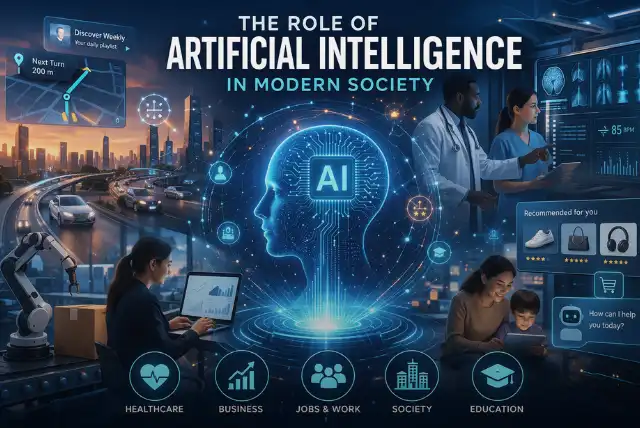
Last week, I watched a small shop owner in London use a simple app to predict what his customers would buy next. He smiled and said, “It feels like the system knows my customers better than I do.” That moment stayed with me. We often hear about machines taking over, but what we’re really seeing is something more human—technology helping people make better choices. This is where the role of artificial intelligence quietly steps in. It’s not just about robots or complex code. It’s about everyday life becoming easier, smarter, and sometimes even more personal. From healthcare to business, AI is slowly becoming part of our story, shaping how we live, work, and dream about the future.
How AI Quietly Entered Our Daily Lives
Think about the last time your phone suggested a song you loved or corrected your typing before you even noticed the mistake. These small moments are not accidents. They are the result of artificial intelligence working behind the scenes. Many people don’t even realise how deeply AI has entered their lives. It’s in navigation apps, online shopping, and even customer service chats.
What makes this fascinating is how natural it feels. You don’t need to understand coding or algorithms. You just use it. According to Google Cloud, AI includes systems that learn from data and improve over time. This means the more we use technology, the smarter it becomes.
It’s almost like having an invisible assistant that learns your habits. Over time, it starts predicting your needs. And while this sounds futuristic, it’s already happening every single day.
Why Businesses Are Falling in Love with AI
Imagine running a business where you don’t have to guess what your customers want. A small café owner once shared how AI helped him track which pastries sold best on rainy days. It wasn’t magic—it was data, analysed smartly.
Businesses today are using AI to save time, reduce mistakes, and make better decisions. It helps them understand customers, improve services, and increase profits. According to CSU Global, AI improves efficiency and supports smarter decision-making across industries.
If you want to explore this deeper, you can read more about how AI is transforming modern business strategies.
From small startups to large companies, everyone is turning to AI. Not because it’s trendy, but because it works.
The Human Side of AI in Healthcare
A doctor once said that AI didn’t replace his job—it gave him more time to care. That simple statement explains a lot. In hospitals, AI is helping doctors detect diseases earlier and more accurately.
Imagine a system that can scan thousands of medical images in seconds and highlight possible issues. This is already happening. According to NIH research, AI supports early diagnosis, personalised treatments, and even drug discovery.
For patients, this means faster answers and better care. For doctors, it means less stress and more confidence in their decisions. It’s not about machines replacing humans—it’s about helping humans do their jobs better.
The Changing Nature of Jobs and Work
There’s always a bit of fear when people talk about AI and jobs. Will machines take over? It’s a fair question. But the reality is more balanced. Yes, some repetitive jobs are being automated. But at the same time, new roles are being created.
Think about roles like AI specialists, data analysts, and digital marketers. These didn’t exist a few decades ago. According to Bernard Marr, AI is reshaping the workplace by improving productivity while also changing job structures.
The key is adaptation. People who learn new skills can benefit from this shift. AI is not the end of work—it’s the beginning of a new kind of work.
How AI Is Shaping Society Around Us
Walk through any modern city, and you’ll see the influence of AI everywhere—traffic systems, security cameras, and even energy management. These systems are designed to make life smoother and safer.
But there’s also a deeper impact. AI is changing how we interact, learn, and even think. According to the United Nations, AI can support global goals like education, climate action, and disaster response.
At the same time, it raises important questions about privacy and fairness. Society is evolving, and AI is one of the main forces behind that change.
The Everyday Benefits We Often Overlook
Sometimes, the biggest changes are the ones we don’t notice. A faster customer service reply, a better product recommendation, or a safer online transaction—these are all powered by AI.
Businesses use AI to improve customer experiences and reduce costs. According to the University of Cincinnati, AI helps organisations scale operations and manage resources more effectively.
Even social media strategies are now influenced by smart data. If you’re curious, check out these effective social media management techniques that align closely with AI-driven insights.
These benefits may seem small individually, but together, they create a powerful impact.
The Role of AI in Innovation and Future Growth
Every big innovation starts with a simple idea. Today, AI is turning those ideas into reality faster than ever. From smart cities to advanced supply chains, AI is driving progress in ways we couldn’t imagine before.
According to Lumenalta, AI is shaping industries by improving automation and enabling smarter systems.
Technologies like blockchain in supply chains are also working alongside AI to create more transparent and efficient systems.
This combination of technologies is building the future, one innovation at a time.
The Ethical Questions We Cannot Ignore
With great power comes great responsibility. AI is powerful, but it also raises serious questions. Who controls the data? How do we ensure fairness? What happens if systems make biased decisions?
These are not just technical issues—they are human concerns. According to the American Academy of Arts & Sciences, transparency and ethical responsibility are essential when developing AI systems.
It’s important to remember that AI reflects the data it learns from. If that data is flawed, the results can be too. That’s why human oversight is still very important.
AI as a Partner, Not a Replacement
At the heart of it all, AI is not here to replace humans. It’s here to support them. Think of it as a tool—like a calculator or a computer. It helps you do things faster and better, but it still needs you.
According to IABAC, AI is becoming a core part of everyday systems, helping people make smarter decisions and improve efficiency.
The future is not about humans versus machines. It’s about humans working with machines to create something better.
Where the Journey Is Taking Us
If you look closely, the role of artificial intelligence is not just about technology—it’s about transformation. It’s changing industries, improving lives, and opening new possibilities.
We are still at the beginning of this journey. The choices we make today will shape how AI develops in the future. And if used wisely, it can become one of the most powerful tools for progress.
The story of AI is still being written—and we are all part of it.
How The UK Approaches AI
Rather than a single AI law, the UK asks existing regulators, such as the Information Commissioner’s Office for data protection and the Competition and Markets Authority for competition, to apply principles such as safety, transparency and fairness in their own sectors. The AI Security Institute tests advanced models for risks.
AI And Jobs
AI is changing many jobs by automating routine tasks, from drafting documents to analysing data. Workers who learn to use AI tools alongside their own expertise are likely to benefit most, and many free courses are available through colleges and online learning platforms.
Using AI Tools Safely
Check AI answers against reliable sources, as tools can produce confident but wrong information. Do not enter personal, financial or confidential work data into public chatbots, and be alert to AI-powered scams such as cloned voices and fake videos. For more, see our guide to AI in business.
Conclusion
Not long ago, AI felt like something distant, almost unreal. But today, it’s part of our everyday lives, quietly helping us make better choices and solve problems faster. The role of artificial intelligence is no longer limited to big tech companies—it’s now in homes, hospitals, and businesses across the UK. As we move forward, the real challenge is not just using AI, but using it wisely. If we embrace it with care and understanding, AI can help us build a smarter and more balanced future. So the next time technology surprises you, take a moment to notice—it might just be AI working behind the scenes.
FAQs
What is the role of artificial intelligence in modern society?
The role of artificial intelligence is to help machines perform tasks that normally require human thinking. It improves efficiency, supports decision-making, and enhances everyday experiences in areas like healthcare, business, and education.
How does AI impact society?
AI impacts society by improving services, creating smarter systems, and changing how people work. It also raises concerns about privacy, ethics, and job changes, making it important to use AI responsibly.
Why is artificial intelligence important today?
Artificial intelligence is important because it helps solve complex problems, reduces human effort, and improves accuracy. It plays a key role in innovation and supports growth in many industries.
What are the main applications of artificial intelligence?
AI is used in healthcare, business, education, finance, and transportation. Common applications include chatbots, recommendation systems, fraud detection, and medical diagnosis.
Is AI replacing human jobs?
AI is changing jobs rather than completely replacing them. While some tasks are automated, new roles are also being created. Learning new skills helps people adapt to these changes.
How is AI used in healthcare and business?
In healthcare, AI helps with diagnosis, treatment planning, and research. In business, it improves customer service, data analysis, and decision-making, making operations more efficient.