
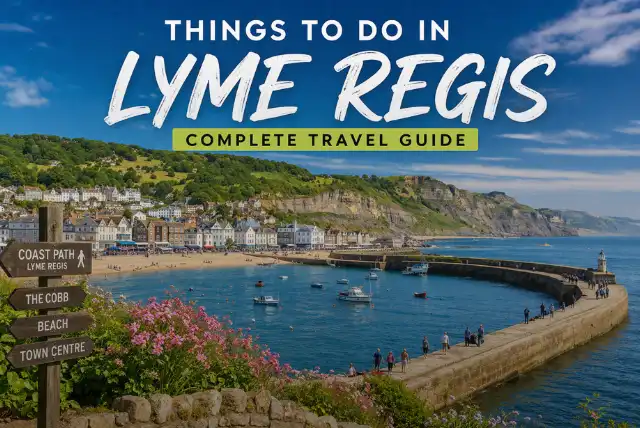
Lyme Regis is a small Dorset town that changed science. Mary Anning dug ichthyosaurs and plesiosaurs out of these cliffs two hundred years ago, and people still walk the same beaches hoping for a fraction of her luck.
This guide covers what to do, what it costs you in planning, and the two things most visitor guides skip entirely: the rules on what you may actually keep when you find a fossil, and the exact dates dogs are banned from the beach.
Last updated: 20 October 2026. Venues, dates and rules checked on this date — including one restaurant this guide previously recommended that has since closed.
Plan it in thirty seconds
- Nearest station: Axminster, then the X51/X53 bus
- Fossil beaches: Monmouth and Charmouth
- Fossil rule: beach only — never dig the cliffs
- Important finds: must be recorded at Charmouth Heritage Coast Centre
- Dogs, Front Beach: banned 1 May – 30 September
- Fossil Festival: 13–14 June 2026, free
- Best fossil weather: right after a storm
- Closed: The Oyster & Fish House — Rockfish is there now
What this article covers
- Mary Anning, and why this town matters
- Fossil hunting: the rules nobody tells you
- The Cobb
- The four beaches, and the dog rules
- Museums, the Town Mill and galleries
- Walks, watersports and boat trips
- Where to eat — including one correction
- Events in 2026
- Getting there, parking and staying
- Frequently asked questions
Mary Anning, and Why This Town Matters

Lyme Regis sits on the Jurassic Coast, England’s only natural UNESCO World Heritage Site, inscribed in 2001. The cliffs here are Lower Jurassic mudstone and limestone, and they erode constantly, which is exactly why they give up fossils.
Mary Anning was born here in 1799 and worked these beaches as a professional fossil collector. Her finds — ichthyosaurs, the first complete plesiosaur, a pterosaur — helped build the science of palaeontology at a time when she could not join the Geological Society because she was a woman.
- Lyme Regis Museum stands on the site of her family home, on Bridge Street.
- A statue of her was unveiled in the town in 2022, after a campaign started by a local schoolgirl.
- Her name is on the street signs too — Anning Road runs up behind the town.
- She sold fossils to support her family. The tongue-twister about selling seashells by the seashore is widely said to be about her.
Fossil Hunting: The Rules Nobody Tells You

Most guides tell you to go fossil hunting. Very few tell you what you are allowed to pick up, or what you must report. This is the genuinely useful part.
Legally, fossils belong to the landowner. Not to whoever picks them up. The West Dorset Fossil Collecting Code of Conduct is a voluntary scheme covering National Trust and Charmouth Parish Council land between Lyme Regis and Hive Beach at Burton Bradstock. Follow it and ownership of what you find passes to you, in recognition of the effort of recovery and preparation.
| The rule | What it means in practice |
|---|---|
| Collect from the beach, not the cliff | Fossils are not to be collected from the cliffs without the landowner’s permission. Work the loose material on the foreshore |
| Record Category 1 finds | Scientifically important fossils must be recorded in the Register of Important Fossils at the Charmouth Heritage Coast Centre |
| Ignoring it has a name | The code warns that collectors who do not follow it — particularly by digging or prospecting in situ in the cliffs, or failing to record Category 1 fossils — “may be regarded as stealing the fossils” |
| The Undercliffs are different | The Lyme Regis to Axmouth Undercliffs National Nature Reserve has its own separate Natural England code |
| If you are not sure whose land you are on | The Charmouth Heritage Coast Centre holds land-ownership maps and landowners’ contact details |
West Dorset Fossil Collecting Code of Conduct — full text. It is a voluntary code, which is precisely why so few visitors have heard of it.
And the safety side, which is not optional. These cliffs are actively eroding — that is the whole reason the fossils keep appearing:
- Stay away from the cliff base and from mudflows. Landslides and rockfalls are routine here, not rare.
- Check the tide before you set out. Sections of beach cut off on a rising tide, and the way back is the cliff you were told to avoid.
- Go just after a storm — that is when fresh material comes down and the sea sorts it onto the beach.
- Wear boots with grip. Wet blue lias is genuinely slippery.
- A guided fossil walk is the honest shortcut. Lyme Regis Museum and the Charmouth Heritage Coast Centre both run them, and you will find more in two hours with a guide than a day on your own.
The Cobb

The curving harbour wall is the image everyone has of Lyme Regis — from The French Lieutenant’s Woman, and from Persuasion before that.
It is older than it looks and newer than you think. Documentary references cited for The Cobb range from 1294 to 1328 depending on the source, and the original structure was oak piles driven into the seabed and packed with boulders, repeatedly wrecked by storms. Dorset Council’s heritage record dates the rebuilding to between 1783 and 1829, largely after the 1824 gales, with the ashlar work done in 1825–29.
So the Portland stone you walk on is Georgian and Victorian, not medieval. The Cobb is ancient as an idea and fairly modern as a structure — which is a better story than “it dates from the 13th century”, and it is the one the records support.
- The upper wall has no railing. It is slippery when wet and genuinely exposed in wind — the lower walkway is there for a reason.
- Best light is early morning or sunset, looking back at the town.
- Address: The Cobb, Lyme Regis, Dorset, DT7 3JJ.
The Four Beaches, and the Dog Rules

Lyme Regis has four beaches and they are genuinely different from each other.
| Beach | Best for |
|---|---|
| Town Beach (Front Beach) | Swimming and the main seafront. Sandy, central, busiest — and the one with the summer dog ban |
| Monmouth Beach | Fossil hunting. Also the Ammonite Pavement, a rock ledge covered in large ammonites — look, photograph, leave |
| Church Cliff Beach | Families with small children — a sheltered cove east of the harbour |
| East Cliff Beach | Quieter and more secluded; shingle rather than sand |
Lifeguards cover some beaches at peak times only. Charmouth Beach, just along the coast, is the other major fossil beach.
Now the dog rules, which are specific and enforced under the town’s Dog-Related Public Space Protection Order:
| Where | Rule |
|---|---|
| Front Beach, 1 May – 30 September | No dogs at all |
| Front Beach, 1 October – 30 April | Dogs allowed, on a lead no longer than two metres |
| Marine Parade, Bell Cliff, the harbour, the slipway and seawalls, the sea wall above Church Beach | Lead of no more than two metres, all year |
| Anning Road playing field and play park, Henry’s Way play park, Charmouth Road skatepark | Dogs excluded all year |
| Cart Road, Gun Cliff Walk, Langmoor and Lister Gardens, cemetery, churchyards, allotments, council car parks | Lead-only |
Lyme Regis Town Council Dog-Related PSPO. Orders are renewed periodically — check the council page for the version in force before you travel.
If a dog-friendly trip is the point, our guide to dog-friendly boutique hotels covers the accommodation side of the same question.
Museums, the Town Mill and Galleries

What to do when the weather turns, which on this coast it will.
- Lyme Regis Museum, Bridge Street, DT7 3QA — built on the site of Mary Anning’s family home, covering local history, geology and the town’s maritime past. It also runs guided fossil walks.
- The Town Mill, Mill Lane, DT7 3PU — a restored working watermill that still grinds flour you can buy, with artisan studios, galleries, a café and a microbrewery on the same site.
- Town Mill Galleries — work by local artists, inside the mill complex.
- Blue Lias Gallery, 47 Coombe Street, DT7 3PY, and Coombe Street Gallery, 33 Coombe Street, DT7 3PP — close enough to do both in an afternoon.
- The Lyme Regis Sculpture Trail in Langmoor and Lister Gardens, if the rain eases.
- Twenty minutes along the coast, The Etches Collection Museum of Jurassic Marine Life at Kimmeridge is the other serious fossil museum on this coast.
Walks, Watersports and Boat Trips

The South West Coast Path runs straight through the town, which makes Lyme Regis an unusually good base for walking.
- Golden Cap — 191 metres (627 feet), owned by the National Trust and the obvious target walk. The careful version of the famous claim is that it is the highest point within a mile of the south coast of Great Britain; the summit sits about 250m back from the shore.
- The Undercliff to Seaton — a landslip wilderness and a National Nature Reserve. It is remote, there are no exits partway, and it takes most of a day. Start early and take water.
- Lyme to Charmouth along the beach — only with the tide behind you, and check the times first.
- Kayaking and paddleboarding in Lyme Bay, with hire and lessons locally.
- Boat trips along the coast, including fast RIB rides, with commentary on the geology — and occasional dolphins.
For more UK coast and country, see our guides to Jurassic Coast cottages, places to visit outside London by train and canal boat holidays.
Where to Eat — Including One Correction

An earlier version of this guide recommended The Oyster & Fish House on Cobb Road. It has closed. Mark Hix announced the closure in December 2024, after sixteen years. Rockfish, from Mitch Tonks’s group, took over the same site and opened in early 2025 — so the address still serves seafood with the same view over the Cobb, under a different name. Hix himself still cooks in the town at a pop-up called Mark’s.
- Rockfish, Cobb Road, DT7 3JP — seafood, terrace, the Cobb view. Book in summer.
- The Town Mill has a café and a microbrewery on site.
- Seafront kiosks and chip shops along Marine Parade — the point of a Dorset seaside town, and best eaten on the wall.
- Book ahead between June and August. The town is small and the good tables go early.
Events in 2026

| Event | When | Detail |
|---|---|---|
| Lyme Regis Fossil Festival | 13–14 June 2026 | Free to attend. Organised by Lyme Regis Museum — talks, guided walks and family activities. It marked its twentieth year in 2025 |
| Lyme Regis Fossil Festival 2027 | 12–13 June 2027 | Already announced as a save-the-date |
| Food and summer events | Mainly June–August | The town’s food events have changed hands in recent years — check the current programme before planning a trip around one |
Festival dates from the Fossil Festival’s own site and Lyme Regis Town Council, checked 20 October 2026.
Getting There, Parking and Staying

By train and bus
- Nearest station: Axminster, roughly five miles away, with direct services from London Waterloo, Salisbury and Exeter.
- Then the X51 or X53 “Jurassic Coaster”, operated by First Bus, which also links Bridport and Weymouth. Dorset Council restored the fuller winter timetable after community feedback, so the service runs year-round.
- From London, allow around three and a half hours door to door.
By car and where to park
Lyme Regis is reached on the A35, or the A3052 from Exeter. Parking is the real constraint in summer — the town is built down a steep hill and there is very little of it.
| Car park | Run by |
|---|---|
| Holmbush | Dorset Council — the main long-stay option |
| Charmouth Road | Dorset Council — good for beach access and views |
| Broad Street, Cobb Gate | Dorset Council — central, fills first |
| Woodmead, Cabanya, Monmouth Beach | Lyme Regis Town Council |
| Pitthouse, Broad Street | NCP |
As listed by Lyme Regis Town Council. Tariffs and stay limits change — check before you travel, and check the council’s park and ride page for current operating dates.
Arrive before 10am in July and August, or accept a walk down the hill and back up it.
Where to stay
The town has hotels, Georgian guesthouses, B&Bs and a campsite on Charmouth Road, plus a large holiday-let market. Book early for the summer and for the Fossil Festival weekend. Rather than list businesses whose status we cannot verify from here, our guides to Jurassic Coast cottages to rent, the best UK family holiday destinations and luxury UK spas cover the options, and for somewhere further afield see Greece and Italy’s best group travel destinations.
Frequently Asked Questions
Is The Oyster & Fish House still open?
No. Mark Hix announced its closure in December 2024 after sixteen years. Rockfish, from Mitch Tonks’s group, took over the same Cobb Road site and opened in early 2025. Hix still cooks in the town at a pop-up called Mark’s.
Do I need permission to collect fossils?
Legally, fossils belong to the landowner. The West Dorset Fossil Collecting Code is a voluntary scheme under which, if you follow it, ownership of what you find on National Trust and Charmouth Parish Council land passes to you. Do not collect from the cliffs without the landowner’s permission.
Do I have to report what I find?
Some of it, yes. Category 1 — scientifically important — fossils must be recorded in the Register of Important Fossils at the Charmouth Heritage Coast Centre. The code warns that people who ignore it, particularly by digging in the cliffs or failing to record Category 1 finds, “may be regarded as stealing the fossils”.
Where is the best place to find fossils?
Monmouth Beach and Charmouth Beach. Hunt the loose material on the beach after a storm, when fresh specimens are exposed — not the cliff face, which is both dangerous and against the code.
Can I take my dog on the beach?
Not on Front Beach between 1 May and 30 September. From 1 October to 30 April dogs are allowed there on a lead of no more than two metres. Marine Parade, Bell Cliff, the harbour, the slipway and seawalls are lead-only all year.
When is the Lyme Regis Fossil Festival?
13 and 14 June 2026, and it is free to attend. It is organised by Lyme Regis Museum, which celebrated the festival’s twentieth year in 2025. The 2027 dates are 12 and 13 June.
How old is The Cobb?
Older than it looks, and newer than you think. Documentary references cited for it range from 1294 to 1328, and the original was oak piles driven into the seabed and packed with boulders. The Portland stone you actually walk on is largely late 18th and 19th century, with ashlar work in 1825–29 after the 1824 gales.
How do I get to Lyme Regis without a car?
Train to Axminster, the nearest station, then the X51 or X53 Jurassic Coaster bus, run by First Bus, which also links Bridport and Weymouth. Dorset Council restored the fuller winter timetable after community feedback.
Where should I park?
Holmbush and Charmouth Road are the big ones, both Dorset Council. The town council runs Woodmead, Cabanya and Monmouth Beach; there is also an NCP at Pitthouse on Broad Street. Arrive early in summer and check the council’s park and ride page for current operating dates.
How high is Golden Cap?
191 metres, or 627 feet. It is owned by the National Trust. The careful claim is that it is the highest point within a mile of the south coast of Great Britain — the summit sits about 250m back from the shoreline.
Is Lyme Regis good for a rainy day?
Yes. Lyme Regis Museum, built on the site of Mary Anning’s family home, the Town Mill with its galleries and studios, and the galleries on Coombe Street all work in bad weather — and the beaches are often best for fossils right after a storm.
How long do I need in Lyme Regis?
A day covers The Cobb, a beach and the museum. Two days lets you add a guided fossil walk and a coast path section — Golden Cap or the Undercliff towards Seaton, which is remote and takes most of a day.
Conclusion
Lyme Regis rewards a bit of planning more than most seaside towns. Go after a storm if fossils are the point, work the beach rather than the cliffs, and know that an important find has to be recorded rather than pocketed.
Check the dog dates before you bring the dog, arrive early for parking, and book a table in summer. Do that and a town of three thousand people will give you a better day out than most cities — which is roughly what Mary Anning proved about the place two centuries ago.
Sources
- Charmouth Heritage Coast Centre — the West Dorset Fossil Collecting Code
- Lyme Regis Town Council — dog controls and the PSPO
- Lyme Regis Town Council — parking
- Lyme Regis Fossil Festival
- Dorset Council heritage record — The Cobb
- The Caterer — Mark Hix to close The Oyster & Fish House
- Love Lyme Regis — bus services
Disclaimer
Opening hours, tariffs, bus timetables, event dates and dog orders all change. Everything above was checked on 20 October 2026, and the official source is always the final word — particularly the town council for dog controls and parking, and the Charmouth Heritage Coast Centre for fossil collecting. The fossil code is voluntary, but the underlying position that fossils belong to the landowner is not. Cliffs on this coast are unstable; keep away from the base and check tide times. More from The UK Post.


