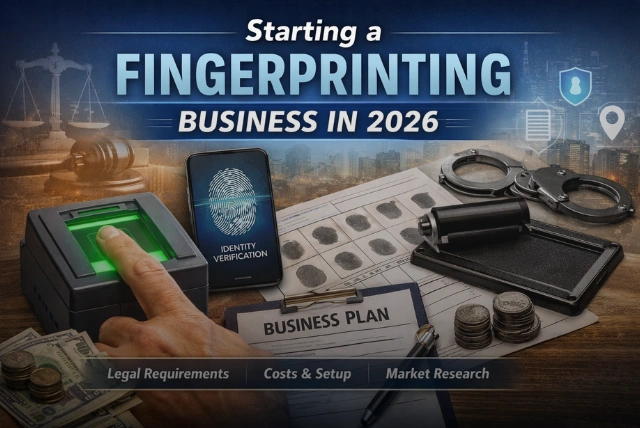

Starting a fingerprinting business in 2026 can be a practical service-based opportunity, but it is not an informal or unrestricted business. Fingerprinting is closely connected to legal processes, identity verification, and personal data protection. Because of this, rules and permissions vary by location.
This guide explains how fingerprinting businesses actually work, what their legal limits are, and what must be verified before starting. It is written to be accurate, cautious, and useful for readers in different countries without making unsafe assumptions.
Important Disclaimer
Fingerprinting laws, approvals, and operating requirements vary by country, state, and local authority. This article provides general guidance based on widely accepted practices, but it does not replace official regulations or legal advice.
Before starting a fingerprinting business, always confirm local requirements directly with the relevant authority. What is allowed in one place may be restricted or prohibited in another.
Understanding the Fingerprinting Industry
Fingerprinting services support formal identity verification processes. A fingerprinting business does not conduct background checks, approve applications, or decide eligibility. Its role is limited to capturing fingerprints accurately and submitting them in the format required by the requesting organisation.
Fingerprinting is commonly required for regulated employment, professional licensing, immigration procedures, security clearances, and certain legal or government-related documentation. These requirements are set by employers or authorities, not by fingerprinting service providers themselves.
Because fingerprinting involves biometric data, strict expectations around privacy, accuracy, and secure handling apply in most regions.
Types of Fingerprinting Services
There are two main fingerprinting methods in use today.
Ink-based fingerprinting uses ink pads and paper fingerprint cards. Although considered traditional, it is still officially required for some international applications, manual systems, and legacy processes. The quality of results depends heavily on correct technique and operator skill.
Electronic fingerprinting, often referred to as digital or Live Scan fingerprinting, uses scanners to capture fingerprints electronically. These prints may be transmitted digitally or printed onto cards, depending on what the receiving authority accepts. While digital fingerprinting is widely used, it is not accepted in every situation, and ink fingerprinting remains necessary in some cases.
Legal and Regulatory Reality
There is no universal right to operate a fingerprinting business. In many places, fingerprinting services are regulated or restricted, and approval may be required before operating.
Common legal expectations include compliance with data protection laws, proper handling of personal information, and adherence to approved procedures. Some regions require operator training, certification, or background checks, while others limit fingerprinting services to approved providers only.
Because of these variations, written confirmation from the appropriate authority is essential before investing in equipment or advertising services.
Market Research: What Actually Matters
Fingerprinting businesses do not create demand on their own. Demand exists only when an organisation or authority requires fingerprint submission as part of a process.
Effective market research focuses on understanding who requires fingerprinting, whether private providers are accepted, what formats are required, and where applicants are currently directed. Competition is often influenced more by regulation and trust than by pricing.
Business Planning Without Hype
A fingerprinting business plan should be realistic and compliance-focused. This type of business typically grows steadily rather than rapidly and depends on accuracy and reliability more than scale.
A practical plan outlines the services you are permitted to offer, legal approvals required, equipment needs, data handling procedures, and ongoing operating costs. Financial planning should prioritise sustainability and risk control rather than aggressive expansion.
Location and Setup
Fingerprinting services are usually operated from a professional office or approved commercial space. In some areas, mobile fingerprinting is allowed, but this depends on local rules. Home-based operations are not automatically permitted and may require specific approval.
Regardless of location, the setup must allow for client privacy, cleanliness, secure record handling, and controlled identity verification.
Equipment and Technical Requirements
Equipment depends on the type of fingerprinting you are authorised to provide. Ink-based services require fingerprint cards and ink pads, while electronic services require approved digital scanners. In some cases, a computer and printer are also necessary.
Owning fingerprinting equipment does not grant permission to operate. Legal approval always comes first.
Staffing and Training
Many fingerprinting businesses operate with a single trained individual, especially in the early stages. Training focuses on accurate fingerprint capture, identity verification procedures, data protection, and consistency.
Errors in fingerprinting can result in rejected applications or delays, making attention to detail essential.
Marketing Within Legal Limits
Fingerprinting businesses may promote factual information such as location, operating hours, appointment availability, and services offered.
They must not claim guaranteed approval, faster processing, or official authority unless formally authorised. Marketing should remain honest, clear, and compliant.
Financial Reality and Growth
Income depends on regulatory acceptance, local demand, and reputation. Fingerprinting is generally a stable service business rather than a high-growth or high-margin venture. Expansion is often limited by regulation rather than market interest.
Long-term success depends on compliance, reliability, and trust.
Conclusion
Starting a fingerprinting business in 2026 is possible, but only when approached as a regulated, compliance-driven service. Accuracy, legal approval, and respect for privacy matter far more than marketing or speed.
Before investing time or money, always confirm local requirements in writing. This single step protects both your business and your clients.
Frequently Asked Questions
Is fingerprinting required for every job?
No. Fingerprinting is required only for specific roles and regulated sectors.
Can anyone start a fingerprinting business?
Not always. Many regions restrict who may legally operate.
Is electronic fingerprinting accepted everywhere?
No. Acceptance depends on the requesting authority.
Do fingerprinting businesses approve applications?
No. They only capture and submit fingerprints.
Is demand guaranteed?
No. Demand depends entirely on external legal and organisational requirements.