
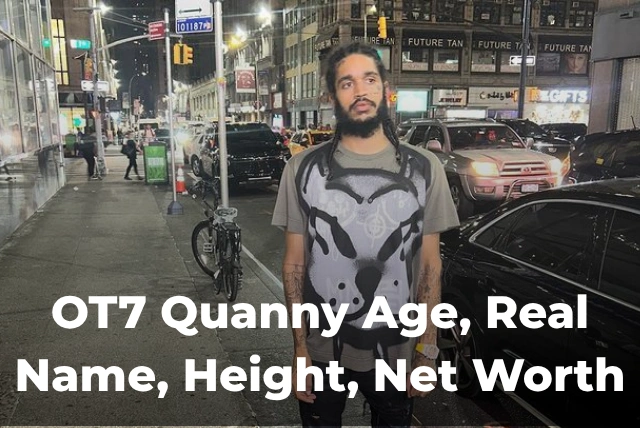
OT7 Quanny is a Philadelphia rapper who is almost certainly 29 — and that “almost” is the honest part of this page. He has no Wikipedia entry. The Wikidata record says three words: American rapper. Everything else in circulation comes from celebrity-bio aggregators that copy one another.
So this guide does two things. It separates what can be checked from what is merely repeated, and it explains, using Spotify’s own published figures, why nobody can put a number on what an artist at this level earns.
Last updated: 21 October 2026. Sources assessed and streaming figures taken from Spotify’s own Loud & Clear material on this date.
What is and is not known
- From: Philadelphia — consistent across every source
- Age: 29, if the widely listed 20 June 1997 is right
- Real name: listed as Ja’Quan Borneo-Lee — reported, not confirmed
- Still active: yes — 2026 releases on Apple Music
- Net worth: no verified figure, and none published here
- Spotify’s rate: there isn’t one — it pays by streamshare
- Official benchmark: $11,000 per one-in-a-million of all streams, 2025
What this article covers
What Can Actually Be Verified

| Detail | Status | Why |
|---|---|---|
| American rapper | Confirmed | The Wikidata record states it |
| From Philadelphia | Consistent | Every profile agrees, and the music is explicitly rooted there |
| Active in 2026 | Checkable | His Apple Music and Last.fm pages show current releases |
| Discography | Checkable | Rate Your Music and the streaming platforms list the releases — this is the most solid ground on the page |
| Date of birth: 20 June 1997 | Reported only | From Famous Birthdays and sites that follow it. No primary source |
| Real name: Ja’Quan Borneo-Lee | Reported only | Same category. Widely repeated, nowhere confirmed |
| Net worth | Unknown | No figure exists that is worth printing. See below |
Assessment of the sources already cited by this article, plus the platforms, 21 October 2026.
Where the Rest of It Comes From
This article previously treated the following as authorities. They are kept as links so you can see the chain for yourself.
- Famous Birthdays — a celebrity date aggregator. The origin of the 20 June 1997 date.
- Zimbio, Briefly, AllBuzz, QuickBlaster, BirthdayBuddies — biography content sites. They do not state where their figures came from.
- BookingAgentInfo — a contact directory.
- Wikidata — the one structured record, and it says only that he is an American rapper.
This is how a rising artist’s “facts” get made. One site publishes a date. Three more cite it. A fifth cites those. Within a year the figure is everywhere and traceable to nobody. It may well be right — the point is that nothing in the chain tested it.
What Streaming Actually Pays

Here the data is excellent, because Spotify publishes it. And the first thing it says contradicts almost every article on the subject.
Spotify has no per-stream rate. From its own Loud & Clear FAQ: “you get paid based on your share of total streams — which is called ‘streamshare’.” It pays out “roughly two-thirds of every dollar generated from music” to rights holders.
Spotify Loud & Clear FAQ: it pays “roughly two-thirds of every dollar generated from music” to rights holders.
The usable benchmark is this. Spotify states: “In 2025, capturing one in every million streams on Spotify equals, on average, $11,000.” That is share of all streams on the platform, not a count of your own — which is exactly why a simple per-stream figure misleads.
Midpoints of commonly cited third-party ranges: Spotify about $0.003–$0.005, Apple Music $0.006–$0.007, Tidal $0.012–$0.013. These are estimates produced by dividing payouts by streams. No platform publishes a per-stream rate.
And the sentence that ends the net worth question. Spotify says it can only report “the total royalties generated on Spotify”, because it has no sight of “everyone’s individual contracts with their labels, publishers, or distributors”. Royalties generated are not earnings received.
Why No Net Worth Figure Appears Here

- Streaming royalties are generated, then split. Label, distributor, publisher and features all take a share before the artist sees anything.
- Advances are recoupable. A large advance is not income — it is borrowed against future royalties.
- Performance fees are private, and vary enormously between a support slot and a headline date.
- Nothing is filed anywhere public. There are no accounts, no disclosures and no register.
- He has never published a figure.
So any article giving a precise net worth for an artist at this stage is producing a number, not reporting one. The same applies across the genre — our profiles of Benny the Butcher and celebrity business ventures run into the same wall, and celebrity early life stories shows how little of the early-career record is ever documented.
The Music Itself

The discography is the one part of this that is genuinely checkable, because the platforms list it.
- Philadelphia drill and street rap — spare production, conversational delivery, local reference points rather than universal ones.
- Built through platforms rather than radio. The route was uploads, playlists and short-form video, which is how most artists at this level now arrive.
- Projects listed across 2024 and 2025 on Rate Your Music and the streaming services, including collaborative work.
- Still releasing in 2026, per his Apple Music page.
- Check the platforms rather than a biography page. A discography is verifiable; a net worth is not.
Who gets paid before the artist does
Spotify pays a rights holder, and the rights holder is very often not the performer. The order matters, and it is the reason “royalties generated” and “artist income” are different numbers:
- The distributor or label is paid first, as the rights holder of record. Spotify’s money goes to them, not to the artist’s bank account.
- Any advance is recouped before the artist receives royalties. Until it is cleared, a hit can generate a great deal and pay the artist nothing.
- The publishing side is separate. Songwriting and composition royalties flow through a different chain from the recording.
- Features and producers take their share, by agreement.
- Only then does the artist’s contracted percentage apply — and that percentage is private.
- Spotify says so itself: it has no visibility into “everyone’s individual contracts with their labels, publishers, or distributors”, so it cannot report what anyone takes home.
None of this means an artist at this level earns nothing. It means the figure is unknowable from outside — which is a different and more honest statement than a number with a dollar sign.
How to Check an Artist Yourself
If you want to judge where an artist actually stands, these are the things you can look up rather than take on trust.
| What to check | Where | What it tells you |
|---|---|---|
| Monthly listeners | The artist’s Spotify page | Current reach, updated constantly. Far more honest than a follower count |
| Release history | Apple Music, Spotify, Rate Your Music | Whether an artist is working or dormant — gaps are visible |
| Chart positions | The official chart body for the country | A placing is a fact. “Charting artist” without a number is not |
| Certifications | The national recording industry body | Gold and platinum awards are formally certified and published |
| Credits and features | Streaming credits, Last.fm | Who an artist actually works with, which is a decent proxy for standing |
| Live dates | Venue and promoter listings | Venue capacity tells you more about drawing power than any biography |
| Net worth | Nowhere | There is no source. That is the whole point of this page |
All of the above are public and free. None of them produces a wealth figure, which is why the sites that print one are not reading it from anywhere.
Corrections Made to This Page
| What was there | Why it has gone |
|---|---|
| A net worth comparison table against other celebrities | Unsourced figures about other living people. Removed |
| “7 Interesting Facts About OT7 Quanny” | A listicle of claims traceable to the same aggregators |
| “Current Status and Future Plans” | He has not announced any plans. The section invented them |
| An “Author Bio” | For an author not identified anywhere else on the site |
| Three opening paragraphs of scene-setting before any fact | “Imagine a young artist sitting alone, replaying his own track again and again…” Removed |
| Biographical details stated as fact | Now marked as reported rather than confirmed, with the source chain shown |
Audit carried out 21 October 2026.
Conclusion
OT7 Quanny is a Philadelphia rapper, he is active in 2026, and he is probably 29. That is the honest extent of it, and it is more than most pages on him can actually support.
On the money: Spotify pays by streamshare, not per stream; about two-thirds of music revenue goes to rights holders; and one in every million streams was worth about $11,000 in 2025. What any individual artist takes home from that, Spotify says plainly it cannot see — and neither can anyone writing a net worth article.
Sources
- Spotify Loud & Clear — FAQ on how royalties are calculated
- Wikidata — OT7 Quanny
- Apple Music — artist page
- Rate Your Music — discography
- Last.fm — artist page
- Famous Birthdays — the origin of the circulating date
- Zimbio
- Briefly
- AllBuzz
- QuickBlaster
- BirthdayBuddies
- BookingAgentInfo
Disclaimer
No net worth figure is published here because none can be verified. Biographical details including date of birth and legal name rest on celebrity-bio aggregators and are described as reported rather than confirmed. Per-stream figures are third-party estimates; no streaming service publishes a per-stream rate, and royalties generated are not the same as money received by an artist. Information correct as at 21 October 2026. More from The UK Post.


