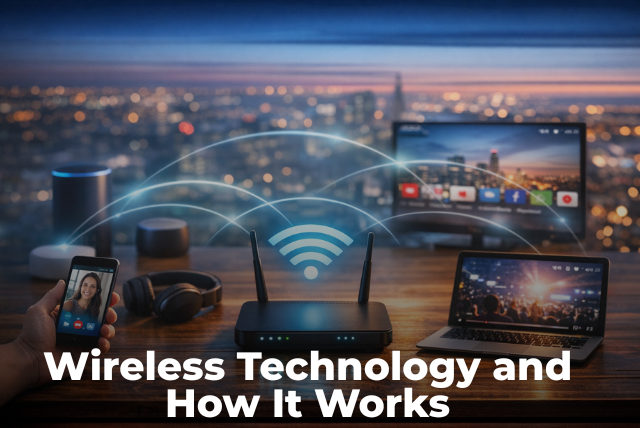

Last night, while sitting in a quiet room, a simple moment made me think — how is it that a phone in my hand can stream a video, send messages, and connect to the world without a single wire? It feels almost invisible, yet powerful. This everyday magic is what we call wireless technology. From homes to offices, from classrooms to cafes, it quietly runs our lives in the background. But have you ever stopped and wondered how it actually works? In this article, we will explore wireless technology in a simple and human way, just like a story unfolding — helping you understand how these unseen signals keep us all connected.
What Does Wireless Really Mean in Everyday Life?
Think about the last time you connected your phone to Wi-Fi or used Bluetooth headphones. You didn’t plug in any cable, yet everything worked smoothly. That is the real meaning of wireless — communication without physical wires. It may sound simple, but behind it lies a powerful system of signals traveling through the air.
Wireless communication uses electromagnetic waves to send data from one device to another. These signals move fast, almost instantly, making it feel like magic. According to Merriam-Webster, wireless simply refers to communication that happens without wires, often using radio signals.
From sending a WhatsApp message to watching your favorite show online, wireless technology is always working silently. It has become such a natural part of life that we rarely notice it — until the signal drops.
The Simple Science Behind Wireless Communication
Imagine speaking to someone across a room without shouting. Instead, you send your voice through invisible waves that travel instantly. That’s exactly how wireless communication works, but with data instead of sound.
Every wireless system has three key parts: a transmitter, a medium (air), and a receiver. Your device converts data into signals, sends them through the air, and another device receives and converts them back. According to ROHM Semiconductor, wireless systems rely on electromagnetic waves to transfer information without cables.
This process happens in seconds. Whether you’re making a video call or browsing the web, your device is constantly sending and receiving signals. It’s like an invisible conversation happening all around you.
How Wireless Networks Keep Us Connected
Picture walking into a coffee shop and instantly getting internet access. No wires, no setup — just connection. That’s the power of a wireless network.
A wireless network connects multiple devices using a central system like a router or access point. These networks allow laptops, smartphones, and tablets to communicate and share data. As explained by Cisco, wireless networks provide flexibility and allow users to stay connected without being tied to one place.
This freedom has changed how we work and live. Offices are no longer limited by cables, and people can work from anywhere. It has made life faster, easier, and more mobile.
The Role of Routers in Wireless Internet
Have you ever noticed that small box with blinking lights in your home? That device — the router — is the heart of your wireless internet.
A wireless router connects your home to the internet and sends signals to your devices. It acts like a bridge between your phone and the global network. According to Cisco’s router guide, routers not only provide internet access but also manage connections and security.
Without a router, your wireless internet would not exist. It ensures that multiple devices can connect at the same time, making it possible for families or offices to stay online together.
Understanding Wi-Fi Technology in Simple Words
Wi-Fi is probably the most common form of wireless technology we use every day. It’s what connects your device to the internet without cables.
Wi-Fi works using radio frequencies, usually 2.4 GHz and 5 GHz bands. These frequencies carry data between your device and the router. According to Cisco’s Wi-Fi explanation, this technology allows devices to connect within a limited range and share internet access.
Even though it feels simple, Wi-Fi is a complex system that manages speed, security, and connectivity. When it works well, we don’t notice it — but when it slows down, we quickly realize how important it is.
Different Types of Wireless Technologies Around Us
Wireless is not just Wi-Fi. There are many types of wireless technologies working around us every day, often without us realizing it.
Bluetooth connects your headphones, while cellular networks power your phone calls and mobile data. Another advanced technology is ultra-wideband, which helps with precise location tracking. According to TechTarget, ultra-wideband uses low energy signals to provide highly accurate positioning.
Each type of wireless communication has a different purpose. Together, they create a connected world where devices can interact seamlessly.
How Wi-Fi Standards and Security Work
Behind every smooth internet connection lies a set of rules that make everything work properly. These rules are known as standards.
Wi-Fi follows standards like IEEE 802.11, which define how devices communicate. Security protocols like WPA2 and WPA3 protect your data from hackers. As explained by GeeksforGeeks, these standards ensure stable and secure wireless communication.
Without these systems, wireless networks would be unsafe and unreliable. They are the silent protectors of your online experience.
Wireless Devices in Daily Life
From the moment you wake up to the time you sleep, wireless devices are part of your routine. Your smartphone alarm, your smart TV, your wireless earbuds — all depend on wireless communication.
Devices like headphones use Bluetooth to connect instantly. According to Sony support, wireless connections allow easy pairing without cables, especially in audio devices.
Modern innovations like smart display glasses show how far wireless technology has come. It continues to evolve, making devices smarter and more connected.
Wireless vs WLAN vs Wi-Fi: Clearing the Confusion
Many people use terms like wireless, Wi-Fi, and WLAN interchangeably, but they are not exactly the same.
Wireless is a broad term that includes all cable-free communication. WLAN refers to a wireless local area network, while Wi-Fi is the technology used within WLAN. According to Motorola support, these terms are related but have different meanings.
Understanding this difference helps you better understand how your devices connect and communicate in the digital world.
The Future of Wireless Technology
The story of wireless technology is still being written. Every year, new innovations make it faster, smarter, and more powerful.
Wireless is now supporting advanced systems like AI in business and streaming platforms in digital entertainment. It is also changing how we learn and communicate globally.
According to ROHM overview, wireless systems are becoming a key part of IoT and smart technologies. The future will bring even more seamless connections, where everything around us is linked without wires.
Final Thoughts on Wireless Technology
Wireless technology may be invisible, but its impact is everywhere. From a simple message to global communication, it keeps the world connected in ways we once thought impossible. The beauty of wireless lies in its simplicity for users and complexity behind the scenes. As we continue to depend on wireless systems in daily life, understanding how they work makes us appreciate them even more. The next time your device connects instantly, take a moment to realize the silent power of wireless — and how it continues to shape our future.
FAQs
What is wireless technology in simple words?
Wireless technology allows devices to communicate without using cables. It uses radio waves or electromagnetic signals to send and receive data. This makes it easy to connect devices like phones, laptops, and smart TVs.
How does wireless communication work?
Wireless communication works by sending signals through the air. A transmitter converts data into signals, and a receiver converts them back into usable information. This process happens very quickly.
Is Wi-Fi the same as wireless?
No, Wi-Fi is just one type of wireless technology. Wireless is a broad term that includes Wi-Fi, Bluetooth, and cellular networks. Wi-Fi specifically connects devices to the internet.
Why is wireless technology important?
Wireless technology is important because it provides freedom and flexibility. It allows people to connect and communicate without being tied to cables, making modern life more convenient.
What are examples of wireless devices?
Common wireless devices include smartphones, laptops, wireless headphones, and smart TVs. These devices use wireless communication to connect and share data easily.